

Little Bunting vs Chestnut Bunting
Emberiza pusilla versus Emberiza rutila
Play a quiz with Little Bunting and Chestnut Bunting
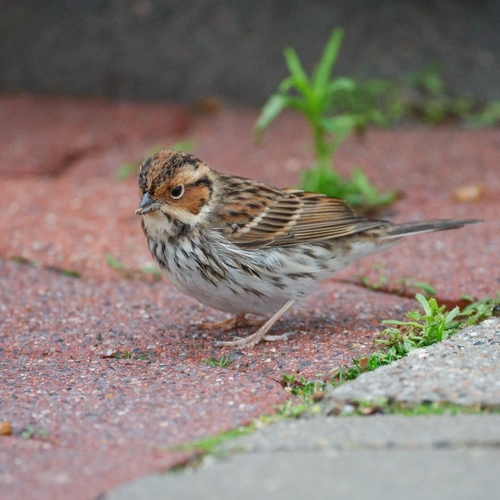 Little Bunting
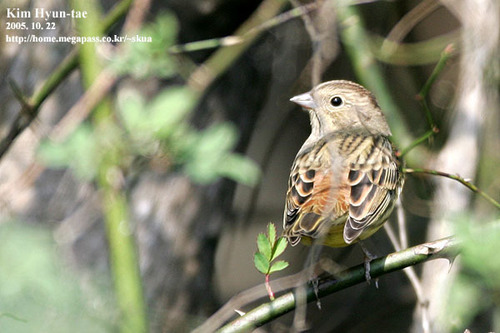 Chestnut Bunting
In short
The most reliable way to separate Little Bunting from Chestnut Bunting is by face pattern: Little Bunting always shows a crisp white malar stripe and a fine dark border to its chestnut cheek, along with a white eye-ring and black crown stripes, while Chestnut Bunting (especially breeding males) has a much more extensive chestnut head with less sharply defined facial markings. In all plumages, Little Bunting is smaller and more compact, with white underparts heavily streaked on the breast and flanks, contrasting with the yellowish underparts and chestnut upperparts of Chestnut Bunting. Females and non-breeding Chestnut Buntings can look dull and streaky, but still lack the Little Bunting's sharply defined facial pattern. Calls are similar, but Little Bunting's is slightly more metallic. Structure and tail pattern can help in flight, especially the lack of white in Chestnut Bunting's tail.
Identification tips
- Face pattern is key: Little Bunting always shows a crisp white malar stripe and a fine dark border to the rear of the chestnut cheek, plus a white eye-ring and black crown stripes. Chestnut Bunting lacks this sharp facial contrast in all plumages.
- Crown stripes: Little Bunting has clear black crown stripes, visible even in dull light. Chestnut Bunting's crown is more uniformly chestnut in breeding males, or dull brown in females/non-breeding, without strong striping.
- Underpart color: Little Bunting has white underparts with heavy dark streaking on breast and flanks. Chestnut Bunting (especially males) has yellow underparts with streaks only on the sides; females are pale yellow below, not white.
- Upperpart color: Chestnut Bunting breeding males are bright chestnut above and on the head, while Little Bunting is much duller and lacks extensive chestnut above.
- Cheek patch: Little Bunting's chestnut cheek is sharply bordered, especially to the rear, while Chestnut Bunting's head is more uniformly chestnut or brownish, with no fine dark border.
- Eye-ring: Little Bunting has a clear white eye-ring; Chestnut Bunting does not show a strong eye-ring in any plumage.
- Tail pattern: Chestnut Bunting's tail is short with little or no white on the outer feathers. While not specified for Little Bunting, most Emberiza show some white in the tail, so look for this in flight if visible.
- Size and structure: Little Bunting is smaller and more compact, with a shorter body and a daintier feel. Chestnut Bunting is longer and bulkier, but this is subtle unless you have direct comparison.
- Sex and age pitfalls: Female and non-breeding Chestnut Buntings are dull and streaky, but still lack the sharply defined malar and cheek pattern of Little Bunting. Do not rely on overall dullness or streaking alone.
- Rump color: Chestnut Bunting females show a dull chestnut rump, which is not a feature of Little Bunting.
- Throat color: Chestnut Bunting females have a buff throat, while Little Bunting's throat is white with the malar stripe.
- Voice: Calls are similar and not reliable for separation unless the full song is heard; Little Bunting's song is a rolling series, Chestnut Bunting's is more variable and high-pitched.
- Habitat/context: Both species can occur in similar habitats on migration or as vagrants; do not rely on habitat for separation.
- Seasonal changes: Chestnut Bunting males are brightest in breeding plumage; in non-breeding, the chestnut is partly obscured but still lacks the sharply defined face pattern of Little Bunting.
- When in doubt: If you see a bunting with a sharply defined white malar stripe, white eye-ring, and black crown stripes, it is a Little Bunting. If the bird is larger, with yellowish underparts and a more uniform head, suspect Chestnut Bunting.
Size
Little Bunting is distinctly smaller, at 12–14 cm in length and about 15.4 g in mass [wikidata], while Chestnut Bunting is 14–15 cm long and appears slightly bulkier. In the field, Little Bunting feels daintier and more compact, whereas Chestnut Bunting is a bit longer-tailed and heavier-bodied, though this difference can be subtle unless birds are side by side.
Plumage
Juvenile and non-breeding birds are the most likely to cause confusion. Little Bunting of all ages shows a white malar stripe, white eye-ring, and a fine dark border to the rear of the chestnut cheek patch, with black crown stripes. Its underparts are white with strong dark streaking on the breast and flanks. Chestnut Bunting breeding males are bright chestnut above and on the head, with yellow underparts and some streaking on the sides; non-breeding males are duller, with chestnut partly obscured by pale feather fringes. Females are mostly dull brown above with dark streaks, pale yellow below, a dull chestnut rump, and a buff throat. Chestnut Bunting never shows the sharply defined malar and cheek pattern of Little Bunting. The tail of Chestnut Bunting is short with little or no white on the outer feathers, while Little Bunting may show some white in the tail (not specified, but typical for the genus). In summary, focus on face pattern and underpart color/streaking for all ages.
Behaviour
Both species are typical buntings in behavior, often feeding on the ground or low in vegetation. No major behavioral differences are noted in the sources; both may perch low and sing from shrubs or trees. Flight style is not described as a strong separator.
Habitat
Both species are Old World buntings of the Palearctic, but Chestnut Bunting is more strictly eastern in distribution. Habitat preferences are not described as a reliable separator in the field for these two species, especially on migration or vagrancy.
Voice
Both species give a short, sharp call: Little Bunting's is described as a distinctive 'zik', while Chestnut Bunting's is a short 'zick', very similar. The songs differ more: Little Bunting's is a rolling 'siroo-sir-sir-siroo', while Chestnut Bunting's is a variable, high-pitched song given from a low perch. In practice, calls are so similar that they are not a safe separator unless the song is heard well.