

Little Black Cormorant vs Bounty Islands Shag
Phalacrocorax sulcirostris versus Leucocarbo ranfurlyi
Play a quiz with Little Black Cormorant and Bounty Islands Shag
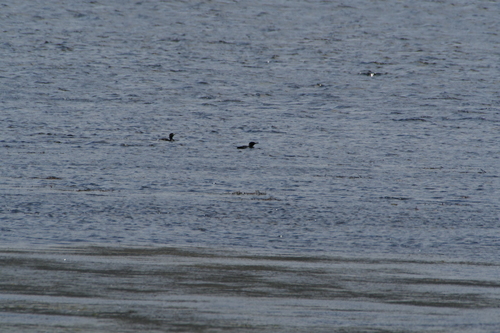 Little Black Cormorant
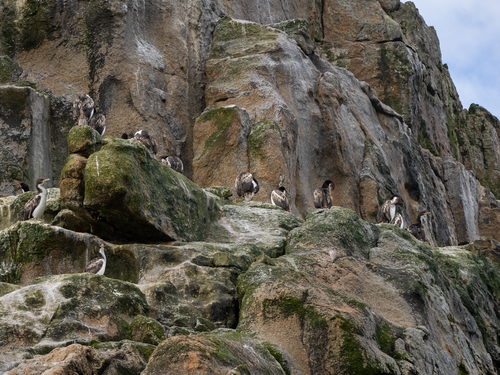 Bounty Islands Shag
In short
The most reliable field mark to separate Little Black Cormorant from Bounty Islands Shag is overall plumage: Little Black Cormorant is entirely black (with a greenish sheen in adults), while Bounty Islands Shag is strikingly black-and-white, with a black upper side and white underparts. In all plumages, the Bounty Islands Shag shows a bold white wing bar when perched, which the Little Black Cormorant never shows. Size is also a strong clue: Bounty Islands Shag is much heavier and bulkier. If you see a cormorant with pink feet and a white belly, it is the Bounty Islands Shag; all-black, green-eyed birds are Little Black Cormorant. Habitat is a strong clue as well, since Bounty Islands Shag is strictly limited to the remote Bounty Islands, while Little Black Cormorant is widespread on lakes and rivers of Australia and northern New Zealand.
Identification tips
- Plumage: All-black vs. black-and-white — Little Black Cormorant is entirely black (adult and immature), while Bounty Islands Shag is always black above and white below. If you see white underparts, it is not Little Black Cormorant.
- White wing bar (Bounty Islands Shag only) — When perched, Bounty Islands Shag shows a bold white patch on the folded wing, forming a bar; Little Black Cormorant never shows this.
- Bill and face — Little Black Cormorant has a long, slender, grey bill and green (adult) or brown (immature) eyes. Bounty Islands Shag's bill is not described in detail, but the facial skin is not carunculated and the eye color is not highlighted as distinctive.
- Feet color — Bounty Islands Shag has pink feet, easily seen when perched; Little Black Cormorant has black legs and feet.
- Breeding marks — In breeding season, Little Black Cormorant may show scattered white feathers on the head and neck, and a faint whitish eyebrow, but never any white on the body or wings. Bounty Islands Shag does not develop such head markings, but always has white underparts.
- Juvenile/immature confusion — Even young Little Black Cormorants are all dark, while Bounty Islands Shag maintains the black-and-white contrast from an early age. There is no stage where a Bounty Islands Shag is all dark.
- Size and bulk — Bounty Islands Shag is much larger and heavier (2.5x the mass), with a more robust build and longer neck. If you see two together, the size difference is striking.
- Habitat — Little Black Cormorant is found on inland lakes and rivers, sometimes in large flocks. Bounty Islands Shag is strictly marine, confined to the Bounty Islands; it is never found inland or on the main islands of New Zealand or Australia.
- Flocking behavior — Little Black Cormorant often feeds in large, coordinated groups; Bounty Islands Shag is not known for this and is usually seen in small numbers.
- Range — If you are not on the Bounty Islands, you are not seeing Bounty Islands Shag. Little Black Cormorant is common and widespread in Australia and northern New Zealand.
- Iris color — Adult Little Black Cormorant has green eyes, which can be visible at close range; Bounty Islands Shag's iris color is not highlighted as distinctive.
- Perched posture — Both species perch upright, but the larger size and white underparts of Bounty Islands Shag are obvious when seen side by side.
- Flight — No detailed wing pattern is described for either species in flight, but the white underparts of Bounty Islands Shag should be visible from below, while Little Black Cormorant is uniformly dark.
- Sexes — Both species are sexually monomorphic in plumage; do not rely on sex for identification.
- Pitfalls — Do not confuse breeding Little Black Cormorant's scattered white head feathers for the bold white wing bar and underparts of Bounty Islands Shag. The overall blackness of Little Black Cormorant is unique among Australasian cormorants except for the much larger Great Cormorant.
Size
Bounty Islands Shag is much larger and heavier than Little Black Cormorant: it averages 2500 g versus 1000 g for Little Black Cormorant [wikidata]. In length, Bounty Islands Shag reaches about 71 cm, compared to 60–65 cm for Little Black Cormorant [wikipedia]. This difference is obvious in the field, with Bounty Islands Shag appearing bulkier, longer-necked, and more robust overall.
Plumage
No matter the age, Little Black Cormorant is all black, with a greenish gloss on the back in adults. In breeding season, adults may show scattered white feathers on the head and neck, and a faint whitish eyebrow, but the body remains black. Immatures are brownish-black, but never show white underparts or wing patches. In contrast, Bounty Islands Shag of all ages is sharply black above and white below, with a metallic blue sheen on the black areas. It has a bold white patch on the folded wing, forming a bar when perched—this is never present in Little Black Cormorant. The feet of Bounty Islands Shag are pink, while Little Black Cormorant has black legs and feet. Juvenile and immature plumages are not described in detail, but the fundamental black-and-white contrast is always present in Bounty Islands Shag, and never in Little Black Cormorant.
Behaviour
Little Black Cormorant often feeds in large, tight flocks, swimming and diving in coordinated lines or groups, especially on inland lakes and rivers [wikipedia]. They are frequently seen in groups of hundreds, moving together to herd fish. Bounty Islands Shag is restricted to rocky offshore islands and is not known for such flocking behavior; its habits are less well described, but it breeds and forages in much smaller, isolated populations.
Habitat
Habitat is a major separator. Little Black Cormorant is widespread on freshwater lakes and rivers across Australia and northern New Zealand, often far inland. Bounty Islands Shag is only found on the Bounty Islands, a remote Subantarctic group southeast of New Zealand, and never occurs on mainland or freshwater habitats. If you are not on the Bounty Islands, you are not seeing Bounty Islands Shag.
Voice
Vocalizations are not diagnostic in the field. Bounty Islands Shag males call only during display, and Little Black Cormorant is generally silent away from the nest. Voice is not a practical separator.
Little Black Cormorant · Bounty Islands Shag · My Tricky Birds