

Little Bittern vs Black-crowned Night Heron
Botaurus minutus versus Nycticorax nycticorax
Play a quiz with Little Bittern and Black-crowned Night Heron
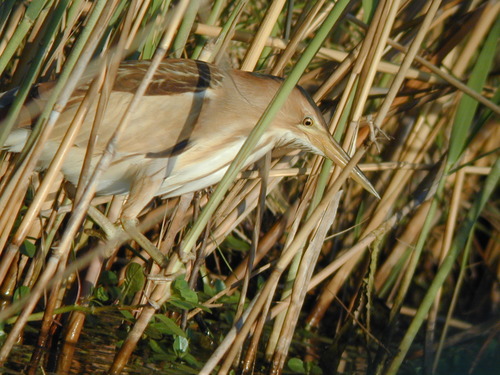 Little Bittern
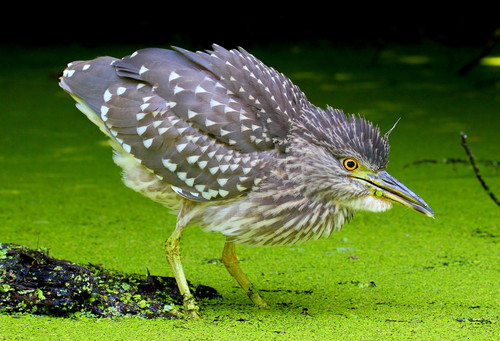 Black-crowned Night Heron
In short
The most reliable field mark to separate Little Bittern from Black-crowned Night Heron is size and structure: Little Bittern is dramatically smaller, with a slim, delicate build and a long, sharp bill, while Black-crowned Night Heron is much heavier, stockier, and has a shorter, thicker bill. In flight or perched, Little Bitterns (especially males) show a pale, pinkish-buff wing panel contrasting with dark wings, while Black-crowned Night Herons have uniform pale grey wings and lack any contrasting panel. Juvenile Little Bitterns are heavily streaked above and below, while juvenile Black-crowned Night Herons are brownish with pale teardrop spots and streaked underparts, but never show the rufous or buffy tones of Little Bittern. Both species can be found in similar wetland habitats, but their size, structure, and wing pattern are the most immediate clues in the field.
Identification tips
- Size is the fastest check: Little Bittern is tiny for a heron—less than a quarter the mass of Black-crowned Night Heron. If the bird looks rail- or kingfisher-sized, it's a Little Bittern; if it's crow-sized and chunky, it's a Night Heron. This works for all ages and sexes.
- Structure: Little Bittern is slim and delicate, with a long, sharp bill and a thick neck that can look surprisingly long when extended. Black-crowned Night Heron is stocky, with a short, thick bill, shorter legs, and a hunched posture when perched.
- Wing pattern in flight (all ages): Little Bittern (especially males) shows a pale, pinkish-buff oval panel on the inner wing coverts, contrasting with dark wings. This panel is less obvious but still present in females and juveniles. Black-crowned Night Heron has uniform pale grey wings, with no contrasting panel or patch.
- Underwing color: Little Bittern has a completely whitish underwing, visible in flight. Black-crowned Night Heron's underwing is pale but not as strikingly white or contrasting.
- Adult male Little Bittern: Glossy black crown, nape, back, and tail with faint green sheen, pale buff underparts, and pinkish-buff wing panel. Black-crowned Night Heron adults have a black crown and back, but wings are pale grey and underparts are white or grey, never buff.
- Adult female Little Bittern: Duller, with brownish-black upperparts and streaked underparts. The wing panel is less obvious but present. Black-crowned Night Heron females look like males, with no buff or streaked underparts.
- Juvenile/immature separation: Juvenile Little Bittern is more rufous, heavily streaked above and below, and may show a faint wing panel. Juvenile Black-crowned Night Heron is brownish-grey above with pale teardrop spots and streaked underparts, but never rufous or buffy. The overall impression is much more spotted and less streaked than Little Bittern.
- Bill color and shape: Little Bittern has a long, sharp, dagger-like bill, often yellowish. Black-crowned Night Heron has a shorter, stouter bill, usually darker.
- Leg color: Little Bittern's legs are not described in detail here, but Black-crowned Night Heron adults have short yellow legs (turning salmon-pink in courtship), while juveniles have dull yellowish-green legs.
- Head plumes: Adult Black-crowned Night Herons in breeding season have long, slender white plumes from the back of the head—never present in Little Bittern.
- Posture: Little Bittern often adopts a vertical, stretched pose in reeds, blending in with vegetation. Black-crowned Night Heron is more likely to be seen hunched on an open perch or branch.
- Habitat context: If the bird is deep in dense reeds and rarely emerges, Little Bittern is more likely. If it's roosting openly in trees or on branches, especially with others, Black-crowned Night Heron is more likely.
- Seasonal context (Europe): Little Bittern is a migrant, present mainly April–September. Black-crowned Night Heron is more widespread and can be resident or a vagrant depending on region.
- Eye color: Adult Black-crowned Night Herons have red eyes; juveniles have orange. Little Bittern's eye color is not specified here, but is not as striking as the Night Heron's red.
- Vocalization: Not diagnostic with the information provided here.
Size
Little Bittern is much smaller and lighter (adult body mass ~147g) compared to Black-crowned Night Heron (~636g). Little Bittern is the smallest European heron, with a length of 33–38 cm and a wingspan of 52–58 cm, giving it a delicate, almost rail-like appearance. Black-crowned Night Heron is a medium-sized heron, noticeably bulkier and more robust, with a much heavier build, shorter neck, and shorter, thicker bill. The size difference is striking in direct comparison or when seen in the same habitat.
Plumage
- Juvenile/Immature: Juvenile Little Bitterns are more rufous overall than female adults, with heavy streaking on both upperparts and underparts, including the wing coverts. Their wing panel is less obvious but still present. Juvenile Black-crowned Night Herons are dull grey-brown above with numerous pale 'teardrop' spots and have paler, streaked underparts. They lack the rufous tones and the contrasting wing panel of Little Bittern. Their eyes are orange, and legs are dull yellowish-green.
- Adult Male Little Bittern: Shows glossy black crown, nape, back, tail, and scapulars with a faint green sheen. The underparts are pale buff, and the inner wing coverts form a distinctive pinkish-buff oval panel against otherwise black wings. Underwing is entirely whitish. Bill is long and sharp.
- Adult Female Little Bittern: Duller than male, with brownish-black upperparts and paler feather margins. Underparts are streaked with dark buff and brown, and the wing panel is less obvious but still present.
- Adult Black-crowned Night Heron: Both sexes have a black crown and back, pale grey wings, and white or grey underparts. The bill is shorter and thicker. They lack any contrasting wing panel. Adults have red eyes, short yellow legs, and (in breeding season) long white head plumes and sometimes salmon-pink legs. Underparts are clean white or pale grey, never buff or streaked.
Behaviour
Little Bittern is secretive, often skulking in dense reedbeds and rarely seen in the open. It moves with a slow, deliberate gait and can freeze with its bill pointed upward, blending into reeds. In flight, it appears weak and fluttery, with rapid wingbeats and legs trailing behind. Black-crowned Night Heron is more robust and often perches in trees or on open branches near water, sometimes in groups. Its flight is direct and strong, with broad, rounded wings and a hunched neck. Night Herons are more likely to be seen at dusk or night, but also roost openly during the day.
Habitat
Both species use wetland habitats such as reedbeds, marshes, and lakes with dense vegetation. Little Bittern is more strictly tied to dense emergent vegetation and is less likely to be seen in open or urban wetland settings. Black-crowned Night Heron is more adaptable, using a wider range of wetlands, including urban parks, and is more likely to perch in trees or on open branches.
Little Bittern · Black-crowned Night Heron · My Tricky Birds