

Motmot

Lesser White-fronted Goose vs Pink-footed Goose

Anser erythropus versus Anser brachyrhynchus

Play a quiz with Lesser White-fronted Goose and Pink-footed Goose
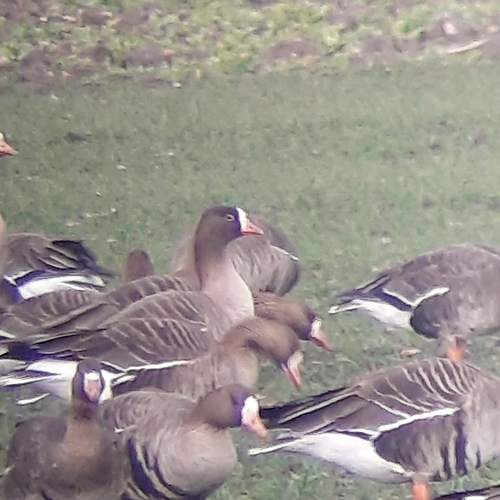
Lesser White-fronted Goose (Anser erythropus) Lesser White-fronted Goose
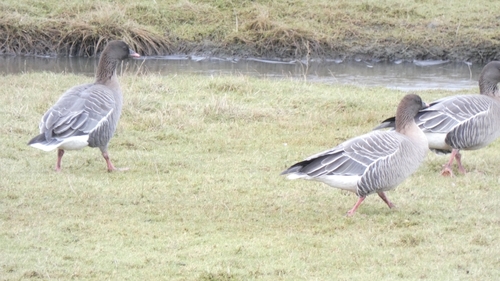
Pink-footed Goose (Anser brachyrhynchus) Pink-footed Goose

Media

Loading…

In short

The most reliable field mark to separate Lesser White-fronted Goose from Pink-footed Goose is the combination of a distinct yellow eye-ring and a white blaze extending up to the crown on the Lesser White-fronted, features never shown by Pink-footed. In addition, Lesser White-fronted is noticeably smaller and more compact, with a shorter bill and bright orange legs, while Pink-footed is larger, with a short but stouter bill that is pink in the middle and black at the base and tip, and pink feet. Both species have pale upperwing-coverts and white rumps, but the detailed facial and leg coloration are key in all ages. In flight or on the ground, careful attention to these head and leg features, as well as overall size, will resolve most confusion.

Identification tips

  1. Yellow eye-ring (Lesser White-fronted only): Look for a clear yellow ring around the eye, present in all ages and seasons of Lesser White-fronted, never in Pink-footed.
  2. White facial blaze to crown (Lesser White-fronted only): The white on the face extends up onto the crown in Lesser White-fronted, while Pink-footed has a plain dark brown head with no blaze.
  3. Leg color: Lesser White-fronted always has bright orange legs and feet; Pink-footed has pink legs and feet. This is visible in both perched and walking birds.
  4. Bill color and shape: Lesser White-fronted has a small, short pinkish bill; Pink-footed has a short but stouter bill with a pink band in the middle and black at both base and tip. This pattern is unique and visible at close range.
  5. Size and structure: Lesser White-fronted is much smaller and more compact, barely larger than a Mallard, while Pink-footed is bulkier and longer-necked. In mixed flocks, Lesser White-fronted stands out as the smallest goose.
  6. Upperwing color: Both have pale upperwing-coverts, but Lesser White-fronted's are mouse-grey, while Pink-footed's are more bluish-grey (like Greylag). This is subtle and best used in good light or photos.
  7. Belly barring: Both species show black bars on the belly, but these are broader and more extensive in Lesser White-fronted. Not always visible, but can support ID.
  8. Tail pattern: Pink-footed has a grey tail with a broad white tip, which can be seen in flight or when preening; Lesser White-fronted's tail pattern is less distinctive.
  9. Rump and vent: Both show white rumps and vents, so this is not diagnostic between the two.
  10. Flock size and context: Large, noisy flocks in open farmland in northwest Europe are almost always Pink-footed. Lesser White-fronted is rare and usually in small groups or mixed flocks.
  11. Flight 'jizz': Pink-footed appears longer-winged and heavier in flight; Lesser White-fronted is more compact and agile.
  12. Vocalization: Pink-footed is extremely vocal, with high-pitched honking in flocks; Lesser White-fronted is quieter and less likely to be heard.
  13. Habitat and range: In the UK, Netherlands, or Denmark, a goose with pink legs in a large flock is almost certainly Pink-footed. Lesser White-fronted is rare and more likely in eastern Europe or as a vagrant.
  14. Juvenile/immature plumage: No detailed differences are described for immature upperwing or body pattern, so rely on facial, bill, and leg color for all ages.
  15. Pitfalls: Beware of distance and poor light obscuring the yellow eye-ring or facial blaze; always try to get a clear view of the head and legs before concluding.

Size

Lesser White-fronted Goose is significantly smaller and lighter, with an average mass of about 1797 g compared to Pink-footed Goose's 2505 g. Lesser White-fronted measures 53–66 cm in length with a 120–135 cm wingspan, while Pink-footed is 60–75 cm long with a 135–170 cm wingspan. In the field, Lesser White-fronted often appears only slightly larger than a Mallard, whereas Pink-footed is bulkier and closer in size to other medium geese. This size difference is usually apparent in mixed flocks or when seen together.

Plumage

For all ages, the most striking difference is in the head: adult and immature Lesser White-fronted Geese show a prominent white blaze reaching up to the crown and a clear yellow eye-ring, while Pink-footed Geese lack both, showing a plain dark brown head and face. Both species have pale upperwing-coverts, but the Lesser White-fronted's are mouse-grey, and Pink-footed's are more bluish-grey, similar to Greylag. Both have white rumps and vent, but the tail of Pink-footed is grey with a broad white tip, while tail pattern is less distinctive in Lesser White-fronted. On the underparts, both have some black barring, but the pattern is broader and more extensive in Lesser White-fronted. Leg color is diagnostic: Lesser White-fronted always has bright orange legs, while Pink-footed has pink legs and feet. Bill color is also a strong mark: Lesser White-fronted has a small, pinkish bill, while Pink-footed shows a short bill with a distinctive pink band in the middle and black at the base and tip. Juvenile and immature plumages are not described in detail for either species in the sources, but the key facial and leg features apply to all ages.

Behaviour

Both species are gregarious and often forage in flocks, but Pink-footed Goose is much more likely to be seen in very large, dense flocks, especially in wintering areas in northwest Europe. Lesser White-fronted Goose is much scarcer and usually found in smaller groups, sometimes associating with other geese. Both graze on farmland and wetlands, but Pink-footed is more tolerant of open agricultural fields and can be spectacularly numerous in migration and winter. In flight, both species show pale upperwings and white rumps, but Pink-footed often appears bulkier and longer-winged, while Lesser White-fronted is more compact and agile.

Habitat

Pink-footed Goose breeds in high Arctic regions (Greenland, Iceland, Svalbard, Novaya Zemlya) and winters widely in northwest Europe, especially the UK, Netherlands, and Denmark, where it is abundant and often seen in open farmland. Lesser White-fronted Goose breeds further east in the northernmost Palearctic and is now a rare breeder in Europe, with reintroduction attempts in Fennoscandia. In winter, Lesser White-fronted is much scarcer and more localized, often found in smaller flocks or mixed with other geese. If you see a large flock of geese in the UK or Netherlands, it is far more likely to be Pink-footed.

Voice

Pink-footed Goose is very vocal, especially in flight, producing a medley of high-pitched honking calls that can be deafening in large flocks. Lesser White-fronted Goose is less vocal and less likely to be heard in the field, especially given its scarcity. Voice is not a primary field mark for separation, but the sheer volume and pitch of Pink-footed flocks can be a supporting clue in context.

Submit a better description

Use the same sections as the comparison. Your text is published immediately.

The most reliable field mark to separate Lesser White-fronted Goose from Pink-footed Goose is the combination of a distinct yellow eye-ring and a white blaze extending up to the crown on the Lesser White-fronted, features never shown by Pink-footed. In addition, Lesser White-fronted is noticeably smaller and more compact, with a shorter bill and bright orange legs, while Pink-footed is larger, with a short but stouter bill that is pink in the middle and black at the base and tip, and pink feet. Both species have pale upperwing-coverts and white rumps, but the detailed facial and leg coloration are key in all ages. In flight or on the ground, careful attention to these head and leg features, as well as overall size, will resolve most confusion.

  1. Yellow eye-ring (Lesser White-fronted only): Look for a clear yellow ring around the eye, present in all ages and seasons of Lesser White-fronted, never in Pink-footed.
  2. White facial blaze to crown (Lesser White-fronted only): The white on the face extends up onto the crown in Lesser White-fronted, while Pink-footed has a plain dark brown head with no blaze.
  3. Leg color: Lesser White-fronted always has bright orange legs and feet; Pink-footed has pink legs and feet. This is visible in both perched and walking birds.
  4. Bill color and shape: Lesser White-fronted has a small, short pinkish bill; Pink-footed has a short but stouter bill with a pink band in the middle and black at both base and tip. This pattern is unique and visible at close range.
  5. Size and structure: Lesser White-fronted is much smaller and more compact, barely larger than a Mallard, while Pink-footed is bulkier and longer-necked. In mixed flocks, Lesser White-fronted stands out as the smallest goose.
  6. Upperwing color: Both have pale upperwing-coverts, but Lesser White-fronted's are mouse-grey, while Pink-footed's are more bluish-grey (like Greylag). This is subtle and best used in good light or photos.
  7. Belly barring: Both species show black bars on the belly, but these are broader and more extensive in Lesser White-fronted. Not always visible, but can support ID.
  8. Tail pattern: Pink-footed has a grey tail with a broad white tip, which can be seen in flight or when preening; Lesser White-fronted's tail pattern is less distinctive.
  9. Rump and vent: Both show white rumps and vents, so this is not diagnostic between the two.
  10. Flock size and context: Large, noisy flocks in open farmland in northwest Europe are almost always Pink-footed. Lesser White-fronted is rare and usually in small groups or mixed flocks.
  11. Flight 'jizz': Pink-footed appears longer-winged and heavier in flight; Lesser White-fronted is more compact and agile.
  12. Vocalization: Pink-footed is extremely vocal, with high-pitched honking in flocks; Lesser White-fronted is quieter and less likely to be heard.
  13. Habitat and range: In the UK, Netherlands, or Denmark, a goose with pink legs in a large flock is almost certainly Pink-footed. Lesser White-fronted is rare and more likely in eastern Europe or as a vagrant.
  14. Juvenile/immature plumage: No detailed differences are described for immature upperwing or body pattern, so rely on facial, bill, and leg color for all ages.
  15. Pitfalls: Beware of distance and poor light obscuring the yellow eye-ring or facial blaze; always try to get a clear view of the head and legs before concluding.

Lesser White-fronted Goose is significantly smaller and lighter, with an average mass of about 1797 g compared to Pink-footed Goose's 2505 g. Lesser White-fronted measures 53–66 cm in length with a 120–135 cm wingspan, while Pink-footed is 60–75 cm long with a 135–170 cm wingspan. In the field, Lesser White-fronted often appears only slightly larger than a Mallard, whereas Pink-footed is bulkier and closer in size to other medium geese. This size difference is usually apparent in mixed flocks or when seen together.

For all ages, the most striking difference is in the head: adult and immature Lesser White-fronted Geese show a prominent white blaze reaching up to the crown and a clear yellow eye-ring, while Pink-footed Geese lack both, showing a plain dark brown head and face. Both species have pale upperwing-coverts, but the Lesser White-fronted's are mouse-grey, and Pink-footed's are more bluish-grey, similar to Greylag. Both have white rumps and vent, but the tail of Pink-footed is grey with a broad white tip, while tail pattern is less distinctive in Lesser White-fronted. On the underparts, both have some black barring, but the pattern is broader and more extensive in Lesser White-fronted. Leg color is diagnostic: Lesser White-fronted always has bright orange legs, while Pink-footed has pink legs and feet. Bill color is also a strong mark: Lesser White-fronted has a small, pinkish bill, while Pink-footed shows a short bill with a distinctive pink band in the middle and black at the base and tip. Juvenile and immature plumages are not described in detail for either species in the sources, but the key facial and leg features apply to all ages.

Both species are gregarious and often forage in flocks, but Pink-footed Goose is much more likely to be seen in very large, dense flocks, especially in wintering areas in northwest Europe. Lesser White-fronted Goose is much scarcer and usually found in smaller groups, sometimes associating with other geese. Both graze on farmland and wetlands, but Pink-footed is more tolerant of open agricultural fields and can be spectacularly numerous in migration and winter. In flight, both species show pale upperwings and white rumps, but Pink-footed often appears bulkier and longer-winged, while Lesser White-fronted is more compact and agile.

Pink-footed Goose breeds in high Arctic regions (Greenland, Iceland, Svalbard, Novaya Zemlya) and winters widely in northwest Europe, especially the UK, Netherlands, and Denmark, where it is abundant and often seen in open farmland. Lesser White-fronted Goose breeds further east in the northernmost Palearctic and is now a rare breeder in Europe, with reintroduction attempts in Fennoscandia. In winter, Lesser White-fronted is much scarcer and more localized, often found in smaller flocks or mixed with other geese. If you see a large flock of geese in the UK or Netherlands, it is far more likely to be Pink-footed.

Pink-footed Goose is very vocal, especially in flight, producing a medley of high-pitched honking calls that can be deafening in large flocks. Lesser White-fronted Goose is less vocal and less likely to be heard in the field, especially given its scarcity. Voice is not a primary field mark for separation, but the sheer volume and pitch of Pink-footed flocks can be a supporting clue in context.

Discard your changes?

You have unsaved edits. If you leave now, those changes will be lost.

Lesser White-fronted Goose · Pink-footed Goose · My Tricky Birds