

Lesser White-fronted Goose vs Brent Goose
Anser erythropus versus Branta bernicla
Play a quiz with Lesser White-fronted Goose and Brent Goose
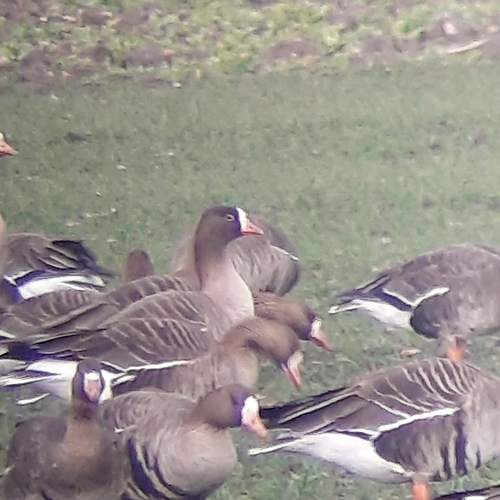 Lesser White-fronted Goose
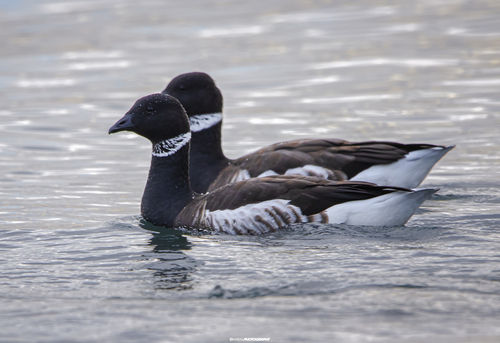 Brent Goose
In short
The most reliable field mark to separate Lesser White-fronted Goose from Brent Goose is the presence of a bright white blaze extending up to the crown and a yellow eye-ring on the Lesser White-fronted, versus the Brent's black head and neck with only a small white patch on the neck sides. In flight or at rest, Lesser White-fronted shows orange legs and a pinkish bill, while Brent Goose has black legs and a short, stubby black bill. Juvenile and adult Lesser White-fronted Geese both show the white blaze and yellow eye-ring, while all Brent Goose forms lack these features. Structure and overall coloration also differ: Lesser White-fronted is compact but still 'goose-like', while Brent is even smaller and more compact, with a very short tail and a darker, more uniform body. Both are small geese, but their plumage and head pattern are distinctive.
Identification tips
- Face pattern is diagnostic: Lesser White-fronted Goose always shows a bright white blaze extending up to the crown and a yellow eye-ring (all ages), while Brent Goose never shows a white blaze or yellow eye-ring—its head and neck are black with only a small white patch on the neck sides.
- Bill color and shape: Lesser White-fronted has a pinkish bill that is proportionally small but still 'goose-like'; Brent Goose has a very short, stubby black bill.
- Leg color: Lesser White-fronted has bright orange legs (very obvious in flight or when walking); Brent Goose has black legs.
- Tail shape and color: Brent Goose has the shortest tail of any goose, which is black with a pure white under-tail; Lesser White-fronted has a more typical goose tail, not as short or contrasting.
- Upperwing in flight: Lesser White-fronted shows mouse-grey upperwing-coverts (shared with Greater White-fronted but not Brent); Brent Goose has a more uniformly dark upperwing with no mouse-grey panel.
- Belly pattern: Lesser White-fronted has broad black bars across the belly (adults), while Brent Goose's belly is plain dark grey-brown (dark-bellied) or paler but never barred.
- Overall coloration: Brent Goose is more uniformly dark, especially in the dark-bellied form, with little contrast between belly and back. Pale-bellied Brent shows more contrast but still lacks any blaze or bars.
- Jizz and structure: Brent Goose is especially compact, with a short neck and very short tail, and looks less 'goose-like' than Lesser White-fronted, which is compact but still shows typical goose structure.
- Habitat context: Brent Goose is strongly coastal in winter, favoring saltmarshes and estuaries; Lesser White-fronted is more likely on inland wetlands or lakes, rarely coastal.
- Association with other species: Lesser White-fronted may be found with other grey geese (especially Greater White-fronted), while Brent is more likely to flock with other Branta geese.
- Juvenile confusion: Juvenile Lesser White-fronted still shows the white blaze and yellow eye-ring, while juvenile Brent Goose never does.
- Subspecies variation in Brent: All forms of Brent Goose (dark-bellied, pale-bellied, black brant) lack the white blaze and yellow eye-ring, so these marks always separate them from Lesser White-fronted.
- Bill and leg color in poor light: In dull conditions, look for the face pattern first; bill and leg color may be harder to see but are still useful if visible.
- Mixed flocks: If you see a small goose with a white face blaze among Branta geese, it is not a Brent Goose.
- No overlap in key marks: There is no age or season where Brent Goose shows a white blaze or yellow eye-ring, nor where Lesser White-fronted lacks them—these are always safe field marks.
Size
Lesser White-fronted Goose is slightly smaller than most other geese but is heavier (mean body mass ~1797g) than Brent Goose, which is similar in length (55–66 cm) but can be lighter, especially in some subspecies (Brent mass not specified here, but typically ranges from 880–2200g). Both are compact, but Brent Goose is especially notable for its short, stubby bill and very short tail—the shortest among geese. In the field, Lesser White-fronted may appear only a little larger than a Mallard, while Brent Goose is even more compact and less 'goose-like' in jizz.
Plumage
- Juvenile/immature and adult Lesser White-fronted Goose: Always shows a bright white blaze reaching up to the crown and a yellow eye-ring. The upperwing-coverts are mouse-grey, and the legs are orange. The belly has broad black bars, and the bill is pinkish.
- Brent Goose (all ages and forms): Never shows a white blaze or yellow eye-ring. Head and neck are black with a small white patch on the neck sides (not on the face or crown). Underparts are dark grey-brown (dark-bellied) or show a paler belly and flanks (pale-bellied), but always with a black tail and pure white under-tail. The bill is short and black, and the legs are black. No mouse-grey upperwing panel or orange legs.
- In flight: Lesser White-fronted shows typical 'grey goose' upperwing with mouse-grey coverts and orange legs trailing; Brent Goose shows a more uniformly dark upperwing and very short black tail with a striking white under-tail.
Behaviour
Both species are typically seen in flocks, often grazing or resting on open ground or near water. Lesser White-fronted Goose may associate with other grey geese, especially Greater White-fronted, while Brent Goose is more often found in coastal flocks, sometimes with other Branta species. Brent Goose tends to be more marine/coastal in habits, often feeding on saltmarshes and tidal flats, while Lesser White-fronted is more likely to be found inland or on freshwater wetlands during migration and winter.
Habitat
Lesser White-fronted Goose is a scarce breeder in the northern Palearctic and is rarely seen in Europe except as a rare migrant or in reintroduction areas. It is more likely to be found on inland wetlands, lakes, or rivers. Brent Goose, by contrast, is a regular winter visitor to temperate-zone sea-coasts, saltmarshes, and estuaries, especially in western Europe and the British Isles. If you see a small goose on a tidal flat or saltmarsh, Brent is much more likely; inland on freshwater, especially in mixed grey goose flocks, Lesser White-fronted is possible but rare.