

Lesser Striped Swallow vs Preuss's Swallow
Cecropis abyssinica versus Petrochelidon preussi
Play a quiz with Lesser Striped Swallow and Preuss's Swallow
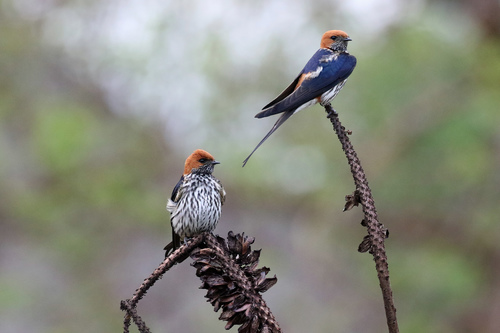 Lesser Striped Swallow
 Preuss's Swallow
In short
The most reliable field mark between Lesser Striped Swallow and Preuss's Swallow is the combination of plumage features: Lesser Striped Swallow shows a rich rufous-chestnut crown, nape, and sides of the head, a deep red rump, and heavily streaked white underparts, while Preuss's Swallow lacks these bold head and rump colors and the strong underpart streaking. Juvenile Lesser Striped Swallows are duller and browner but still show some streaking and a hint of rufous on the head, whereas Preuss's Swallow juveniles are less contrasting overall. In flight, Lesser Striped Swallow's long, deeply forked tail with elongated outer feathers is a strong clue, especially in adults. Both species are swallows, but their structure, plumage, and flight style differ enough for careful observers to separate them, especially with good views of the head, rump, and tail.
Identification tips
- Head Color (All Ages): Lesser Striped Swallow has a rufous-chestnut crown, nape, and sides of the head, which is bright and obvious in adults and still present, though duller, in juveniles. Preuss's Swallow lacks this feature, with a more uniformly dark or muted head.
- Rump Color (All Ages): Look for the deep red rump on Lesser Striped Swallow, contrasting with the dark blue upperparts. Preuss's Swallow does not show a rufous or red rump.
- Underpart Streaking (All Ages): Lesser Striped Swallow has white underparts with heavy, dark streaking (variable by subspecies, but always present). Preuss's Swallow has plainer underparts, lacking bold streaks.
- Tail Shape and Length (Adults, Especially Males): Lesser Striped Swallow has a long, deeply forked tail with elongated outer feathers; these are shorter but still present in juveniles. Preuss's Swallow has a shorter, squarer tail typical of cliff swallows, with no elongated outer feathers.
- Upperwing and Underwing (All Ages): Lesser Striped Swallow's upperwings are blackish-brown, with tawny underwing coverts. Preuss's Swallow's wing pattern is less contrasting and lacks the tawny underwing.
- Juvenile Confusion: Juvenile Lesser Striped Swallows are duller and browner, with less contrast and shorter tail streamers, but they still show some rufous on the head and faint streaking below. Juvenile Preuss's Swallow is plain and lacks these features.
- Size and Structure: Lesser Striped Swallow is larger and more slender, with a longer tail and more graceful jizz. Preuss's Swallow is more compact, shorter-tailed, and stockier in flight and when perched.
- Flight Style: Lesser Striped Swallow flies with an erratic, swooping motion, often solo or in pairs. Preuss's Swallow is more likely to be seen in flocks, flying directly and rapidly near cliffs.
- Perched Posture: When perched, Lesser Striped Swallow's long tail streamers are obvious, often crossing or drooping well below the perch. Preuss's Swallow perches with a squarer tail and less tail projection.
- Habitat Context: Lesser Striped Swallow is often found near human structures, open country, and savannah. Preuss's Swallow is more restricted to cliffs and rocky outcrops.
- Vocalization: Listen for the nasal 'zeh zeh zeh' of Lesser Striped Swallow. Preuss's Swallow does not give this call, but voice is a supporting, not primary, field mark.
- Seasonal Movement: Lesser Striped Swallow is partially migratory in southern Africa, so check local status by season. Preuss's Swallow is more sedentary and tied to breeding cliffs.
- Pitfalls: Beware of dull juveniles—focus on head and rump color, and underpart streaking. Tail length is less reliable in juveniles but still useful.
- Sex Differences: Male Lesser Striped Swallows have the longest tail streamers, but females also show a forked tail longer than any Preuss's Swallow.
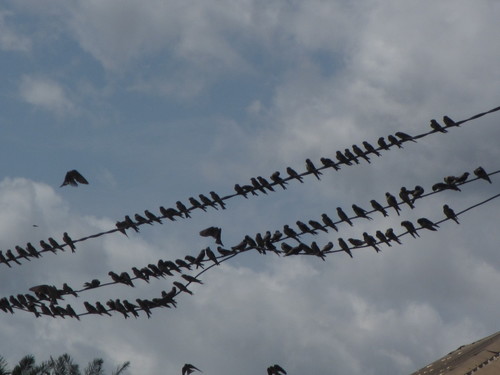
- Flock Association: If seen in a large, tight flock near a cliff, suspect Preuss's Swallow; if in pairs or small groups on wires or buildings, suspect Lesser Striped Swallow.
Size
Lesser Striped Swallow is a large swallow, measuring 15–19 cm in length. No direct size data is provided for Preuss's Swallow, but by comparison with other Petrochelidon species, it is likely smaller and more compact than Cecropis abyssinica. In the field, Lesser Striped Swallow will appear longer and more slender, especially due to its long, deeply forked tail. Preuss's Swallow, as a cliff swallow, is expected to look shorter-tailed and stockier, with a squarer tail and more compact silhouette.
Plumage
Juvenile and immature Lesser Striped Swallows are duller and browner than adults, with less contrast and shorter outer tail feathers, but they still show some rufous on the head and faint streaking below. The adult Lesser Striped Swallow is distinctive with its rufous-chestnut crown, nape, and sides of the head, deep red rump, dark blue upperparts, and heavily streaked white underparts. The upperwings and underwing flight feathers are blackish-brown, with tawny underwing coverts. The tail is blackish and deeply forked, with long outer feathers (longest in adult males). Preuss's Swallow lacks the rufous head and rump, and its underparts are not as heavily streaked; its overall coloration is more muted and lacks strong head or rump contrast. In all ages, the absence of a rufous crown and rump, and the lack of heavy underpart streaking, separate Preuss's Swallow from Lesser Striped Swallow. In flight, the long, deeply forked tail of Lesser Striped Swallow is a key difference from the shorter, squarer tail of Preuss's Swallow.
Behaviour
Lesser Striped Swallow has an erratic flight style typical of Cecropis swallows, often seen swooping and gliding with long, pointed wings and a deeply forked tail trailing behind. It often perches on wires or exposed branches. Preuss's Swallow, as a cliff swallow, is likely to be seen in tight, fast-flying flocks, especially near breeding colonies, and has a more compact, direct flight with less tail projection. Lesser Striped Swallow is more likely to be seen singly or in pairs, while Preuss's Swallow is often gregarious.
Habitat
Lesser Striped Swallow breeds widely across Sub-Saharan Africa, favoring open country, savannah, and areas with suitable nesting sites such as cliffs, caves, buildings, and bridges. It is adaptable and often nests on man-made structures. Preuss's Swallow is also African but is more closely tied to cliffs and rocky outcrops for nesting, and is less likely to be found using buildings or bridges. In areas where both occur, Lesser Striped Swallow is more likely in open, human-altered habitats, while Preuss's Swallow favors more natural cliff faces.
Voice
Lesser Striped Swallow gives a nasal 'zeh zeh zeh zeh zeh' call. No specific vocalization is provided for Preuss's Swallow, but cliff swallows generally have more chattering, twittering calls. If you hear a repeated nasal 'zeh' call, it supports Lesser Striped Swallow, but voice alone is not always diagnostic.