
Lesser Kestrel vs Red-footed Falcon
Falco naumanni versus Falco vespertinus
Play a quiz with Lesser Kestrel and Red-footed Falcon
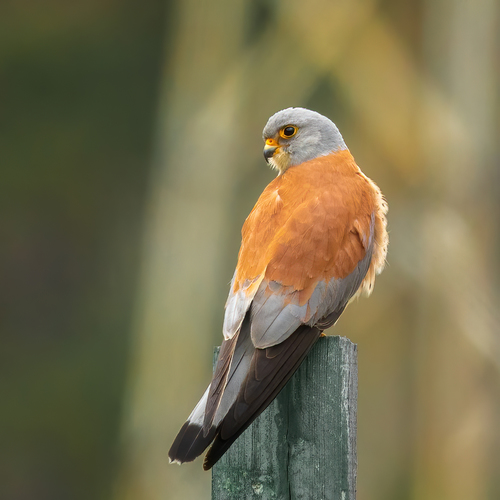 Lesser Kestrel
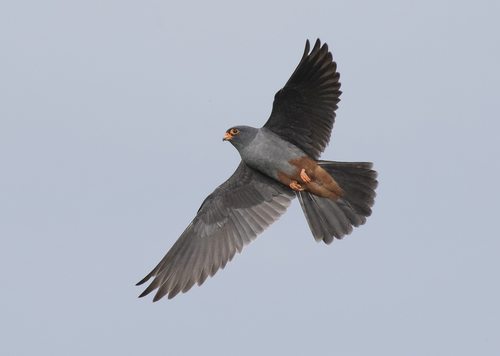 Red-footed Falcon
In short
The most reliable field mark between Lesser Kestrel and Red-footed Falcon is the adult male's coloration: male Red-footed Falcons are all blue-grey with red legs and undertail, while male Lesser Kestrels have a grey head and tail but a brown back and lack the red tones. Juvenile and female plumages are more similar and can be confusing, but subtle differences in face pattern, wing coloration, and structure help separate them. Both species are similar in size and often overlap in range and habitat, but their flight jizz and calls differ. Careful attention to age, sex, and especially face pattern and underwing coloration is crucial for confident identification.
Identification tips
- Adult male coloration: Male Red-footed Falcon is all blue-grey with red undertail and legs; male Lesser Kestrel has a grey head and tail but a brown back and lacks any red tones. This is the most straightforward separation in adult males.
- Female and juvenile face pattern: Female and juvenile Red-footed Falcons have a white face with a strong black eye stripe and moustaches, giving a masked appearance. Lesser Kestrel females and young are paler, with less contrast and lack the bold facial markings.
- Underwing coloration (adults): Red-footed Falcon adult males have uniformly grey underwings; Lesser Kestrel males have grey patches but not the uniformity or extent of blue-grey.
- Back color (adults): Lesser Kestrel males have a brown back, while Red-footed Falcon males are blue-grey above. Females of both species are grey-backed, but Red-footed Falcon females have orange heads and underparts.
- Leg and talon color: Red-footed Falcon has red legs (all ages), while Lesser Kestrel has pale, whitish-horn talons (unusual for falcons), but this is only visible at close range.
- Malar stripe: Lesser Kestrel males lack the black malar stripe; Red-footed Falcon females and juveniles have a black moustachial stripe.
- Overall tone: Lesser Kestrel females and juveniles are paler and less contrasting than Red-footed Falcon equivalents, which show more orange and stronger facial contrast.
- Wing and tail proportions: Lesser Kestrel has proportionally shorter wings and tail compared to Red-footed Falcon, which appears longer-winged and more falcon-like in flight.
- Flight jizz: Red-footed Falcon often appears more buoyant and agile in flight, while Lesser Kestrel is more delicate and fluttery.
- Vocalizations: Listen for the harsh 'chay-chay-chay' of Lesser Kestrel; Red-footed Falcon does not give this call.
- Habitat context: If in the Mediterranean or Central Asia, Lesser Kestrel is more likely; in eastern Europe and the Carpathian Basin, both are possible, but Red-footed Falcon is more localized.
- Seasonal context: Both are summer migrants and may be seen together in overlapping ranges. In winter, Lesser Kestrel migrates to Africa and Pakistan, while Red-footed Falcon's wintering grounds are not detailed here.
- Colony behavior: Both may nest colonially, but massive communal roosts (thousands of birds) are more typical of Lesser Kestrel in winter.
- Bill and talon details: Not usually visible in the field, but Lesser Kestrel's pale talons are unique among falcons.
- When in doubt: Focus on face pattern (especially in females and juveniles), overall coloration, and call, as these are the most reliable field marks when plumage is ambiguous.
Size
Both species are nearly identical in size and mass, with Lesser Kestrel averaging 159 g and Red-footed Falcon 158.5 g [wikidata]. Length and wingspan overlap completely (27–33 cm and 63–72 cm for Lesser Kestrel; 28–34 cm and 65–75 cm for Red-footed Falcon) [wikipedia]. In the field, neither species appears noticeably larger or bulkier than the other, so size is not a reliable separator.
Plumage
- Juvenile/Immature birds: Both species' young are brown above and buff below with streaking, but Red-footed Falcon juveniles show a face pattern similar to the female (white face with black eye stripe and moustaches), while Lesser Kestrel juveniles are paler overall and lack strong facial markings. Underwing pattern is not described in detail for either species' juveniles, so separation relies on face and general tone.
- Adult males: Male Red-footed Falcons are all blue-grey except for a red undertail and legs, and their underwings are uniformly grey. Male Lesser Kestrels have a grey head and tail, brown back, barred grey underparts, and lack the black malar stripe; they also have grey wing patches but not the uniform blue-grey of Red-footed Falcon. Lesser Kestrel males lack the red tones entirely.
- Adult females: Female Red-footed Falcons have a grey back and wings, orange head and underparts, and a white face with black eye stripe and moustaches. Female Lesser Kestrels are paler overall, with less contrast and less distinct facial markings. Both can appear similar at a distance, but the Red-footed Falcon's face pattern and orange tones are distinctive.
- Leg and talon color: Red-footed Falcon has red legs; Lesser Kestrel has whitish-horn talons (unusual for falcons), but this is only visible at close range.
Behaviour
Both species hunt from perches or by hovering and often take prey on the ground. Lesser Kestrels are more strictly insectivorous, especially in winter, and often seen in large communal roosts. Red-footed Falcons may also hunt in groups but are less likely to form such massive roosts. Both nest colonially, often using buildings or tree holes, and neither builds a nest structure. In flight, Lesser Kestrel may appear slightly more delicate and with shorter wings and tail, while Red-footed Falcon is described as long-winged and may show a more buoyant, falcon-like flight.
Habitat
Both species breed in open country, steppe, and agricultural landscapes, often overlapping in range across southern and eastern Europe and Central Asia. Lesser Kestrel is more widespread in the Mediterranean and Central Asia, while Red-footed Falcon is concentrated in eastern Europe and the Carpathian Basin, with smaller populations elsewhere. Both use artificial nest sites and are sometimes found near human settlements. Red-footed Falcon prefers areas with more natural grassland, while Lesser Kestrel is more flexible but also affected by habitat changes.
Voice
Lesser Kestrel gives a harsh 'chay-chay-chay' call, which is diagnostic and quite different from the Red-footed Falcon's calls. Red-footed Falcon's typical call is not described in detail here, but it is not the same as the Lesser Kestrel's. If you hear the 'chay-chay-chay', you are likely hearing a Lesser Kestrel.