

Lesser Horned Owl vs Rufous-legged Owl
Bubo magellanicus versus Strix rufipes
Play a quiz with Lesser Horned Owl and Rufous-legged Owl
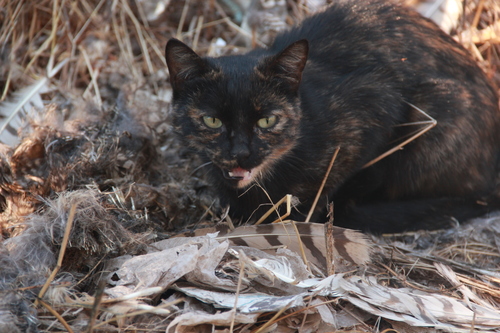 Lesser Horned Owl
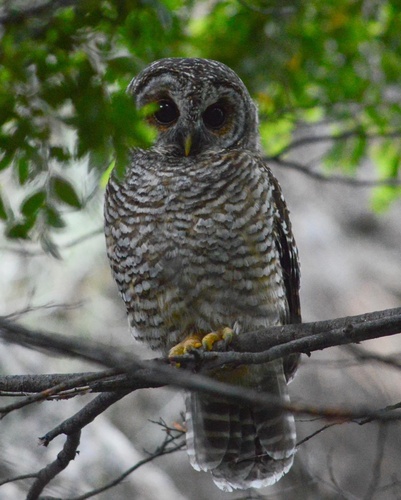 Rufous-legged Owl
In short
The most reliable field mark to separate these two owls is the presence or absence of ear tufts: Lesser Horned Owl always shows prominent ear tufts, while Rufous-legged Owl never does. Lesser Horned Owl is also much larger and bulkier, with a paler, more barred underside and a bold black border to the facial disc. In contrast, Rufous-legged Owl is compact, round-headed, and richly rufous overall, with a rusty facial disk and fine black barring below. Juveniles of Rufous-legged Owl are warm buff with faint barring and a tawny face, lacking any suggestion of ear tufts. These differences are visible both when perched and in flight, but ear tufts and overall structure are the quickest field checks.
Identification tips
- Ear tufts: Lesser Horned Owl always shows prominent ear tufts, visible both when perched and in flight. Rufous-legged Owl never shows ear tufts at any age. This is the single most reliable field mark.
- Head shape: Lesser Horned Owl has a large, angular head due to the tufts; Rufous-legged Owl's head is round and compact.
- Facial disk: Lesser Horned Owl has a pale facial disk with a bold black border and white stripes above the yellow eyes. Rufous-legged Owl has a rusty facial disk with white 'brows' over dark brown eyes and white lores.
- Eye color: Lesser Horned Owl has yellow eyes; Rufous-legged Owl has dark brown eyes. This is visible at close range.
- Underparts: Lesser Horned Owl is pale below with narrow grey-brown bars and dark blotches on the breast. Rufous-legged Owl is buffy white below with many fine black bars; the vent is orange-buff.
- Upperparts: Lesser Horned Owl is grey-brown and variable; Rufous-legged Owl is dark reddish brown with orange-buff bars and spots.
- Tail: Rufous-legged Owl's tail is reddish brown with buff bars, matching the warm tones of the rest of the plumage. Lesser Horned Owl's tail is not specifically described but is not noted as rufous.
- Juvenile plumage: Rufous-legged Owl juveniles are warm buff with faint barring and a tawny face, always lacking ear tufts. Lesser Horned Owl juveniles would show developing ear tufts and a paler, more barred look.
- Size and bulk: Lesser Horned Owl is much larger and bulkier, with a broad-winged, big-headed appearance. Rufous-legged Owl is smaller, lighter, and more compact.
- Feet and bill: Lesser Horned Owl has stronger feet and bill, but this is only apparent at close range or in the hand.
- Flight silhouette: Lesser Horned Owl appears broad-winged and heavy in flight, with ear tufts often visible. Rufous-legged Owl is more compact and round-winged, lacking any tufts.
- Voice: If heard, Lesser Horned Owl gives a deep, double-note hoot followed by a vibrating note. Rufous-legged Owl's call is not described here.
- Habitat: Both can occur in similar regions, so do not rely on habitat alone for separation.
- Pitfalls: In poor light or at distance, ear tufts may be hard to see if flattened, but Rufous-legged Owl never shows them. Juvenile Rufous-legged Owls are especially plain and warm-toned, but still lack tufts.
- Sex and season: No strong seasonal or sexual differences are described for either species; the main marks are consistent year-round.
Size
Lesser Horned Owl is substantially larger, reaching about 45 cm (18 in) in length, while Rufous-legged Owl measures only 33–38 cm (13–15 in). The mass difference is also considerable: Rufous-legged Owl averages about 620 g, while Lesser Horned Owl is heavier (exact mass not specified, but clearly larger-bodied). Lesser Horned Owl appears broad-winged and big-headed, with a robust build, whereas Rufous-legged Owl is more compact and lighter in jizz.
Plumage
- Juvenile/immature plumage: Rufous-legged Owl juveniles are warm buff with faint dusky brown barring and a tawny face, lacking any ear tufts or strong patterning. Lesser Horned Owl juveniles are not described in detail but would show the beginnings of ear tufts and a generally paler, barred underpart pattern.
- Adults: Lesser Horned Owl is mainly grey-brown, variable in color, with pale underparts and narrow grey-brown bars, plus dark blotches on the breast. The facial disc is pale with a bold black border and white stripes above yellow eyes. Rufous-legged Owl adults are dark reddish brown above with narrow orange-buff bars and spots, a rusty facial disk, white 'brows' over dark brown eyes, and buffy white underparts with many black bars. The vent is orange-buff, and the tail is reddish brown with buff bars. Rufous-legged Owl never shows ear tufts, and its facial disk is rusty rather than pale.
Behaviour
Both species are nocturnal hunters, but Lesser Horned Owl is more likely to be seen hunting over open country, while Rufous-legged Owl's behavior is less described. Both perch in trees or on rocks, but Lesser Horned Owl may also nest on cliffs or between rocks.
Habitat
Lesser Horned Owl occupies a wide range of habitats, including open forest, scrubland, farmland, grassland, and hunts over open country. Rufous-legged Owl is found in Argentina and Chile, but specific habitat preferences are not detailed here. Both can occur in overlapping regions, so habitat alone is not diagnostic.
Voice
Lesser Horned Owl gives a deep hooting call: a double-note followed by a loud, vibrating note (imitated by the local name 'tucúquere'). Rufous-legged Owl's voice is not described in these notes, so vocalization is only useful for Lesser Horned Owl if heard.