

Laysan Duck vs Hawaiian Duck
Anas laysanensis versus Anas wyvilliana
Play a quiz with Laysan Duck and Hawaiian Duck
 Laysan Duck
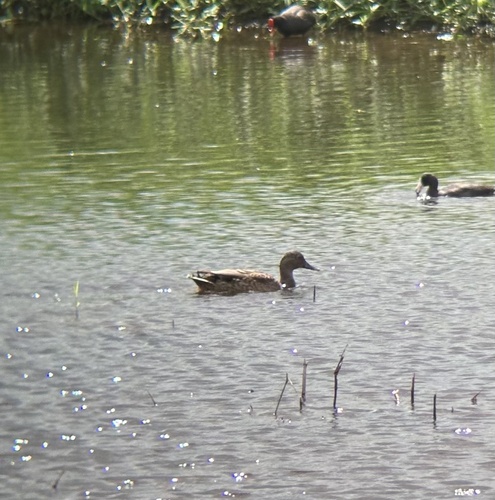 Hawaiian Duck
In short
The most reliable field mark for separating Laysan Duck from Hawaiian Duck is the prominent white eye-ring on the Laysan Duck, which is absent in Hawaiian Duck. Laysan Ducks are overall darker brown and more compact, with a short spatulate bill and a tendency to freeze rather than flush when startled. Hawaiian Ducks resemble female Mallards, with a more mottled brown plumage and a green-to-blue speculum bordered by white. Both species can show orange legs and similar bill coloration in females, but structural and behavioral differences, as well as subtle plumage details, are key for confident identification.
Identification tips
- White eye-ring (Laysan Duck only): The single most reliable mark. If you see a bold white ring around the eye, it's a Laysan Duck of any age or sex. Hawaiian Duck never shows this.
- Overall size and structure: Laysan Duck is smaller, rounder, and more compact, with a short spatulate bill. Hawaiian Duck is larger, longer-bodied, and more Mallard-like in shape.
- Speculum color and borders: Laysan Duck's speculum is iridescent purplish-green with no strong white borders; Hawaiian Duck's is green to blue, always bordered on both sides by white. This is best seen in flight or when the wing is spread.
- Plumage tone: Laysan Duck is dark brown overall, with less contrast and a more uniform appearance. Hawaiian Duck is mottled brown, resembling a female Mallard, with more patterning and a generally lighter tone, especially in females.
- Bill color: Female Laysan and Hawaiian Ducks both have dull orange bills with dark markings, but Laysan males have a dark green bill with black blotching, while Hawaiian males have an olive green bill.
- Leg and foot color: Both species have orange to yellow-orange legs, but Laysan Duck's are usually brighter, especially in males. This is subtle and can overlap.
- Head and neck iridescence (males): Some Laysan males show faint iridescence on the head or neck, but this is not as pronounced as in Mallard or Hawaiian Duck males.
- Tail shape: Laysan males may show slightly upturned central tail feathers, a subtle difference from the straight tail of Hawaiian Duck.
- Leucism in older birds: Extensive white feathering on the head and neck is common in older Laysan Ducks, never in Hawaiian Duck.
- Behavior when approached: Laysan Duck is more likely to freeze or run than to fly, while Hawaiian Duck will flush readily.
- Habitat and range: Laysan Duck is restricted to Laysan Island and a few atolls; Hawaiian Duck is found on the main Hawaiian Islands. Location is a strong clue.
- Hybrid confusion (Hawaiian Duck): Hawaiian Duck can be very difficult to separate from Mallard and hybrids, but Laysan Duck is not known to hybridize in the wild.
- Juvenile/immature plumage: No specific juvenile wing pattern differences are described, but the white eye-ring of Laysan Duck is present at all ages and remains the best mark.
- Context: If seen in dense low vegetation, especially on Laysan Island, suspect Laysan Duck. In open wetlands on the main islands, Hawaiian Duck is far more likely.
- Flight ability: Laysan Duck is a poor flyer and rarely seen in sustained flight; Hawaiian Duck flies well and often flushes when disturbed.
Size
Hawaiian Duck is notably larger and heavier (adult mass ~615g [wikidata]), with a structure closer to Mallard, while Laysan Duck is teal-sized and more compact. Laysan Duck's reduced wings and wing muscles reflect its poor flying ability and terrestrial adaptation, making it appear shorter and chunkier than the more elongated Hawaiian Duck. In the field, Laysan Duck will look distinctly smaller and stockier, especially when both species are seen together (rare outside captivity or translocation sites).
Plumage
For all ages, Laysan Duck shows a dark brown body with a conspicuous white eye-ring, a feature not present in Hawaiian Duck at any age. The Laysan Duck's speculum is iridescent purplish-green in both sexes, while Hawaiian Duck's is green to blue and always bordered by white. Older Laysan Ducks may show white feathering (leucism) on the head and neck, which is not seen in Hawaiian Duck. Hawaiian Duck, in all ages and sexes, is mottled brown overall, resembling a female Mallard, with males slightly darker on the head and neck. Both species have orange to yellow-orange legs, but Laysan Duck's are usually brighter, especially in males. Bill color is similar in females (dull orange with dark markings), but Laysan Duck males have a dark green bill with black blotching, while Hawaiian Duck males have an olive green bill. Tail feathers in Laysan Duck males may be slightly upturned, another subtle difference. In flight, both species show an iridescent speculum, but the bordering and color differ: Laysan's is purplish-green without the bold white borders typical of Hawaiian Duck.
Behaviour
Laysan Duck is a poor flyer, often preferring to freeze or run rather than flush, reflecting its adaptation to a predator-free environment. It is more terrestrial, frequently seen walking or running with a distinctive, energetic foraging style (such as fly-snapping sprints). Hawaiian Duck, by contrast, behaves more like a typical dabbling duck: it flushes readily and is more at home in open wetlands, swimming and flying with ease. Laysan Duck's terrestrial habits and reluctance to fly are strong behavioral clues, especially if observed at close range.
Habitat
Laysan Duck is now restricted to Laysan Island and a few atolls, preferring dense grass and shrub cover near shallow lakes and mudflats. It is highly localized and rarely seen outside these habitats. Hawaiian Duck is found on the larger Hawaiian Islands in a variety of wetland habitats, including rivers, streams, marshes, and ponds. If seen on the main Hawaiian Islands, a duck is almost certainly a Hawaiian Duck or hybrid; Laysan Duck is extremely unlikely except at managed reintroduction sites.