

Lappet-faced Vulture vs White-backed Vulture
Torgos tracheliotos versus Gyps africanus
Play a quiz with Lappet-faced Vulture and White-backed Vulture
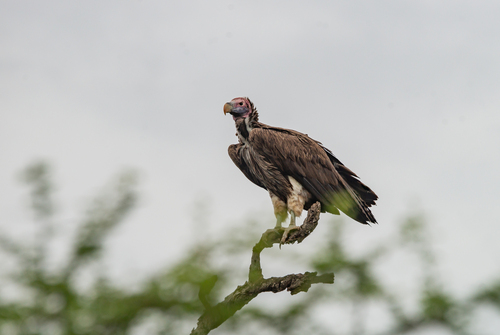 Lappet-faced Vulture
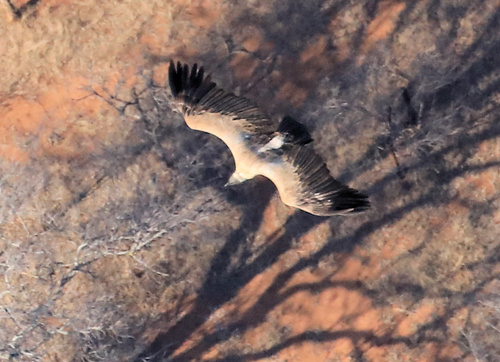 White-backed Vulture
In short
The most reliable field mark between Lappet-faced and White-backed Vultures is size and head structure: Lappet-faced is much larger, with a massive bill and a vividly colored, fleshy-headed appearance, while White-backed is smaller and slimmer, with a pale back and a less striking head. In flight, Lappet-faced shows broad, blackish wings with contrasting white thigh feathers, whereas adult White-backed Vultures have a pale back and generally paler underparts, with juveniles being mostly dark. If you see a vulture with a huge, colorful, wrinkled head and a powerful build, it's Lappet-faced; a paler-backed, smaller vulture with a white neck ruff is White-backed. Immature White-backed Vultures are more uniformly dark and can be confused with other dark vultures, but never show the Lappet-faced's massive bill or head folds.
Identification tips
- Size and bulk: Lappet-faced is much larger and bulkier than White-backed. If you see both together, the difference is obvious; alone, compare to other vultures or large raptors nearby.
- Head structure: Lappet-faced has a huge, bare, colorful head with fleshy folds (lappets) on the sides; White-backed's head is smaller, covered in down, and lacks lappets or bright coloration.
- Bill size: The bill of Lappet-faced is massive and deep, easily seen even at a distance; White-backed's bill is medium-sized and less prominent.
- White thigh feathers: Lappet-faced shows striking white thigh feathers contrasting with dark body and wings, visible both perched and in flight; White-backed never shows this feature.
- Back color (adults): Adult White-backed has a pale, whitish back that stands out against dark wings and body; Lappet-faced is uniformly dark above (except for white thighs), never pale-backed.
- Neck ruff: White-backed adults have a conspicuous white neck ruff; Lappet-faced lacks this, instead showing bare skin and folds.
- Juvenile confusion: Juvenile White-backed Vultures are all dark and can be confused with other dark vultures, but never show the Lappet-faced's massive bill, head folds, or white thighs.
- Head color: Lappet-faced's head varies from reddish to pink to gray, depending on region; White-backed's head is always pale and covered in down, never brightly colored.
- Flight silhouette: Lappet-faced has broad, parallel-edged wings with serrated wingtips and a powerful, heavy flight; White-backed is slimmer-winged and less imposing in the air.
- Behavior at carcass: Lappet-faced often dominates and feeds alone or in pairs, sometimes hunting live prey; White-backed is gregarious, feeding in groups and arriving early at carcasses.
- Perched jizz: Lappet-faced sits upright, appearing massive with a heavy bill and bare, wrinkled head; White-backed perches more hunched, with a smaller, downy head and visible neck ruff.
- Habitat context: Large groups of vultures circling or at a carcass are likely White-backed; a solitary, imposing vulture in open country is more likely Lappet-faced.
- Pitfall: At great distance, size and head structure may be hard to judge; focus on white thigh feathers (Lappet-faced) vs pale back and neck ruff (White-backed adult) when possible.
- No vocal separation: No diagnostic vocal differences are described in the sources.
- Sex/season: No strong sexual or seasonal plumage differences in either species; age is more important for identification.
Size
Lappet-faced Vulture is the largest vulture in its African range, measuring 95–115 cm in length with a wingspan of 2.5–2.9 m, and weighing 4.4–13.6 kg (females even heavier). In contrast, White-backed Vulture is much smaller: 78–98 cm long, wingspan 1.96–2.25 m, and weight 4.2–7.2 kg. In the field, Lappet-faced appears bulkier, with a more imposing presence both perched and in flight. White-backed is distinctly lighter and more slender, especially noticeable when both species are seen together at a carcass.
Plumage
- Juvenile/immature White-backed Vulture: Uniformly dark overall, lacking the pale back and white neck ruff of adults. This can make them superficially similar to other dark vultures, but they never show the Lappet-faced's white thigh feathers or colorful, wrinkled head.
- Adult White-backed Vulture: Shows a pale, whitish back that contrasts with otherwise dark plumage, and a distinctive white neck ruff. The head is covered in down, not bare skin, and is never brightly colored.
- Lappet-faced Vulture (all ages): Blackish above with strongly contrasting white thigh feathers (visible both perched and in flight). The head is bare, with colorful skin (reddish, pink, or gray depending on region) and prominent fleshy folds (lappets) on the sides. The underparts can range from white to buff-brown. In flight, wings are broad and dark with serrated-looking wingtips, and the white thigh feathers can be a key mark.
- Key contrast: Only Lappet-faced shows the combination of a massive, colorful, wrinkled head and white thigh feathers; only adult White-backed has a pale back and white neck ruff.
Behaviour
Lappet-faced Vultures are more solitary or occur in pairs, often dominating at carcasses due to their size and powerful bill, and are known to hunt small live prey or pirate from other raptors. White-backed Vultures are highly social, feeding in groups and often among the first to arrive at carcasses, relying on each other to find food. Lappet-faced will often displace White-backed at a carcass, especially when both are present.
Habitat
Both species occur in open savannahs and semi-arid regions, often overlapping at carcasses. White-backed Vultures are more abundant and widespread, especially in wooded savannahs, and nest in trees. Lappet-faced Vultures are scarcer, often found in more arid or open habitats, and their declining numbers make them much less likely to be seen. If you see a vulture in a large group, it's more likely White-backed; a lone, imposing vulture is more likely Lappet-faced.
Lappet-faced Vulture · White-backed Vulture · My Tricky Birds