

Lappet-faced Vulture vs Griffon Vulture
Torgos tracheliotos versus Gyps fulvus
Play a quiz with Lappet-faced Vulture and Griffon Vulture
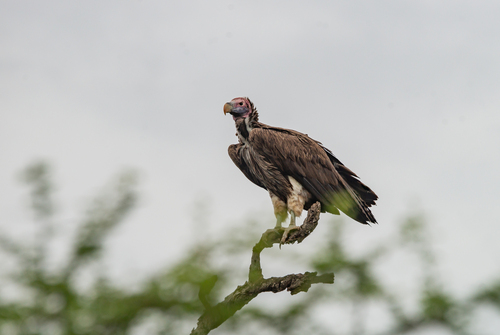 Lappet-faced Vulture
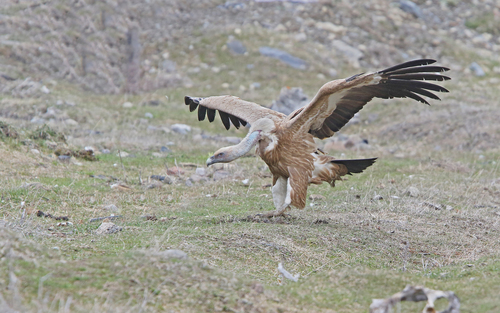 Griffon Vulture
In short
The most reliable field mark to separate Lappet-faced Vulture from Griffon Vulture is overall coloration and head pattern: Lappet-faced is much darker above, with a strikingly bare, colorful head featuring fleshy folds ('lappets'), while Griffon is paler with a white head and neck ruff. In flight, Lappet-faced shows broad, blackish wings with contrasting white thighs, whereas Griffon Vulture has buff body and wing coverts contrasting with dark flight feathers and lacks the white thigh patch. Structurally, Lappet-faced is bulkier with a massive bill and a more powerful jizz, while Griffon is still large but less imposing. Both are large Old World vultures, but their plumage and head details are the quickest field clues, especially at distance.
Identification tips
- Head and Lappets: Lappet-faced Vulture has a bare, colorful head with obvious fleshy folds (lappets) on the sides; Griffon Vulture has a white, bald head with a fluffy white neck ruff and no lappets. This is the single most diagnostic feature at close to moderate range.
- Bill Size: Lappet-faced has a massive, deep bill (up to 10 cm long, 5 cm deep), noticeably larger than Griffon's proportionally smaller, yellowish bill. This is best seen when perched or at close range.
- Overall Plumage Tone: Lappet-faced is blackish above (brownish in Arabian birds), with a strong contrast from white thigh feathers; Griffon is much paler, with buff body and wing coverts and contrasting dark flight feathers. Use this in all ages.
- White Thigh Patch: Only Lappet-faced shows a bold white patch on the thighs, visible both perched and in flight. Griffon lacks this feature entirely.
- Neck Ruff: Griffon Vulture has a conspicuous white neck ruff; Lappet-faced lacks any ruff, further emphasizing its bare, wrinkled head.
- Flight Silhouette: Lappet-faced shows broad, squared wings with parallel leading edges and slightly pointed, serrated wingtips; Griffon has broader, more bulging secondaries and a less squared-off wing shape. Look for this at distance.
- Tail: Both have short tails, but this is not a strong separator based on the notes.
- Size and Bulk: Both are huge, but Lappet-faced is bulkier and more robust, especially in the head and bill. Griffon is slightly heavier on average but appears less massive in the field.
- Head Color Variation: Lappet-faced head color varies by region (red in southern Africa, dull pink in north, pink/gray in Arabia); Griffon always has a white head.
- Behavior at Carcasses: Lappet-faced is more likely to dominate at carcasses and may be seen feeding on fresh kills or even hunting; Griffon is strictly a scavenger.
- Habitat Context: Lappet-faced prefers arid, open country; Griffon is more often found in mountainous or open upland areas, especially in Europe and Asia.
- Confusion Risk: At great distance, both can appear large and dark, but the white thigh patch (Lappet-faced) and pale body/neck ruff (Griffon) are key. Do not confuse with smaller vultures or all-dark Cinereous Vulture (which lacks white thigh patch and has a different head shape).
- Age-related Marks: No specific juvenile/immature upperwing marks are described for either species in the notes, so rely on overall color and head/neck features in all ages.
- Sex Differences: Not reliably separable in the field for either species based on the notes.
- Voice: Not diagnostic or described for separation in the notes.
Size
Both species are among the largest Old World vultures, but Lappet-faced Vulture is generally longer (95–115 cm) and has a slightly larger wingspan (2.5–2.9 m) compared to Griffon Vulture (93–122 cm, wingspan 2.3–2.8 m). However, Griffon Vulture is heavier on average (mean adult mass ~8.3 kg, with some individuals up to 10.5 kg or more), while Lappet-faced can range from 4.4 to 9.4 kg in the wild, with some larger captive females. In the field, Lappet-faced appears bulkier and more robust, especially in the head and bill, but both are unmistakably large.
Plumage
- Juvenile/Immature Upperwing (if visible): No detailed age-specific upperwing pattern is described for either species in the notes, but both show broad wings in flight. Lappet-faced is blackish above with a strong white thigh patch, while Griffon is much paler with buff body and wing coverts and dark flight feathers.
- Head and Neck: Lappet-faced has a bare, colorful head (red, pink, or gray depending on region) with distinctive fleshy lappets on the sides; Griffon has a white, bald head with a fluffy white neck ruff and yellow bill.
- Body and Wing Coverts: Lappet-faced is blackish above (brownish in Arabian birds), with white or buff underparts and a bold white thigh patch. Griffon is overall much paler, with buff body and wing coverts contrasting with dark flight feathers; lacks the white thigh patch.
- Flight Silhouette: Lappet-faced shows broad, parallel-edged wings with slightly pointed, serrated wingtips; Griffon has broad wings but with more bulging secondaries and a less squared-off look.
- Tail: Both have relatively short tails, but tail shape is not highlighted as a key difference in the notes.
Behaviour
Lappet-faced Vultures are more likely to be seen feeding on freshly killed small animals, sometimes even hunting live prey, including young mammals and birds. They may hunt from a perch and drop onto prey, using their powerful bill. Griffon Vultures are typical scavengers, relying almost entirely on carrion and not known to hunt live animals. Both species soar on thermals and are often seen gliding with broad wings, but Lappet-faced may appear more solitary or dominant at carcasses due to its size and aggression.
Habitat
Both species are found in open habitats, but Lappet-faced Vulture is more widespread in arid and semi-arid regions of Africa and Arabia, while Griffon Vulture is more typical of mountainous and open country in southern Europe, North Africa, and parts of Asia. Overlap can occur in North Africa and the Middle East. Lappet-faced is declining in much of its range and is now Endangered, while Griffon Vulture has a wider range and is locally common in some areas.