

Knysna Turaco vs Purple-crested Turaco
Tauraco corythaix versus Gallirex porphyreolophus
Play a quiz with Knysna Turaco and Purple-crested Turaco
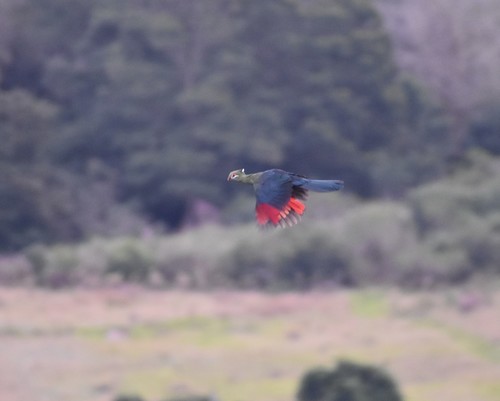 Knysna Turaco
 Purple-crested Turaco
In short
The most reliable field mark to separate Knysna Turaco from Purple-crested Turaco is the color and pattern of the crest and face: Knysna has a tall green crest tipped with white and a white line under the eye, while Purple-crested shows a striking purple crest, lacks the white facial line, and has a more extensive purple wash on the body. Both species show red flight feathers in flight, but Knysna's body is mainly green, whereas Purple-crested is purple-bodied with a green head and chest. Juvenile Knysna Turacos have a shorter, all-green crest without white tips, which can cause confusion, but the facial pattern and overall color still separate them. Both are large, long-tailed birds of southern African forests, but their plumage contrasts remain visible even at a distance.
Identification tips
- Crest Color and Shape: Knysna Turaco has a tall green crest with white tips (adults); Purple-crested Turaco has a shorter, all-purple crest. Juvenile Knysna lacks the white tips but still shows a green crest, unlike the purple of Purple-crested.
- Facial Pattern: Knysna shows a distinct white line under the eye and a deep red eye-ring; Purple-crested has a red eye-ring but no white facial line, giving a plainer face.
- Bill Color: Knysna has a small but thick orange-red bill; Purple-crested has a black bill. This is visible at close range or in good light.
- Crest Tip: Only Knysna Turaco (adult) has a white-tipped crest. If you see a white-tipped green crest, it's Knysna.
- Body Color: Knysna is mainly green overall; Purple-crested is purple-bodied with a green head and chest. If the body appears mostly purple, it's Purple-crested.
- Flight Feathers: Both species show crimson red primaries in flight, so this is not a separator, but the body color seen in flight can help—green for Knysna, purple for Purple-crested.
- Juvenile Confusion: Juvenile Knysna lacks the white crest tip but still has a green crest and white facial line. Purple-crested juveniles (not described in detail) are expected to show purple body and crest from early on.
- Perched vs. Flight Views: In perched birds, focus on crest and facial pattern. In flight, look for overall body color (green vs. purple) and white facial marks.
- Tail and Structure: Both are long-tailed and similar in shape; structure is not a reliable separator.
- Eye-ring: Both have a red eye-ring, but Knysna's is described as deeper red.
- Sex Differences: Both species are sexually similar; do not rely on sex for identification.
- Seasonal Variation: Both species maintain their colors year-round; no seasonal plumage changes to consider.
- Habitat/Range: Both occur in southern Africa forests, including Eswatini; do not use habitat as a primary separator where ranges overlap.
- Behavioral Cues: Knysna may use its red wing feathers as a decoy when escaping; this is not a visual separator but may explain sudden disappearance of red in perched birds.
- Museum Specimens: Not relevant for field ID, but note that Knysna's pigments may deepen with age in specimens, not in live birds.
Size
Both species are large turacos, with Knysna Turaco measuring about 40–42 cm in length including the tail [wikipedia]. No direct size comparison is available for Purple-crested Turaco in the provided notes, but both are described as large, long-tailed birds and are similar in overall structure and jizz. Size alone is not a reliable separator in the field.
Plumage
- Juvenile/Immature: Juvenile Knysna Turacos have a shorter green crest lacking the white tips seen in adults, but still show a mainly green body and the distinctive white line under the eye. Purple-crested Turaco juveniles are not described in detail, but the species' purple body and purple crest are present from an early age, and they lack the Knysna's white facial line and green crest.
- Adults: Knysna Turaco is mainly green with a tall green crest tipped with white, a white line under the eye, and a deep red eye-ring. The bill is orange-red. In flight, both species show crimson red primary flight feathers, but Knysna's green body and white facial markings contrast with Purple-crested's purple body and green head. Purple-crested Turaco has a purple crest, green head and chest, red eye-ring, black bill, and the rest of the body is purple. The facial pattern is less contrasting, lacking the white line and white crest tip of Knysna.
Behaviour
Both species are often inconspicuous in the treetops and can be difficult to spot despite their size and color. Knysna Turaco is noted for using its red wing feathers as a predator distraction—when it lands and folds its wings, the red disappears. Purple-crested Turaco is described as a large frugivore, known for carrying and regurgitating seeds over long distances, but this is not a field mark. Both species are likely to be seen flying between trees or perched high in the canopy.
Habitat
Knysna Turaco is a resident breeder in mature evergreen forests of southern and eastern South Africa and Eswatini. Purple-crested Turaco also occurs in southern Africa, including Eswatini, but the notes do not specify habitat differences. Both are forest birds, and habitat overlap is likely in regions where both occur. Habitat alone is not diagnostic.