

Karoo Bustard vs White-quilled Bustard
Heterotetrax vigorsii versus Afrotis afraoides
Play a quiz with Karoo Bustard and White-quilled Bustard
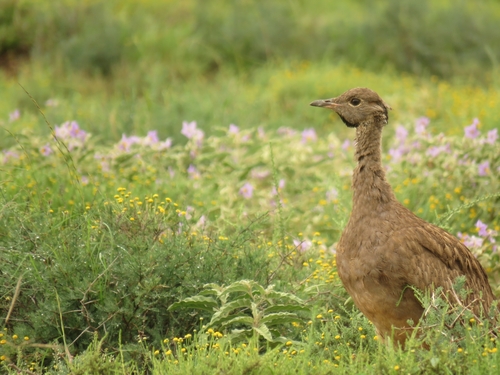 Karoo Bustard
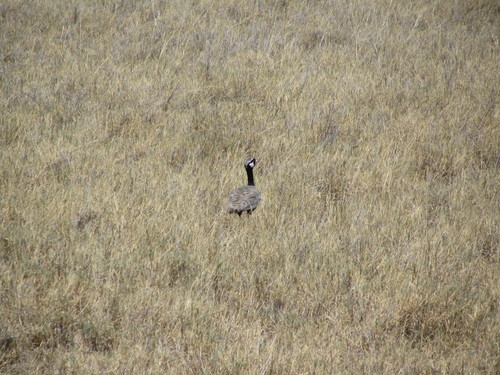 White-quilled Bustard
In short
The most reliable field mark to separate these two bustards is the presence of large white primary patches on the wings of the White-quilled Bustard (Afrotis afraoides) — striking in flight and visible even when perched, especially on males. In contrast, the Karoo Bustard (Heterotetrax vigorsii) has uniformly brown wings with no white panel. Adult male White-quilled Bustards are boldly black-and-white above and below, while Karoo Bustards are much more subdued, with grey-brown and pinkish-white tones. Females of both species are less contrasting, but the white in the wing of Afrotis is still a key separator. Both species occur in arid southern Africa, but Karoo Bustard prefers denser, shrubby Karoo vegetation, while White-quilled Bustard favors open grassland and scrub.
Identification tips
- White primary panel in wing (all ages, both sexes): In flight, White-quilled Bustard shows a bold white patch on the upperwing formed by the primary feathers. Karoo Bustard's wings are uniformly brown. This is the single most reliable field mark.
- Male plumage (breeding/adult): Male White-quilled Bustard is dramatically black on the head, neck, and underparts, with black-and-white barring above. Karoo Bustard males are much duller, with grey-brown head, neck, and breast, and a black chin/throat edged in white.
- Female plumage: Female White-quilled Bustard is barred or chequered in black and buff above, with a black belly. Female Karoo Bustard is plainer grey-brown, with less black on the throat and no bold barring or black belly.
- Bill and leg color: Both sexes of White-quilled Bustard have a red bill and bright yellow legs, which can be visible at close range. Karoo Bustard's bill and legs are not described as brightly colored.
- Belly color: Karoo Bustard has a pinkish-white belly (both sexes), while White-quilled Bustard (especially females) has a black belly.
- Head and neck pattern: Karoo Bustard has a grey-brown head and neck, with a black chin/throat edged white in males. White-quilled Bustard males have a black head and neck; females are barred or chequered.
- Habitat context: Karoo Bustard is found in denser, shrubby Karoo habitats, sometimes in fynbos; White-quilled Bustard prefers open grassland and scrub. If the bird is in open grassland, White-quilled Bustard is more likely.
- Behavior when flushed: White-quilled Bustard often flushes at a greater distance and shows white in the wings; Karoo Bustard tends to crouch or freeze in denser cover, and if flushed, shows brown wings.
- Size: Karoo Bustard is slightly larger and heavier, but this is subtle and unreliable in the field unless both species are side by side.
- Sex differences: Both species show sexual dimorphism, but only White-quilled Bustard males are boldly black-and-white; Karoo Bustard males are only slightly more marked than females.
- Subspecies variation: Karoo Bustard subspecies H. v. namaqua is greyer on the neck and breast, but this does not overlap with the bold black-and-white of White-quilled Bustard.
- Plumage pitfalls: Immature and female White-quilled Bustards can appear less contrasting, but the white in the wing is always present. Karoo Bustard never shows white in the wing at any age.
- Perched views: Even when perched, the white primary panel of White-quilled Bustard may be visible as a pale patch on the folded wing; Karoo Bustard's wing is always brown.
- Jizz: White-quilled Bustard often appears more upright and conspicuous in open ground, while Karoo Bustard is more secretive and blends into shrubby cover.
- When in doubt: Wait for the bird to fly or shift position to check for the white in the wing — this is diagnostic at all ages and seasons.
Size
Both species are small bustards, but the Karoo Bustard is slightly larger and heavier. Karoo Bustard males reach about 60 cm in length and weigh up to 1,600 g, while females are around 1,350 g [wikipedia]. No direct measurements are given for White-quilled Bustard, but it is generally considered smaller and lighter. In the field, size difference is subtle and easily masked by posture or distance, so it is not a primary separator.
Plumage
The most diagnostic plumage difference, visible at all ages but especially in flight, is the wing pattern: White-quilled Bustard (all ages and sexes) shows large white primary feathers, forming a bold white panel on the upperwing, while Karoo Bustard has entirely brown wings with no white. Adult male White-quilled Bustards are strikingly black on the head, neck, and underparts, with black-and-white barring on the back and wings; females are barred or chequered in black and buff above, with a black belly. Karoo Bustard males and females are both much plainer: grey-brown head, neck, and breast (with a black chin/throat edged white in males), pinkish-white belly, and brown wings. The subspecies H. v. namaqua is slightly greyer on the neck and breast. Female Karoo Bustards have less black on the throat than males, but never show the bold black-and-white contrast of Afrotis. Both sexes of White-quilled Bustard have a red bill and bright yellow legs, which can be useful if seen well.
Behaviour
Both species are ground-dwelling and walk with a bustard's upright, deliberate gait. White-quilled Bustard is more likely to be seen in open areas, often standing conspicuously or flushing with a loud wingbeat that flashes the white primaries. Karoo Bustard tends to stay lower in denser scrub, moving more secretively and relying on camouflage. Both species may freeze or crouch when disturbed, but White-quilled Bustard is more likely to flush at a greater distance, revealing its wing pattern.
Habitat
Karoo Bustard is closely tied to arid, shrubby habitats of the Karoo and similar regions, preferring areas with 10–50 cm of cover and sometimes occurring in karoo-like fynbos. White-quilled Bustard is found in more open grassland and scrub, often in drier, less vegetated areas. Overlap is possible in transitional zones, but Karoo Bustard avoids the most open grasslands favored by White-quilled Bustard.