

Jerdon's Baza vs Crested Goshawk
Aviceda jerdoni versus Lophospiza trivirgata
Play a quiz with Jerdon's Baza and Crested Goshawk
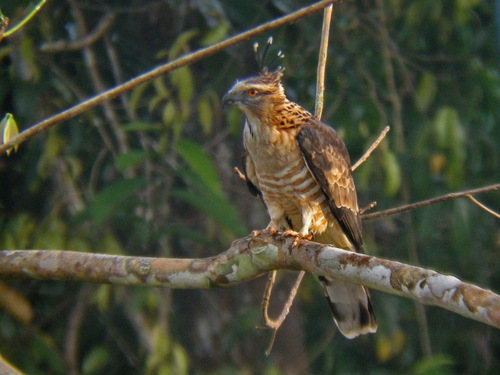 Jerdon's Baza
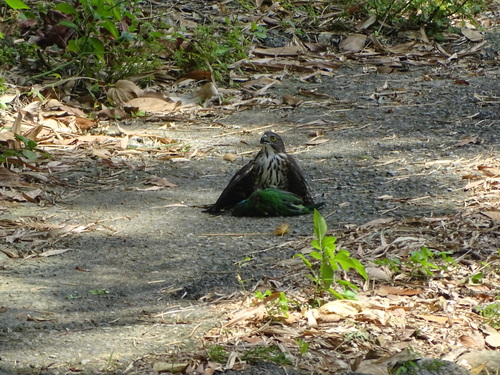 Crested Goshawk
In short
The most reliable field mark between Jerdon's Baza and Crested Goshawk is the long, thin, white-tipped black crest of Jerdon's Baza, which is noticeably longer and more upright than the short crest of Crested Goshawk. In flight, Jerdon's Baza shows very broad, paddle-shaped wings and mostly pale, plain underparts, while Crested Goshawk has shorter, broader wings and a long tail, with underparts marked by rufous or brown streaks and bars. Juvenile Crested Goshawks have a buffier underpart background and pale head feather fringes, which can help separate them from the plainer Jerdon's Baza. Both species may be confused in flight, but attention to crest length, wing shape, and underpart pattern is key.
Identification tips
- Crest length and shape: Jerdon's Baza has a long, thin, white-tipped black crest, usually held upright and very prominent in both perched and flight views. Crested Goshawk's crest is short and only clearly visible in profile when perched.
- Wing shape in flight: Jerdon's Baza shows very broad, rounded, paddle-shaped wings, giving it a distinctive silhouette. Crested Goshawk has shorter, broader wings but not as paddle-shaped, and the wings appear more pointed at the tips.
- Tail length: Crested Goshawk has a noticeably longer tail relative to its body, an adaptation for maneuvering in dense forest. Jerdon's Baza's tail is shorter and less prominent in flight.
- Underpart pattern (adults): Jerdon's Baza has mostly plain, pale underparts with a bold black stripe down the center of the throat and a white chin. Crested Goshawk adults show rufous or brown streaks on the breast and bars on the belly; females are browner, males more rufous.
- Underpart pattern (juveniles): Juvenile Crested Goshawks have a buff background to the underparts with brown streaks and bars, and pale fringes to head feathers. Jerdon's Baza juveniles are not well described but are expected to be plainer below.
- Head pattern: Jerdon's Baza has a white chin and a bold black mesial stripe down the throat. Crested Goshawk has a dark brown crown, grey sides to the head, and black moustachial and throat stripes.
- Flight style: Jerdon's Baza tends to soar on broad wings with steady, buoyant flight. Crested Goshawk uses a 'slow flap, slow flap, straight glide' pattern, typical of Accipiters, and is more agile in woodland.
- Perched posture: Jerdon's Baza often looks longer-necked and more upright due to its long crest. Crested Goshawk appears more compact, with a shorter crest and longer tail.
- Habitat context: If seen in open foothills or edge habitats, especially in the terai, suspect Jerdon's Baza. In dense forest or urban parks with many trees, Crested Goshawk is more likely.
- Size impression: While there is some overlap, Jerdon's Baza generally appears larger and heavier-bodied, especially compared to male Crested Goshawks.
- Potential confusion in flight: Both can appear similar at a distance, especially in silhouette, but focus on the combination of crest length, wing shape, and underpart pattern for separation.
- Sex differences: Female Crested Goshawks are larger and browner below than males, but both sexes share the short crest and barred underparts.
- Subspecies variation: Jerdon's Baza has several subspecies, but the long crest and plain underparts are consistent across its range.
- No reliable vocal differences described: Voice is not a primary field mark for separating these two in the available sources.
- Common pitfalls: Immature Crested Goshawks with buffy underparts and pale head fringes may appear paler than adults, but still show more streaking/barring than Jerdon's Baza. Always check for the long crest and plainness of the underparts.
Size
Jerdon's Baza is generally larger, measuring about 41–48 cm in length with a wingspan of 117 cm and weighing around 350 grams. Crested Goshawk is more variable in size (30–46 cm), with females much larger than males, but typically has a shorter wingspan and is lighter overall. The size overlap means structure and plumage are more reliable than size alone for identification.
Plumage
- Juvenile/Immature: Juvenile Crested Goshawks have pale fringes to the head feathers and a buff background to the underparts, which are streaked and barred brown. Jerdon's Baza juveniles are not described in detail, but the species overall is noted for plain, pale underparts and a bold black mesial stripe, lacking the dense streaking/barred pattern of the goshawk.
- Adult: Jerdon's Baza adults have a mostly plain, pale underside with a white chin and a bold black stripe down the center of the throat. The wings are broad and rounded, appearing paddle-shaped in flight. The crest is long, thin, and white-tipped. Crested Goshawk adults have a short, visible crest, dark brown crown, grey sides to the head, black moustachial and throat stripes, and underparts with rufous streaks on the breast and bars on the belly (brown in females). Their wings are short and broad, and the tail is long and adapted for maneuverability.
Behaviour
In flight, Jerdon's Baza appears with broad, rounded wings and a steady, buoyant flight style. Crested Goshawk shows a characteristic 'slow flap, slow flap, straight glide' flight pattern typical of Accipiters, with more rapid wingbeats and agile, twisting movements through trees. Perched, Jerdon's Baza often holds its long crest erect, while Crested Goshawk's crest is shorter and less conspicuous.
Habitat
Jerdon's Baza is typically found in foothills, especially in the terai region, and is rarer in evergreen forests and tea estates. Crested Goshawk is widely distributed in tropical Asia and is adapted to maneuvering through forested habitats, often seen in dense woodland. While both can occur in forested areas, Jerdon's Baza is more likely in open foothill habitats, and Crested Goshawk is more of a forest specialist.