

Motmot

Japanese Sparrowhawk vs Eurasian Goshawk

Tachyspiza gularis versus Astur gentilis

Play a quiz with Japanese Sparrowhawk and Eurasian Goshawk
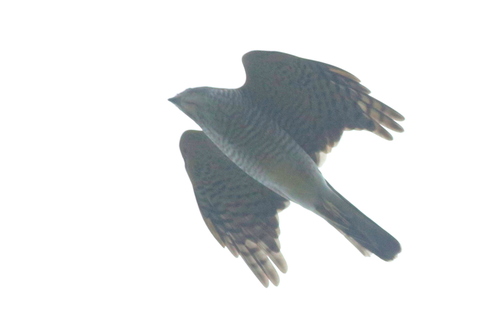
Japanese Sparrowhawk (Tachyspiza gularis) Japanese Sparrowhawk
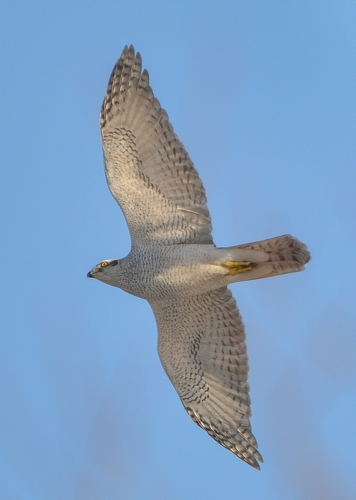
Eurasian Goshawk (Astur gentilis) Eurasian Goshawk

Media

Loading…

In short

The most reliable field mark between Japanese Sparrowhawk and Eurasian Goshawk is size: the goshawk is vastly larger and bulkier, with a much heavier build and deeper, more deliberate wingbeats. For immatures, both show brown upperparts and barred tails, but the goshawk's underparts are more heavily and broadly streaked or barred, and adults always show a bold white supercilium (eyebrow) absent in Japanese Sparrowhawk. In flight, the sparrowhawk appears more compact with shorter, rounder wings and a shorter tail, while the goshawk's wings are longer and more pointed for its size. If you see a small, slim raptor with a faint throat stripe and quick, fluttery flight, it's likely a Japanese Sparrowhawk; a large, powerful bird with a strong white eyebrow and steady, deep wingbeats is a Eurasian Goshawk.

Identification tips

  1. Size is decisive: Eurasian Goshawk is about five to ten times heavier than Japanese Sparrowhawk. If the bird looks buzzard- or crow-sized, it's a goshawk; if it's pigeon- or thrush-sized, it's a sparrowhawk. This holds for all ages and sexes.
  2. Supercilium (eyebrow): Goshawk of all ages shows a bold white supercilium, especially obvious in adults. Japanese Sparrowhawk has only a faint, thin pale line above the eye in juveniles, and adults lack a strong eyebrow.
  3. Underpart pattern (juveniles): Juvenile sparrowhawks have cream underparts with fine red-brown streaks and spots; juvenile goshawks are much more heavily and broadly streaked or barred with dark cinnamon-brown, often making the underparts look much darker overall.
  4. Tail barring: Both have barred tails, but the pattern is more striking and the bars broader in goshawk, with 3–5 bold dark bars. Japanese Sparrowhawk's tail bars are thinner and less contrasting.
  5. Adult male plumage: Japanese Sparrowhawk males are slate-black above with a faint reddish wash on the chest; adult goshawks are blue-grey or brownish-grey above with dense grey barring below and a strong white supercilium.
  6. Adult female plumage: Female sparrowhawks are browner above and have heavier brown barring on the underparts, but still appear much smaller and slimmer than any goshawk. Female goshawks are massive, with a similar barred pattern but always with a bold white eyebrow.
  7. Throat stripe: Both species can show a throat stripe, but it's more obvious in female Japanese Sparrowhawk. Goshawk's throat is usually clean white with the supercilium dominating the facial pattern.
  8. Eye color: Adult male Japanese Sparrowhawks have red-orange eyes, females yellow; goshawk eyes change from pale yellow in juveniles to orange or ochre in adults. This can help at close range.
  9. Flight style: Japanese Sparrowhawk has quick, fluttery wingbeats and short glides; Eurasian Goshawk's wingbeats are deeper, slower, and more powerful, with longer, steadier glides and frequent soaring.
  10. Wing and tail shape: Sparrowhawk's wings are shorter and rounder, tail shorter; goshawk's wings are longer and more pointed for its size, tail longer and more squared-off when spread.
  11. Legs and bill: Goshawk has thicker legs and toes, and a more robust bill; sparrowhawk's legs are long and slim, bill smaller and more delicate.
  12. Perched jizz: Sparrowhawk looks slim, upright, and light; goshawk is bulkier, more horizontal, and imposing.
  13. Habitat context: Goshawk prefers large, mature forests; sparrowhawk is more likely in small woods, edges, or even open country on migration.
  14. Vocalizations: If heard, Japanese Sparrowhawk's chattering 'kiki-kik-kik...' or 'kwu' calls may help, but voice is rarely diagnostic in the field.
  15. Pitfalls: A small male goshawk can be confused with a large female sparrowhawk, but even then, the size, bulk, and supercilium of the goshawk are distinctive. Always use multiple features, especially size and facial pattern, for a confident ID.

Size

Size is the most clear-cut difference: Eurasian Goshawk is a true heavyweight, with an average adult mass around 926 g [wikidata], while Japanese Sparrowhawk is much smaller (adult males 92–142 g, females up to 193 g [wikipedia]). Even a female Japanese Sparrowhawk is dwarfed by the smallest male goshawk. Goshawk is not only heavier but also has a much bulkier body, thicker legs and toes, and a more robust bill. In the field, a perched goshawk often looks crow- or buzzard-sized, while Japanese Sparrowhawk is closer to a large thrush or small pigeon. This size gap is visible even at a distance, especially when both species are seen in the same area.

Plumage

Juvenile Japanese Sparrowhawks are dark brown above with cream underparts marked by red-brown streaks on the breast, spots on the belly, and barring on the sides. They have a thin, pale supercilium and a throat stripe, with thin bars on the tail. Juvenile Eurasian Goshawks are also brown above, but their underparts are much more heavily streaked or broadly barred with dark cinnamon-brown, sometimes nearly covering the white base. The goshawk's supercilium is always prominent and white, even in juveniles, and the tail shows 3–5 bold dark bars. Adult Japanese Sparrowhawks (males) are slate-black above with a faint red-brown wash on the chest and fine brown-grey barring; females are browner above with heavier barring below and a more obvious throat stripe. Adult goshawks are blue-grey or brownish-grey above, with white underparts densely barred with dark grey, and always have a bold white supercilium. Eye color also differs: adult male sparrowhawks have red-orange eyes, females yellow; goshawks' eyes shift from yellow in juveniles to orange or ochre in adults.

Behaviour

In flight, Japanese Sparrowhawk is quick and agile, with frequent, fluttery flapping and short glides, often appearing compact and light. Eurasian Goshawk, by contrast, flies with deep, powerful wingbeats and longer, steadier glides, sometimes soaring for extended periods—something sparrowhawks rarely do. Perched, the sparrowhawk looks slim and upright, while the goshawk is bulkier, more horizontal, and often appears more imposing. Both can perform display flights with undulating or circling patterns, but the goshawk's flight is always more forceful and deliberate.

Habitat

Both species are forest raptors, but Eurasian Goshawk prefers larger tracts of mature woodland and is more likely to be found in extensive forests or at the forest edge. Japanese Sparrowhawk also breeds in wooded areas, but can be found in smaller woodlots and sometimes in more open or edge habitats, especially on migration. In areas of overlap, the goshawk is much less likely to be seen in small, isolated groves where sparrowhawks may hunt.

Voice

Both species can give sharp calls, but Japanese Sparrowhawk is sometimes heard giving a chattering 'kiki-kik-kik...' or 'kwu' sounds, especially during display. The Eurasian Goshawk's calls are not described in the provided notes, but are generally deeper and more resonant. In practice, voice is rarely diagnostic unless the bird is calling repeatedly and at close range.

Submit a better description

Use the same sections as the comparison. Your text is published immediately.

The most reliable field mark between Japanese Sparrowhawk and Eurasian Goshawk is size: the goshawk is vastly larger and bulkier, with a much heavier build and deeper, more deliberate wingbeats. For immatures, both show brown upperparts and barred tails, but the goshawk's underparts are more heavily and broadly streaked or barred, and adults always show a bold white supercilium (eyebrow) absent in Japanese Sparrowhawk. In flight, the sparrowhawk appears more compact with shorter, rounder wings and a shorter tail, while the goshawk's wings are longer and more pointed for its size. If you see a small, slim raptor with a faint throat stripe and quick, fluttery flight, it's likely a Japanese Sparrowhawk; a large, powerful bird with a strong white eyebrow and steady, deep wingbeats is a Eurasian Goshawk.

  1. Size is decisive: Eurasian Goshawk is about five to ten times heavier than Japanese Sparrowhawk. If the bird looks buzzard- or crow-sized, it's a goshawk; if it's pigeon- or thrush-sized, it's a sparrowhawk. This holds for all ages and sexes.
  2. Supercilium (eyebrow): Goshawk of all ages shows a bold white supercilium, especially obvious in adults. Japanese Sparrowhawk has only a faint, thin pale line above the eye in juveniles, and adults lack a strong eyebrow.
  3. Underpart pattern (juveniles): Juvenile sparrowhawks have cream underparts with fine red-brown streaks and spots; juvenile goshawks are much more heavily and broadly streaked or barred with dark cinnamon-brown, often making the underparts look much darker overall.
  4. Tail barring: Both have barred tails, but the pattern is more striking and the bars broader in goshawk, with 3–5 bold dark bars. Japanese Sparrowhawk's tail bars are thinner and less contrasting.
  5. Adult male plumage: Japanese Sparrowhawk males are slate-black above with a faint reddish wash on the chest; adult goshawks are blue-grey or brownish-grey above with dense grey barring below and a strong white supercilium.
  6. Adult female plumage: Female sparrowhawks are browner above and have heavier brown barring on the underparts, but still appear much smaller and slimmer than any goshawk. Female goshawks are massive, with a similar barred pattern but always with a bold white eyebrow.
  7. Throat stripe: Both species can show a throat stripe, but it's more obvious in female Japanese Sparrowhawk. Goshawk's throat is usually clean white with the supercilium dominating the facial pattern.
  8. Eye color: Adult male Japanese Sparrowhawks have red-orange eyes, females yellow; goshawk eyes change from pale yellow in juveniles to orange or ochre in adults. This can help at close range.
  9. Flight style: Japanese Sparrowhawk has quick, fluttery wingbeats and short glides; Eurasian Goshawk's wingbeats are deeper, slower, and more powerful, with longer, steadier glides and frequent soaring.
  10. Wing and tail shape: Sparrowhawk's wings are shorter and rounder, tail shorter; goshawk's wings are longer and more pointed for its size, tail longer and more squared-off when spread.
  11. Legs and bill: Goshawk has thicker legs and toes, and a more robust bill; sparrowhawk's legs are long and slim, bill smaller and more delicate.
  12. Perched jizz: Sparrowhawk looks slim, upright, and light; goshawk is bulkier, more horizontal, and imposing.
  13. Habitat context: Goshawk prefers large, mature forests; sparrowhawk is more likely in small woods, edges, or even open country on migration.
  14. Vocalizations: If heard, Japanese Sparrowhawk's chattering 'kiki-kik-kik...' or 'kwu' calls may help, but voice is rarely diagnostic in the field.
  15. Pitfalls: A small male goshawk can be confused with a large female sparrowhawk, but even then, the size, bulk, and supercilium of the goshawk are distinctive. Always use multiple features, especially size and facial pattern, for a confident ID.

Size is the most clear-cut difference: Eurasian Goshawk is a true heavyweight, with an average adult mass around 926 g [wikidata], while Japanese Sparrowhawk is much smaller (adult males 92–142 g, females up to 193 g [wikipedia]). Even a female Japanese Sparrowhawk is dwarfed by the smallest male goshawk. Goshawk is not only heavier but also has a much bulkier body, thicker legs and toes, and a more robust bill. In the field, a perched goshawk often looks crow- or buzzard-sized, while Japanese Sparrowhawk is closer to a large thrush or small pigeon. This size gap is visible even at a distance, especially when both species are seen in the same area.

Juvenile Japanese Sparrowhawks are dark brown above with cream underparts marked by red-brown streaks on the breast, spots on the belly, and barring on the sides. They have a thin, pale supercilium and a throat stripe, with thin bars on the tail. Juvenile Eurasian Goshawks are also brown above, but their underparts are much more heavily streaked or broadly barred with dark cinnamon-brown, sometimes nearly covering the white base. The goshawk's supercilium is always prominent and white, even in juveniles, and the tail shows 3–5 bold dark bars. Adult Japanese Sparrowhawks (males) are slate-black above with a faint red-brown wash on the chest and fine brown-grey barring; females are browner above with heavier barring below and a more obvious throat stripe. Adult goshawks are blue-grey or brownish-grey above, with white underparts densely barred with dark grey, and always have a bold white supercilium. Eye color also differs: adult male sparrowhawks have red-orange eyes, females yellow; goshawks' eyes shift from yellow in juveniles to orange or ochre in adults.

In flight, Japanese Sparrowhawk is quick and agile, with frequent, fluttery flapping and short glides, often appearing compact and light. Eurasian Goshawk, by contrast, flies with deep, powerful wingbeats and longer, steadier glides, sometimes soaring for extended periods—something sparrowhawks rarely do. Perched, the sparrowhawk looks slim and upright, while the goshawk is bulkier, more horizontal, and often appears more imposing. Both can perform display flights with undulating or circling patterns, but the goshawk's flight is always more forceful and deliberate.

Both species are forest raptors, but Eurasian Goshawk prefers larger tracts of mature woodland and is more likely to be found in extensive forests or at the forest edge. Japanese Sparrowhawk also breeds in wooded areas, but can be found in smaller woodlots and sometimes in more open or edge habitats, especially on migration. In areas of overlap, the goshawk is much less likely to be seen in small, isolated groves where sparrowhawks may hunt.

Both species can give sharp calls, but Japanese Sparrowhawk is sometimes heard giving a chattering 'kiki-kik-kik...' or 'kwu' sounds, especially during display. The Eurasian Goshawk's calls are not described in the provided notes, but are generally deeper and more resonant. In practice, voice is rarely diagnostic unless the bird is calling repeatedly and at close range.

Discard your changes?

You have unsaved edits. If you leave now, those changes will be lost.

Japanese Sparrowhawk · Eurasian Goshawk · My Tricky Birds