

Japanese Night Heron vs Chinese Pond Heron
Gorsachius goisagi versus Ardeola bacchus
Play a quiz with Japanese Night Heron and Chinese Pond Heron
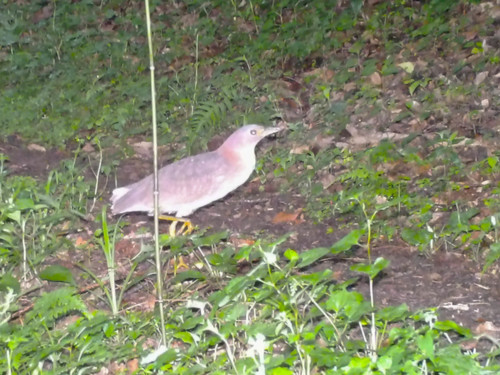 Japanese Night Heron
 Chinese Pond Heron
In short
The most reliable field mark to separate Japanese Night Heron from Chinese Pond Heron is the upperwing pattern and overall coloration: Japanese Night Heron (especially adults) shows dark-brown wings with dense, irregular black lines on the wing coverts, while Chinese Pond Heron in non-breeding plumage has greyish-brown, flecked wings, and in breeding plumage, striking white wings contrasting with a red, blue, and white body. Juvenile Japanese Night Herons have paler wings than adults but still show the distinctive black lines, while juvenile Chinese Pond Herons are more uniformly flecked brown and white. Structurally, Japanese Night Heron is stockier with a thicker bill, and its russet head and neck (adult) contrast with the more sharply colored Chinese Pond Heron in breeding. Both species can be found in East Asia, but Japanese Night Heron is much more secretive and forest-associated, while Chinese Pond Heron is common in open wetlands.
Identification tips
- Upperwing covert pattern (all ages): Japanese Night Heron shows dense, irregular black lines on the wing coverts, visible at rest and especially in flight. Chinese Pond Heron never shows this pattern—its wings are either pure white (breeding) or flecked brown and white (non-breeding/juvenile).
- Juvenile confusion: Juvenile Japanese Night Heron has a blackish head and paler brown wings, but still shows the black covert lines. Juvenile Chinese Pond Heron is brownish and flecked, lacking any black lines on the wing coverts.
- Adult head and neck color: Adult Japanese Night Heron has a russet (reddish-brown) head and neck, contrasting with its dark-brown wings. Chinese Pond Heron in breeding plumage has a striking red, blue, and white body, with a much brighter and more sharply contrasting appearance.
- Bill structure: Japanese Night Heron has a noticeably thicker, heavier bill, adapted for digging in soil. Chinese Pond Heron's bill is slimmer, with a yellow base and black tip.
- Eye color: Both species have yellow eyes, so this is not a useful separator.
- Leg color: Both have yellow legs, not a strong separator.
- Flight appearance: In flight, Chinese Pond Heron shows broad, pure white wings (especially in breeding plumage) contrasting with its colored body. Japanese Night Heron appears darker overall, with no white on the wings and a more compact, stocky jizz.
- Foraging behavior: Japanese Night Heron is secretive, feeding at dusk or in dense cover, often on the forest floor. Chinese Pond Heron is much more likely to be seen feeding openly in wetlands during the day.
- Habitat: If seen in dense forest or woodland, Japanese Night Heron is far more likely. In open wetlands, rice paddies, or ponds, Chinese Pond Heron is the default.
- Seasonal context: Japanese Night Heron breeds in Japan and is a rare migrant elsewhere; Chinese Pond Heron is widespread and common in East Asian wetlands.
- Group size: Japanese Night Heron is usually solitary or in very small groups; Chinese Pond Heron often nests and feeds in mixed heronries.
- Plumage pitfalls: Non-breeding Chinese Pond Heron can look dull and brownish, but lacks the black covert lines of Japanese Night Heron. Beware of distant views where covert pattern is not visible—use structure and habitat as backup.
- Bill use: Japanese Night Heron may be seen probing soil for earthworms or snails, a behavior less typical of Chinese Pond Heron.
- Vagrancy: Both species can wander, but Chinese Pond Heron is much more likely to turn up in unexpected open wetland sites.
- Voice: Not diagnostic from available notes.
Size
Both species are similar in length, with Chinese Pond Heron typically around 47 cm long [wikipedia], and Japanese Night Heron having a wingspan of 43–47 cm [wikipedia]. There is no strong size difference in the field, but Japanese Night Heron may appear stockier and more compact due to its shorter neck and thicker bill.
Plumage
Juvenile Japanese Night Herons have blackish head feathers and paler brown wings than adults, but both ages show dense, irregular black lines running down the wing coverts—a unique and diagnostic feature. Adults have a russet head and neck with dark-brown wings. In contrast, Chinese Pond Heron in breeding plumage is unmistakable: the body is a mix of red, blue, and white, with pure white wings. Outside breeding, Chinese Pond Heron is greyish-brown overall, flecked with white, and the wings are white (in flight) but not patterned with black lines. Juvenile Chinese Pond Herons are brownish and flecked, lacking the strong covert markings of Japanese Night Heron. Both species have yellow eyes and a yellow-based bill, but Japanese Night Heron's bill is thicker.
Behaviour
Japanese Night Heron is typically solitary or in small groups, feeding at dusk and rarely venturing into the open. It forages mainly on the forest floor for earthworms, snails, and insects, sometimes probing with its thick bill. Chinese Pond Heron is much more likely to be seen in open wetlands, often in mixed heronries, and is less secretive, feeding in daylight on insects, fish, and crustaceans. In flight, Chinese Pond Heron shows broad white wings, while Japanese Night Heron appears darker and more compact.
Habitat
Japanese Night Heron is a forest specialist, breeding in wooded areas in Japan and wintering in Southeast Asian forests. It is rarely seen in open country and prefers dense cover. Chinese Pond Heron is a classic wetland bird, found in shallow freshwater and saltwater wetlands, rice paddies, and ponds across East Asia. It is common in lowlands and open habitats, and much less tied to forest than Japanese Night Heron.