

Japanese Leaf Warbler vs Arctic Warbler
Phylloscopus xanthodryas versus Phylloscopus borealis
Play a quiz with Japanese Leaf Warbler and Arctic Warbler
 Japanese Leaf Warbler
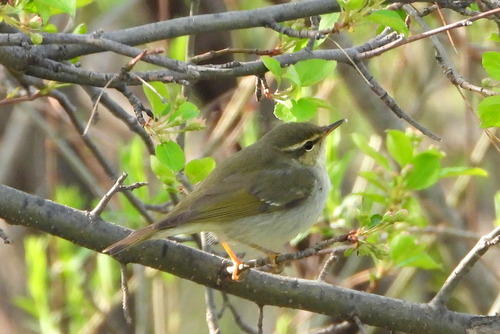 Arctic Warbler
In short
The most reliable field mark between Japanese Leaf Warbler and Arctic Warbler is overall plumage tone: Japanese Leaf Warbler is distinctly brighter olive-green above, while Arctic Warbler is duller greyish-green. Both species show a single white wingbar, but Japanese Leaf Warbler’s is often more prominent and set against a greener background. Juveniles of both are duller, but Japanese Leaf Warbler remains more olive, while Arctic Warbler is always more ashy. Structurally, Arctic Warbler has a heavier, dagger-like bill with a dark tip to the lower mandible, compared to the Japanese Leaf Warbler’s shorter, blackish bill. Song and call differ, but require experience: Arctic Warbler’s song is a fast trill, while Japanese Leaf Warbler’s is slower and lower-pitched.
Identification tips
- Upperparts color: Japanese Leaf Warbler is bright olive-green above, while Arctic Warbler is duller greyish-green. This is the most useful single mark in good light, especially on adults.
- Wingbar: Both have a single white wingbar, but Japanese Leaf Warbler’s is often brighter and more sharply defined against the green back; Arctic Warbler’s is less contrasting on a duller background. Works best on fresh-plumaged adults.
- Supercilium (eyebrow stripe): Japanese Leaf Warbler shows a clear yellowish-white supercilium, often with a yellowish tinge; Arctic Warbler’s is paler, less yellow, and less striking. This can be subtle on worn or juvenile birds.
- Bill structure: Arctic Warbler has a noticeably heavier, longer, dagger-like bill with a dark tip to the lower mandible. Japanese Leaf Warbler’s bill is shorter, blackish (with a hint of yellow), and finer. Bill shape is best judged at close range or in photos.
- Tail color: Japanese Leaf Warbler’s tail is greenish, matching the back; Arctic Warbler’s tail is less green, blending with the duller upperparts.
- Underparts: Japanese Leaf Warbler is light greenish below, while Arctic Warbler is off-white. This is subtle and can be affected by light or wear.
- Juvenile/immature plumage: Juvenile Japanese Leaf Warblers are duller, more grey-brown above, but still show some olive tones; Arctic Warbler juveniles are ashy-grey above and off-white below, lacking any greenish cast. Use this for autumn birds.
- Leg color: Japanese Leaf Warbler’s legs are extremely small and vary from pale yellow to orange-brown; Arctic Warbler’s leg color is not distinctive for separation.
- Song: Japanese Leaf Warbler’s song is slower, lower-pitched, and in short repeated phrases (1.5–2 sec); Arctic Warbler’s is a fast, high-pitched trill. Useful if singing, but requires experience.
- Call: Japanese Leaf Warbler gives a dry, low “brrt”; Arctic Warbler’s call is sharper and higher. Calls are subtle and best used by experienced listeners.
- Habitat and context: In Japan during breeding season, Japanese Leaf Warbler is expected; Arctic Warbler is a rare migrant. In Fennoscandia or Alaska, only Arctic Warbler breeds. Always consider location and season.
- Size: Arctic Warbler is slightly larger and bulkier, but this is rarely diagnostic unless both are seen together.
- Sex differences: Both species are sexually monomorphic; do not use sex for separation.
- Behavior: Both species are active foliage foragers; behavior is not a reliable separator.
- Pitfalls: Do not rely solely on wingbar presence, as both species show a single white wingbar. Always combine several marks, especially color tones and bill shape, for confident identification.
Size
Both species are similar in length (Japanese Leaf Warbler: 12–13 cm), but Arctic Warbler is slightly larger overall and appears bulkier, with a noticeably heavier bill. In the field, this size difference is subtle and best judged with direct comparison or experience.
Plumage
Juvenile and immature birds of both species are duller than adults, but Japanese Leaf Warbler juveniles are more grey-brown, while Arctic Warbler juveniles are ashy-grey above and off-white below. Both species show a single white wingbar, but Japanese Leaf Warbler’s is often brighter and more contrasting against its olive-green upperparts, whereas Arctic Warbler’s wingbar is set on a duller, greyish-green background. The Japanese Leaf Warbler has a clear yellowish-white eyebrow stripe (supercilium) and a greenish tail, while Arctic Warbler’s supercilium is paler and less yellow, and the tail is less green. Underparts of Japanese Leaf Warbler are light greenish, while Arctic Warbler is off-white below. Both sexes are similar in both species.
Behaviour
Both species are active, restless foragers in foliage, often flicking wings and tails. No strong behavioral differences are noted in the sources for field separation.
Habitat
Japanese Leaf Warbler breeds in Japan and migrates through eastern China and nearby islands, wintering in Taiwan, the Philippines, Borneo, and Java. Arctic Warbler breeds in Fennoscandia, northern Palearctic, and Alaska, wintering in southeast Asia. In Japan, Japanese Leaf Warbler is the expected breeder, while Arctic Warbler is a rare migrant or vagrant. Both favor wooded habitats, but Arctic Warbler is more associated with birch or mixed birch forest near water in its breeding range.
Voice
Japanese Leaf Warbler’s song is a series of short phrases, repeated several times, lasting 1.5–2 seconds, lower in pitch and slower than Arctic Warbler. Its call is a dry, low “brrt.” Arctic Warbler’s song is a fast trill, higher in pitch and more rapid than Japanese Leaf Warbler. Calls are less distinctive in the field unless familiar with both.