

Japanese Cormorant vs Schrenck's Bittern
Phalacrocorax capillatus versus Botaurus eurhythmus
Play a quiz with Japanese Cormorant and Schrenck's Bittern
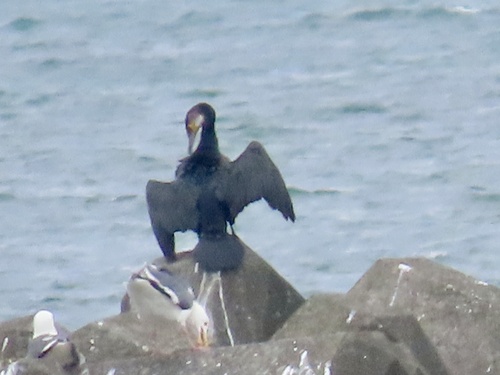 Japanese Cormorant
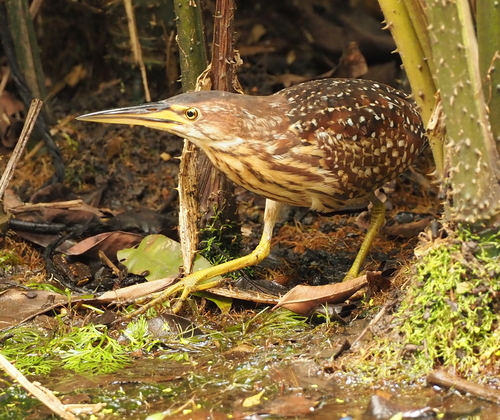 Schrenck's Bittern
In short
The most reliable field mark to separate Japanese Cormorant from Schrenck's Bittern is overall structure and size: Japanese Cormorant is a large, heavy-bodied seabird with a long neck and white throat, while Schrenck's Bittern is much smaller, with a short neck, compact build, and chestnut/buff plumage. In flight, cormorants show long, narrow wings and a steady, direct flight, whereas bitterns have broad, rounded wings and a slower, fluttering flight. Juvenile cormorants are brownish but still large and pale-throated, while juvenile bitterns are streaked and chestnut with black flight feathers. Bill shape and color are also distinctive at all ages.
Identification tips
- Size is the fastest check: Japanese Cormorant is more than twice the length of Schrenck's Bittern and many times heavier. If the bird looks goose-sized or larger, it's a cormorant; if it's crow-sized or smaller, it's a bittern. This holds for all ages and sexes.
- Neck and body shape: Cormorant has a long, thick neck and elongated body, especially obvious when swimming or flying. Bitterns have a short, thick neck and compact, chunky body, with a hunched posture when perched.
- Bill shape and color: Cormorant's bill is long, hooked, and partially yellow, suited for catching fish. Bittern's bill is straight, dagger-like, and yellow, with no hook. This is visible at all ages.
- Plumage – throat and cheeks: Cormorant (all ages) shows a white throat and cheeks, contrasting with a dark head and body. Bitterns never show this pattern; their face is buff or chestnut with no white patch.
- Plumage – upperparts and underparts: Adult cormorants are glossy black with a white throat, while bitterns are chestnut above and buff or streaked below. Juvenile cormorants are brownish but plain, lacking the streaks and speckles of juvenile/female bitterns.
- Flight pattern and wing shape: Cormorants fly with long, narrow wings and a steady, direct flight, neck outstretched. Bitterns have broad, rounded wings, a slower, fluttery flight, and fly with neck retracted. In flight, bitterns show black flight feathers contrasting with chestnut coverts; cormorants are more uniform.
- Tail: Bitterns show a black tail in flight, contrasting with the rest of the body. Cormorant's tail is short and dark but not contrasting.
- Perched posture: Cormorants often perch upright on rocks or posts, sometimes with wings spread. Bitterns are secretive, usually hunched and hidden in reeds, rarely perched openly.
- Habitat context: Cormorants are almost always on open water, rocky coasts, or harbors. Bitterns are in reedbeds, marshes, or dense freshwater vegetation. If the bird is in reeds, it's almost certainly a bittern.
- Juvenile confusion: Young cormorants are browner but still large and pale-throated, never streaked. Juvenile bitterns are smaller, chestnut with white speckles/streaks, and show black in the wings and tail.
- Leg color: Bitterns have yellow legs, often visible when wading or in flight. Cormorants' legs are dark and less likely to be seen.
- Swimming behavior: Cormorants swim low in the water, often diving. Bitterns rarely swim and are more likely to be seen walking or standing in shallow water.
- Wing drying: Cormorants frequently perch with wings spread to dry; bitterns never do this.
- Seasonal/sex differences: Male bitterns are more uniformly chestnut above, females and juveniles more streaked. Cormorant sex differences are subtle and not usually visible in the field.
- Vocalization: Not diagnostic with current notes, but generally, cormorants are silent or give guttural croaks, while bitterns are also quiet and secretive.
Size
Japanese Cormorant is dramatically larger: adults measure 81–92 cm in length with a wingspan around 152 cm, and weigh 2.3–3.55 kg [wikipedia]. Schrenck's Bittern is much smaller, only 33–39 cm long, with a proportionally shorter neck and smaller body [wikipedia]. Even a juvenile cormorant dwarfs an adult bittern. This size gap is obvious in the field, especially when both are seen near water for scale.
Plumage
- Juvenile/immature birds: Juvenile Japanese Cormorants are plainer and browner than adults but retain a pale (white) throat and cheeks, and lack strong streaking or speckling. Juvenile Schrenck's Bitterns are chestnut with white speckles above and white streaks below, and show black flight feathers and tail in flight. The bittern's upperwing in flight is strongly contrasting (black primaries, chestnut coverts), while cormorants are more uniformly dark above with no such pattern.
- Adults: Adult Japanese Cormorants are glossy black with a white throat and cheeks, and a partially yellow bill. Adult male Schrenck's Bitterns are chestnut above and buff below, with buff wing coverts and black flight feathers. Females resemble juveniles but are less streaked. In all ages, the bittern's black flight feathers and tail contrast with the rest of the wing, which is not seen in cormorant.
Behaviour
Japanese Cormorant is typically seen swimming low in the water, diving for fish, or perched upright with wings spread to dry. Its flight is strong, direct, and often low over water, with neck outstretched. Schrenck's Bittern is secretive, skulking in reeds or dense vegetation, and is rarely seen swimming. When flushed, it flies with slow, fluttery wingbeats and a retracted neck, often dropping quickly back into cover. Bitterns are much less likely to be seen perched openly or swimming.
Habitat
Japanese Cormorant is a coastal species, usually found along rocky shores, harbors, and open sea, rarely venturing far inland. Schrenck's Bittern prefers freshwater marshes, reedbeds, and dense wetland vegetation, though it may occur near lakes and ponds. Overlap is possible in coastal wetlands, but cormorants are rarely in dense reeds, and bitterns avoid open sea or rocky coastlines.