

Jack Snipe vs Eurasian Woodcock
Lymnocryptes minimus versus Scolopax rusticola
Play a quiz with Jack Snipe and Eurasian Woodcock
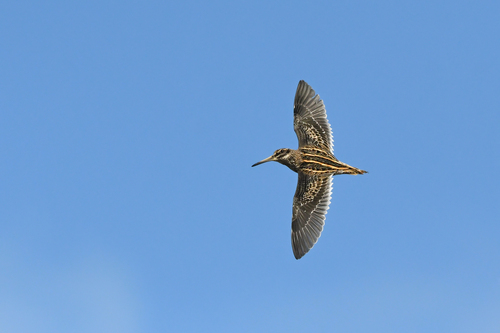 Jack Snipe
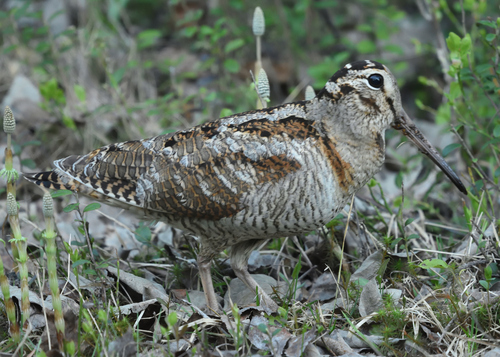 Eurasian Woodcock
In short
The most reliable field mark to separate Jack Snipe from Eurasian Woodcock is size and structure: Jack Snipe is much smaller, with a short bill and compact, stocky build, while Eurasian Woodcock is noticeably larger, with a long, straight bill and a more rounded, chunky appearance. In flight, Jack Snipe shows pointed, narrow wings and distinctive yellowish back stripes, whereas Woodcock has broad, rounded wings and lacks these stripes. Head pattern is also key: Jack Snipe has two pale lateral crown stripes (no central stripe), while Woodcock's crown is barred with black. Both species are cryptically camouflaged, but their preferred habitats and typical behaviors differ, aiding identification.
Identification tips
- Size is the first check: Jack Snipe is about half the length and much lighter than Eurasian Woodcock. If you see a small, stocky wader, think Jack Snipe; a large, chunky bird with a long bill points to Woodcock.
- Bill length and shape: Jack Snipe has a relatively short bill for a snipe, while Woodcock's bill is long, straight, and prominent—almost twice the length of Jack Snipe's bill. Bill color is not a strong field mark, but Woodcock's base is flesh-colored with a dark tip.
- Head pattern: Jack Snipe has two pale lateral crown stripes (no central stripe), separated from the supercilium by a dark area. Eurasian Woodcock's crown is barred with black, not striped. This is visible on perched or flushed birds.
- Upperwing and flight pattern: In flight, Jack Snipe shows pointed, narrow wings and clear yellowish stripes down the back. Woodcock has broad, rounded wings and lacks any yellow back stripes. This is especially useful when birds are flushed.
- Body shape and jizz: Jack Snipe appears compact, almost dumpy, with a short neck and tail. Woodcock is bulkier, with a longer body and a more rounded, chunky appearance.
- Behavior when flushed: Jack Snipe flushes only when almost stepped on, flies quietly for a short distance, and drops back into cover. Woodcock flushes at a greater distance, flies strongly and erratically, often zigzagging away.
- Feeding behavior: Jack Snipe bobs up and down while feeding or when alert—a unique, almost hypnotic motion. Woodcock does not bob.
- Habitat context: Jack Snipe is found in open, wet, marshy ground; Woodcock is almost always in woodland or dense cover. If you find a cryptic wader in a forest, it's almost certainly a Woodcock.
- Underparts: Both have pale underparts, but Woodcock's are buff, while Jack Snipe's are paler and less warm-toned.
- Eye placement: Woodcock's eyes are set far back on the head, giving it a distinctive profile and 360-degree vision. Jack Snipe's eyes are more typical for a snipe.
- Leg color: Woodcock's legs vary from grey to pinkish; Jack Snipe's leg color is not highlighted as diagnostic.
- Sex and age: Both species are similar in plumage across sexes and ages for field purposes; Woodcock males are larger, but this is not easily judged in the field.
- Vocalization: Do not rely on calls for separation in winter or migration; both are usually silent when flushed.
- Pitfalls: Do not confuse Jack Snipe's head stripes with Woodcock's crown bars; check for the presence or absence of a central crown stripe and the nature of the pattern.
- Flight distance: If the bird flushes at very close range and lands again quickly, suspect Jack Snipe; if it flushes at distance and flies far, suspect Woodcock.
Size
Jack Snipe is dramatically smaller: body mass averages around 50 g, with a length of 18–25 cm and a wingspan of 30–41 cm. Eurasian Woodcock is much larger, with a length of 33–38 cm and a wingspan of 55–65 cm (no mass provided, but it is substantially heavier). The difference is striking in the field, especially if both are seen in similar contexts. Jack Snipe appears compact and almost dumpy, while Woodcock is chunky but with a longer, bulkier body and a proportionally much longer bill.
Plumage
- Juvenile/Immature/Adult Jack Snipe: Shows a mottled brown upperbody with pale underparts, a dark eye-stripe, and, crucially, two pale lateral crown stripes separated from the supercilium by dark plumage. In flight, Jack Snipe reveals pointed, narrow wings and distinctive yellowish stripes down the back. There is no central crown stripe. These features are consistent across ages, as no age-specific upperwing pattern differences are noted for Jack Snipe.
- Eurasian Woodcock (all ages): Has intricately patterned reddish-brown upperparts and buff underparts, but the head pattern is different: the crown is barred with black, not striped. The wings are broad and rounded (not pointed), and there are no yellowish back stripes in flight. The base of the bill is flesh-colored with a dark tip. Both sexes look similar in the field, but males are larger.
- Key contrast: In any plumage, Jack Snipe's head stripes and pointed wings with yellow back stripes are diagnostic, while Woodcock's barred crown and rounded wings are unique among these two.
Behaviour
Jack Snipe is secretive and often remains hidden in marshy vegetation, only flushing at very close range, and then flying a short distance before dropping back into cover. Its flight is quiet and low. When feeding or disturbed, Jack Snipe exhibits a distinctive bobbing motion, as if on springs—a behavior not shown by Woodcock. Eurasian Woodcock, by contrast, is more likely to be encountered in woodland or forest edge, and when flushed, it flies off powerfully with a zigzagging flight and broad, rounded wings. Woodcock does not bob when feeding or walking.
Habitat
Jack Snipe prefers open, wet habitats such as marshes, bogs, wet meadows, and tundra with short vegetation, especially during migration and winter. It is rarely found in woodland. Eurasian Woodcock is a bird of woodland and forest, nesting and feeding in areas with dense cover, tall heather, or leaf litter. While both can be found on the ground and are well camouflaged, their habitat preferences rarely overlap: Jack Snipe is almost never in deep woodland, and Woodcock is rarely in open marsh.
Voice
Jack Snipe is silent in winter and does not call when flushed, making it very quiet in the field. During the breeding season, the male performs an aerial display with a distinctive sound, but this is not heard in wintering areas. Eurasian Woodcock males perform a display flight ('roding') at dusk in spring, with a repeated 'orr, orr, orr, pist' call. However, outside the breeding season, Woodcock is generally silent and rarely calls when flushed. Thus, vocalizations are not usually helpful for separation in most field situations.