

Italian Sparrow vs Spanish Sparrow
Passer italiae versus Passer hispaniolensis
Play a quiz with Italian Sparrow and Spanish Sparrow
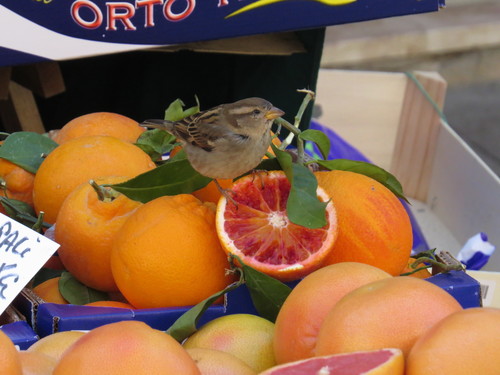 Italian Sparrow
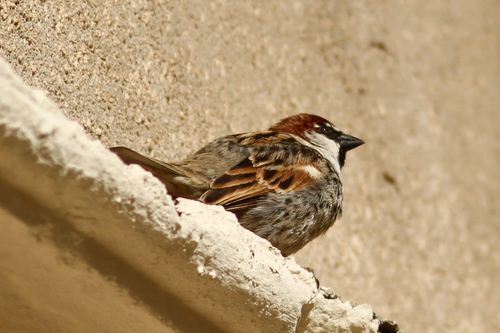 Spanish Sparrow
In short
The most reliable field mark between Italian Sparrow and Spanish Sparrow is the presence or absence of bold black streaking on the underparts of adult males: Spanish Sparrow males have heavy black streaks on the flanks and belly, while Italian Sparrow males have clean pale grey underparts. Both species have chestnut crowns and white cheeks in males, but the Italian Sparrow is intermediate in appearance and lacks the Spanish Sparrow's streaked underparts. Females are extremely similar and nearly inseparable in the field, but subtle differences in streaking and back pattern may help. Both species overlap in parts of the Mediterranean, and hybrids/intermediates can occur, especially in southern Italy and nearby islands, so some individuals may be ambiguous.
Identification tips
- Male underpart streaking (adults): The single best field mark—Spanish Sparrow males have bold black streaks on the flanks and belly, while Italian Sparrow males have clean, pale grey underparts. Use this mark whenever you see a clear view of the underparts.
- Male crown and cheek: Both have chestnut crowns and white cheeks, so this is not diagnostic between them. Do not rely on crown color alone.
- Male throat bib: Both show a black bib, but its size and intensity are variable and not reliably different.
- Female plumage: Females are nearly inseparable in the field. Both are brownish-grey with a pale supercilium and streaked back. Spanish Sparrow females may show slightly more side streaking and broader back streaks, but these are subtle and overlap.
- Juvenile/immature plumage: No reliable separation in young birds; both resemble House Sparrow juveniles and lack distinctive upperwing or flight marks.
- Bill structure: Spanish Sparrow may show a slightly longer, stouter bill, but this is a minor difference and hard to judge without direct comparison.
- Size: Spanish Sparrow is a bit larger and heavier, but the overlap is substantial and not useful for most field encounters.
- Habitat context: Italian Sparrow is mostly restricted to Italy, Corsica, and nearby regions, often in towns and villages. Spanish Sparrow is more widespread in the Mediterranean and prefers farmland and open country, but can occur in urban areas where House Sparrow is absent. Use range and habitat as supporting, not primary, clues.
- Voice: Calls and songs are very similar and not a reliable way to separate these species in the field.
- Hybrid/intermediate birds: In southern Italy, Sicily, Malta, and some Mediterranean islands, intermediates occur and may show a mix of features. Some individuals may not be safely assignable to either species.
- Non-breeding plumage: Italian Sparrow males may appear duller in winter, but the lack of underpart streaking remains the key mark. Spanish Sparrow subspecies may vary in chestnut tone, but always show underpart streaking.
- Flock composition: Mixed flocks can occur in overlap zones; do not assume all birds in a flock are the same species.
- Urban vs rural: Italian Sparrow is more likely in urban settings within its range, while Spanish Sparrow is more rural, but this is not absolute.
- Back streaking (females): Spanish Sparrow females may have broader cream streaks on the back, but this is subtle and not always visible.
- Geographic location: Knowing your location can help; pure Italian Sparrow is unlikely outside Italy/Corsica, and Spanish Sparrow dominates in Iberia, North Africa, and much of the eastern Mediterranean.
Size
Spanish Sparrow is slightly larger and heavier than Italian Sparrow, with a length of 15–16 cm and weight of 22–36 g, compared to Italian Sparrow's 14–16 cm and 26–30 g (seasonal variation). The difference is subtle and not usually diagnostic in the field, but Spanish Sparrow may appear a bit bulkier and have a slightly longer, stouter bill. Tail and wing lengths overlap considerably.
Plumage
- Adult males (breeding): Spanish Sparrow males have a chestnut crown, white cheeks, and—most distinctively—bold black streaks running down the flanks and belly. Italian Sparrow males also have a chestnut crown and white cheeks, but their underparts are a clean pale grey, lacking any black streaking. Both have a black throat bib, but the Italian Sparrow's bib may appear duller in non-breeding plumage.
- Adult females: Both species' females are very similar to female House Sparrow: brownish-grey overall, with a pale supercilium and streaked back. Spanish Sparrow females may show slightly more pronounced streaking on the sides and broader cream streaks on the back, but these differences are subtle and unreliable for most field views. Italian Sparrow females lack the underpart streaking seen in Spanish Sparrow females, but this is often hard to discern.
- Immatures/juveniles: No distinctive upperwing or flight pattern differences are described for these ages. Both species' young birds resemble House Sparrow juveniles and are not reliably separable in the field.
- Seasonal variation: In non-breeding (fresh) plumage, the male Italian Sparrow's bib and crown may appear duller, but the absence of underpart streaking remains a key mark. Spanish Sparrow subspecies may show paler or less chestnut in winter, but streaking is still present.
Behaviour
Both species are gregarious and often seen in flocks, especially outside the breeding season. Spanish Sparrow may appear slightly more robust and may flock in larger groups, especially in open country. Italian Sparrow is often found in towns and villages, behaving similarly to House Sparrow. Flight and general jizz are very similar and not reliably diagnostic.
Habitat
Italian Sparrow is mainly found in Italy, Corsica, and nearby regions, often in urban or semi-urban habitats, closely associated with human settlements. Spanish Sparrow has a broader range across the Mediterranean, southwest and central Asia, and prefers farmland, open woodland, and moister habitats when in sympatry with House Sparrow. Where House Sparrow is absent (e.g., some islands), Spanish Sparrow may occupy urban areas. In southern Italy and Sicily, intermediates occur, making habitat less reliable for separation.
Voice
Vocalizations of both species are very similar and overlap with House Sparrow. Italian Sparrow males give a 'chreep' call similar to Spanish Sparrow, and song patterns grade into each other in southern Italy. Spanish Sparrow's display call is a pair of loud, high-pitched chirps, but both species' calls are hard to separate in the field. Voice is not a reliable field mark for separation.