

Hen Harrier vs Levant Sparrowhawk
Circus cyaneus versus Tachyspiza brevipes
Play a quiz with Hen Harrier and Levant Sparrowhawk
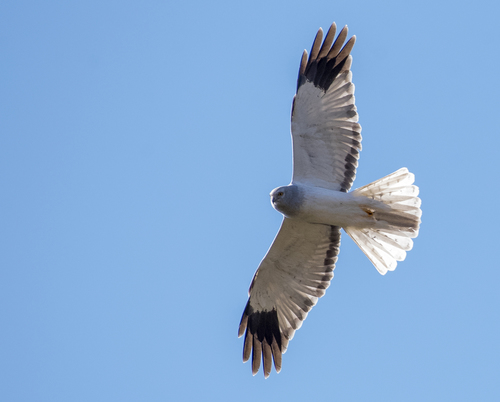 Hen Harrier
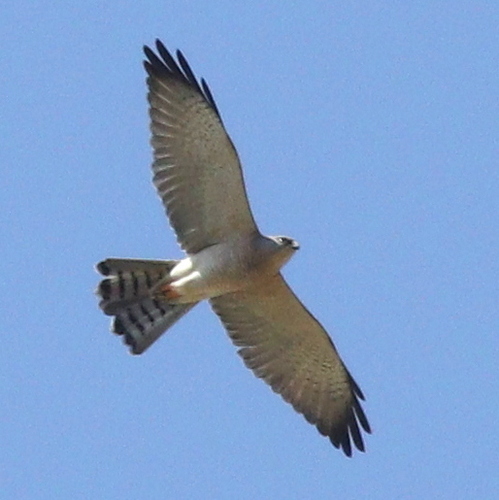 Levant Sparrowhawk
In short
The most reliable field mark to separate Hen Harrier from Levant Sparrowhawk is overall structure and flight style: Hen Harrier is much larger, longer-winged, and longer-tailed, with a characteristic low, buoyant flight on wings held in a shallow V, while Levant Sparrowhawk is compact, with short, broad, pointed wings and a more direct, accipiter-like flight. Juvenile and female Hen Harriers ('ringtails') have a distinctive white rump patch and brown, less distinctly barred plumage, whereas Levant Sparrowhawk juveniles show a dark throat line and lack the white rump. Adult males of both species are grey above, but the harrier is much paler below and has black wingtips, while the sparrowhawk is finely barred below and more falcon-like in shape. Size difference is substantial and should be apparent in the field.
Identification tips
- White rump patch (Hen Harrier only): Females and juveniles ('ringtails') always show a bold white rump in flight or perched, a key mark absent in Levant Sparrowhawk of any age or sex.
- Overall size and shape: Hen Harrier is much larger and longer-winged, with a long tail and rangy proportions. Levant Sparrowhawk is compact, short-winged, and more falcon-like. Use this especially when birds are seen together or with familiar species for scale.
- Flight style: Hen Harrier quarters low over open ground with wings in a shallow V, giving a buoyant, gliding impression. Levant Sparrowhawk flies with rapid flaps and short glides, often through or above trees, and rarely quarters open fields.
- Wing and tail shape: Harrier's wings are long and broad (especially in males), with a long, rounded tail. Levant Sparrowhawk has short, broad, pointed wings and a shorter, more squared tail. In flight, the sparrowhawk's wings look more swept back and pointed.
- Adult male plumage: Both are grey above, but Hen Harrier male is white below with black wingtips and a grey upper breast. Levant Sparrowhawk male is finely barred below (rufous and white), blue-grey above, and has a white throat with a dark central stripe (sometimes faint).
- Juvenile/female underparts: Hen Harrier 'ringtails' have buff underparts with brown barring (less distinct in juveniles), while Levant Sparrowhawk juveniles are dark-streaked below with a dark throat line. The harrier's barring is broader and the overall look is paler.
- No white rump (Levant Sparrowhawk): If the bird lacks a white rump, especially in a brownish or streaked individual, Hen Harrier is ruled out.
- Habitat context: In open country (marsh, moor, grassland), Hen Harrier is far more likely. In woodland, forest edge, or near water with trees, especially in southeastern Europe or the Middle East, Levant Sparrowhawk is more probable.
- Leg and cere color: Levant Sparrowhawk shows orangish-yellow legs and yellow cere in adults; these details are subtle and rarely diagnostic at distance.
- Head pattern: Levant Sparrowhawk (all ages) may show a dark throat line, especially obvious in juveniles and females. Hen Harrier lacks this feature.
- Vocalizations: If heard, Hen Harrier is notably vocal with distinctive calls during hunting and food passes; Levant Sparrowhawk is less likely to be heard in the open.
- Sexual dimorphism: Both species show female-larger dimorphism, but the difference is much more pronounced in Hen Harrier.
- Confusion with other raptors: Both can be confused with Eurasian Sparrowhawk or other harriers, but the white rump and flight style are the best initial clues.
- Migration context: Levant Sparrowhawk migrates in large numbers over the Middle East, often seen in flocks; Hen Harrier is usually solitary or in small groups.
- When in doubt: Focus on rump color, flight style, and habitat—these three together will resolve most field encounters between these species.
Size
Hen Harrier is a medium-sized raptor, much larger and longer-winged than Levant Sparrowhawk. Hen Harrier averages 41–52 cm in length with a 97–122 cm wingspan and a mean body mass of 436.5 g [wikidata]. Levant Sparrowhawk is distinctly smaller at 32–38 cm length and 65–75 cm wingspan, with a more compact build. The harrier's size and proportions are closer to a buzzard, while the sparrowhawk is more similar to a kestrel or small falcon. In direct comparison, the harrier will appear rangy and slim, the sparrowhawk stubby and agile.
Plumage
- Juveniles and females: Hen Harrier 'ringtails' (females and juveniles) are brown above with a strongly contrasting white rump patch, buff underparts with brown barring, and less distinct barring in juveniles. The rump patch is a key field mark in flight or perched. Levant Sparrowhawk juveniles are dark grey-brown above, with dark-streaked underparts and a dark throat line, but lack the white rump. Female Levant Sparrowhawk is slate-grey above, reddish barred below, and may show a dark throat line, but never has a white rump.
- Adult males: Both species' males are grey above, but Hen Harrier is much paler below with a white belly and black wingtips, while Levant Sparrowhawk male is pale below with fine rufous and white barring, blue-grey head, and a white throat bisected by a dark line (sometimes faint). The harrier's underparts are cleaner, and its upper breast is grey like the back.
- Wings and tail: Hen Harrier has long, broad wings with black tips (male) and a long tail; Levant Sparrowhawk has short, broad, pointed wings and a shorter, more squared tail. In flight, the harrier's wings are held in a shallow V, while the sparrowhawk's are more level and swept back.
Behaviour
Hen Harrier hunts by flying low over open ground with wings held in a shallow V, often gliding and circling close to the contours of the land. It is very vocal while hunting and relies on both sight and sound, thanks to its facial disc. Levant Sparrowhawk is adapted for maneuvering through trees, using rapid flapping, soaring, and gliding, especially during migration. Its flight is more direct and accipiter-like, and it is less likely to be seen quartering low over open ground.
Habitat
Hen Harrier breeds and hunts in open habitats: marshes, grasslands, moorland, bogs, and farmland across Eurasia. It avoids dense woodland. Levant Sparrowhawk breeds in open woodland, forest edges, or isolated clumps of trees, often near water, and is adapted for woodland hunting. In migration, Levant Sparrowhawk may be seen in a wider range of habitats but is rarely found in the open-country settings typical for Hen Harrier.
Voice
Hen Harrier is a vocal species, especially during hunting and food passes: females give a whistled 'piih-eh' and an alarm 'chit-it-it-it-it-et-it', while males call 'chek-chek-chek' or 'chuk-uk-uk-uk' in display. Levant Sparrowhawk's calls are not described in the provided notes, so vocalization is not a reliable separator in this context.