

Hawaiian Duck vs American Black Duck
Anas wyvilliana versus Anas rubripes
Play a quiz with Hawaiian Duck and American Black Duck
 Hawaiian Duck
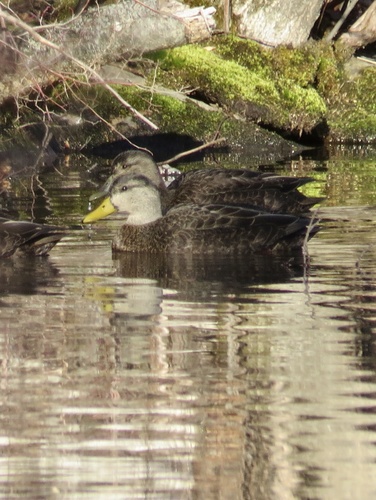 American Black Duck
In short
The most reliable field mark between Hawaiian Duck and American Black Duck is the speculum and its borders: Hawaiian Duck shows a green to blue speculum bordered by white on both edges, while American Black Duck has an iridescent violet-blue speculum with mostly black margins and rarely a white trailing edge. In flight, American Black Duck also shows strikingly pale underwing linings contrasting with a dark body, a feature not described for Hawaiian Duck. Size is a strong secondary clue: American Black Duck is nearly twice as heavy as Hawaiian Duck. Both species resemble female Mallards, but American Black Duck is overall darker and bulkier, while Hawaiian Duck is more mottled and variable, with more subtle differences between sexes. Hybridization with Mallard complicates Hawaiian Duck ID further, making some individuals nearly inseparable without genetic testing.
Identification tips
- Speculum Borders: Look for the color and borders of the speculum in flight or at rest. Hawaiian Duck has a green to blue speculum with white borders on both edges; American Black Duck has a violet-blue speculum with mostly black borders and rarely a white trailing edge. This is the most reliable mark for all ages and sexes.
- Underwing Pattern in Flight: American Black Duck shows bright white underwing linings that contrast sharply with its dark body and upperparts in flight. Hawaiian Duck does not show this strong contrast.
- Overall Darkness: American Black Duck is generally much darker overall, especially on the body, than Hawaiian Duck, which is more evenly mottled brown. This is especially true for adult males and females.
- Tail Pattern: Hawaiian Duck has a uniformly dark tail, while American Black Duck's tail is not described as contrasting, but Mallard (and sometimes hybrids) show a black-and-white tail, which Hawaiian Duck lacks.
- Bill Color: Male American Black Duck has a yellow bill, female a dull green with dark marks. Hawaiian Duck males have olive green bills, females dull orange with dark markings. These differences are subtle and overlap, so use with caution.
- Leg Color: Both species have orange feet, but American Black Duck's feet have dark webbing, while Hawaiian Duck's are orange to yellow-orange. This is a minor and variable mark.
- Juvenile Markings: Juvenile American Black Ducks are browner with streaked underparts, while Hawaiian Duck juveniles are not well described but expected to be mottled like adults. Use caution with young birds.
- Size and Structure: American Black Duck is nearly twice as heavy and appears bulkier and longer-billed than Hawaiian Duck. If seen side by side, this is obvious, but beware of overlap with large female Mallards or hybrids.
- Sexual Dimorphism: Both species show limited sexual dimorphism. Hawaiian Duck males are slightly darker on the head and neck, females paler with plainer backs. American Black Duck sexes are very similar, but males have a brighter yellow bill.
- Hybrid Pitfalls: Hawaiian Duck hybridizes extensively with Mallard, leading to birds with intermediate features. Some hybrids are visually inseparable from pure Hawaiian Ducks or female Mallards. American Black Duck also hybridizes with Mallard, but less so with Hawaiian Duck due to range separation.
- Geographic Range: Use location as a strong clue. Hawaiian Duck is only found in Hawaii; American Black Duck is only in eastern North America. Any 'black duck' in Hawaii is almost certainly Hawaiian Duck or a hybrid.
- Habitat Context: Hawaiian Duck is restricted to Hawaiian wetlands; American Black Duck prefers coastal and freshwater wetlands in its range. If you are outside Hawaii, American Black Duck is the likely species.
- Voice: Both species have Mallard-like quacks, with no reliable differences noted. Do not rely on voice for separation.
- Seasonal Variation: Both species have limited seasonal plumage change; eclipse males resemble females. Use structural and wing pattern marks year-round.
- Mallard Confusion: Both species closely resemble female Mallards. Always check speculum borders and overall darkness, and be aware of the high likelihood of hybrids, especially in Hawaii.
Size
American Black Duck is substantially larger and heavier, with an average body mass of 1181.5 g compared to Hawaiian Duck's 614.5 g. In the field, American Black Duck appears bulkier and longer-billed, while Hawaiian Duck is more compact and closer in size to a female Mallard. This size difference is especially apparent when both species are seen together, but less so if only one is present.
Plumage
-
Juvenile and Immature Birds: American Black Duck juveniles resemble adult females but are browner overall, with broken, narrow pale edges on the underparts giving a streaked look. Juvenile males have brownish-orange feet, females have browner feet and a greyish-green bill. Hawaiian Duck juveniles are not described in detail, but both sexes resemble female Mallards, with mottled brown plumage and variable tones.
-
Speculum and Wing Pattern: Hawaiian Duck of all ages shows a green to blue speculum bordered by white both in front and behind. American Black Duck's speculum is violet-blue with mostly black borders and only rarely a white trailing edge. In flight, American Black Duck has a striking white underwing lining contrasting with a dark underbody and upperparts; this is not reported for Hawaiian Duck.
-
Adult Plumage: American Black Duck is overall darker, especially on the body, with a brown head slightly paler than the body, and a dark crown and eye-stripe. Hawaiian Duck is more evenly mottled, with males slightly darker on the head and neck, and females paler with plainer backs. Hawaiian Duck has a dark tail, while American Black Duck's tail is not specifically described as contrasting.
-
Bill and Legs: Male American Black Duck has a yellow bill, female a dull green with dark marks; feet are orange with dark webbing. Hawaiian Duck males have olive green bills, females dull orange with dark markings; feet are orange to yellow-orange. These differences are subtle and variable.
Behaviour
Both species are dabbling ducks with similar feeding and swimming behaviors. No distinctive behavioral differences are described in the notes that would reliably separate them in the field.
Habitat
Hawaiian Duck is endemic to the Hawaiian Islands and found only in local wetlands there, while American Black Duck is native to eastern North America, breeding in coastal and freshwater wetlands from central Canada to the Atlantic and wintering in the east-central U.S. Thus, location is a major clue: any duck in Hawaii is far more likely to be Hawaiian Duck (or a hybrid), while American Black Duck is expected only in North America.
Voice
Both species produce quacks similar to Mallard, with females giving a loud, descending series of quacks. No distinctive vocal differences are described that would help separate them in the field.