

Hammond's Flycatcher vs Western Flycatcher
Empidonax hammondii versus Empidonax difficilis
Play a quiz with Hammond's Flycatcher and Western Flycatcher
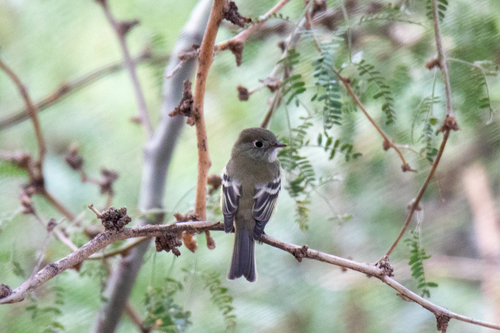 Hammond's Flycatcher
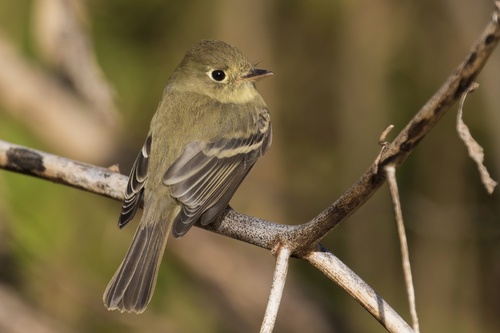 Western Flycatcher
In short
The most reliable way to separate Hammond's Flycatcher from Western Flycatcher is by voice, but subtle plumage and structural differences can help, especially when calls are not heard. Immature birds of both species look very similar, but Hammond's tends to have a grayer, less yellow-washed belly and a more compact, short-tailed, small-billed look. Western Flycatcher usually shows a brighter yellow belly and a teardrop-shaped eye ring, with a slightly longer, broader bill. Both species overlap in habitat and size, so careful attention to these subtle marks and any vocalizations is essential for confident identification.
Identification tips
- Juvenile/immature wing bars: Both species have broad, buffy wing bars when young, so this is not diagnostic, but check for overall color tones.
- Underpart color: Hammond's Flycatcher is generally whiter below with only a faint yellow wash on the belly sides, while Western Flycatcher is distinctly more yellowish below, especially on the belly. This is most apparent in good light and on adults.
- Eye ring shape: Hammond's has a round, conspicuous white eye ring; Western Flycatcher shows a teardrop-shaped eye ring that often looks pointed or extended below the eye. This can be subtle but is a helpful mark in close views.
- Bill size and shape: Hammond's has a smaller, shorter bill (females especially, which may be shorter and wider), while Western's bill is slightly longer and broader. This is best judged with experience or side-by-side comparison.
- Tail length and jizz: Hammond's appears more compact and short-tailed, while Western may look slightly longer-tailed and more elongated. This is a subtle difference and can be affected by posture.
- Upperpart color: Hammond's is grayish-olive above, Western is more olive or greenish-olive, but this can be affected by light and wear.
- Breast wash: Hammond's often shows a gray wash across the breast, while Western is more evenly yellowish below.
- Secondary edging (advanced): Western Flycatcher may show more buffy edging on the secondaries, but this is subtle and not always visible in the field.
- Vocalizations: If you hear the bird, use voice as your primary clue. Hammond's gives a sharp 'peek' and hoarse, multi-part song; Western gives a rapid 'pseet, ptsick, seet' series and distinctive 'pit pete' or 'tse-seet' calls.
- Habitat context: If the bird is in dense, mature coniferous forest high in the canopy, Hammond's is more likely; if near running water in mixed or deciduous woods, Western is more likely. However, both can occur in similar habitats.
- Perched vs. in flight: Both species often perch upright and sally for insects, but Hammond's may be seen higher in the canopy.
- Range overlap: Both species breed in western North America with overlapping ranges, so do not rely on range alone for ID.
- Sex and season: Females of Hammond's may have a slightly shorter, wider bill, but sex differences are subtle and not usually helpful in the field.
- Immature confusion: Immature birds of both species are very similar; focus on underpart color and eye ring shape, and try to obtain vocalizations for confirmation.
- When in doubt: If visual marks are ambiguous, prioritize voice and habitat context, but be honest about uncertainty—many Empidonax are best left unidentified without vocal evidence.
Size
Both Hammond's and Western Flycatchers are very close in size, with Hammond's measuring 12–14 cm in length and Western Flycatcher similar. Both have short tails and small bills, but Hammond's is typically a bit more compact overall. Weight and wingspan are nearly identical, so size alone is not a reliable separator in the field.
Plumage
Juvenile and immature birds of both species are extremely similar, with buffy wing bars and overall Empidonax patterning. Hammond's Flycatcher (adults and immatures) shows grayish-olive upperparts, a white eye ring, and whitish underparts with gray-washed breast and only a faint yellowish tinge on the belly sides. Immatures have broader, more buff wing bars but otherwise resemble adults. Western Flycatcher adults and immatures are more olive above and noticeably more yellow below, especially on the belly, and the eye ring is teardrop-shaped rather than round. DNA studies note buffy edging on the secondaries as a mark for Western, but this is subtle and not always visible in the field. Both have white wing bars and similar upperwing patterns, so focus on underpart color and eye ring shape for plumage clues.
Behaviour
Both species feed by sallying from perches to catch insects in flight (hawking) and by gleaning from foliage. Hammond's often perches higher in the canopy, while Western Flycatcher may be found lower and closer to water, but this is not always reliable. Both may hover briefly while foraging. Behavior is not a strong separator between these two.
Habitat
Both species breed in coniferous and mixed forests of western North America, often in overlapping areas. Hammond's is more strictly associated with mature coniferous forests, especially higher in the canopy, while Western Flycatcher is more flexible, using both coniferous and deciduous woods, often near running water and at lower elevations. However, habitat alone is not diagnostic due to overlap and variability.
Voice
Vocalizations are the most reliable field separator. Hammond's Flycatcher gives a hoarse, multi-part song (ssilit, greeep, silit, pweet) and a sharp 'peek' call. Western Flycatcher has a rapid series of notes (pseet, ptsick, seet), with Pacific birds giving a distinctive 'ptik' or 'ptsick' where the first syllable is higher-pitched. The typical call is a loud 'pit pete' or 'tse-seet', sometimes a rising 'tsweep' or slurred 'tseeweep'. If you hear the bird, use voice as your primary ID tool.