

Guira Cuckoo vs Greater Ani
Guira guira versus Crotophaga major
Play a quiz with Guira Cuckoo and Greater Ani
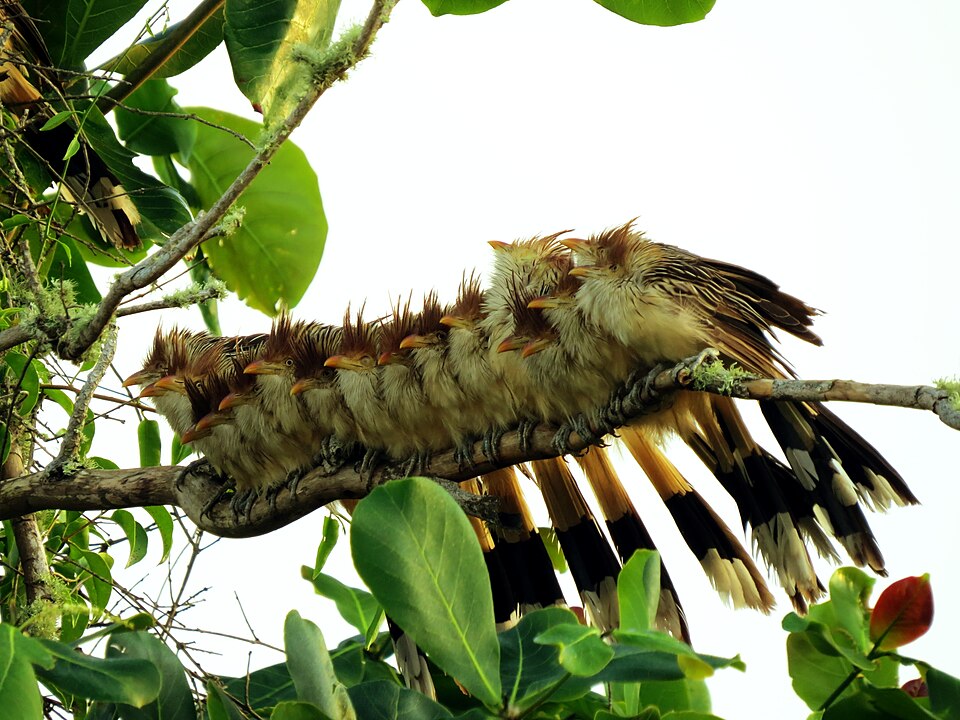 Guira Cuckoo
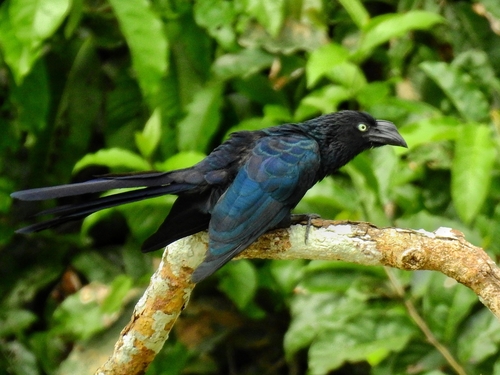 Greater Ani
In short
The most reliable way to separate Guira Cuckoo from Greater Ani is by overall coloration and bill shape: Guira Cuckoo is pale below with a streaked brown back, orange crest, and yellow-orange bill, while Greater Ani is glossy blue-black all over with a massive, ridged black bill and white (adult) or brown (immature) iris. Both are long-tailed, social cuckoos often seen in groups, but Guira Cuckoo's pale, streaky appearance and orange facial features stand out against the Greater Ani's uniform dark gloss. Juveniles of both species are similar to adults, so age is not a strong separator here. In flight or perched, focus on the bill, iris, and body color for quick ID.
Identification tips
- Bill shape and color: Guira Cuckoo has a slender, yellow to orange bill; Greater Ani has a massive, ridged black bill. This is often the quickest separator, especially at close range.
- Overall coloration: Guira Cuckoo is pale below with white-buff underparts and a streaked brown back; Greater Ani is glossy blue-black all over, with no pale areas.
- Crest: Guira Cuckoo shows a prominent orange-rufous crest, visible even at a distance; Greater Ani lacks any crest and has a smooth head profile.
- Eye color: Adult Guira Cuckoo has a yellow to orange iris and a thin yellow eye-ring; adult Greater Ani has a striking white iris (immatures brown). This is a subtle but reliable mark if seen well.
- Tail pattern: Guira Cuckoo's tail is dark brown with a distinct white tip; Greater Ani's tail is uniformly dark and lacks a white tip.
- Facial color: Guira Cuckoo's face is pale with orange-yellow tones; Greater Ani's face is dark and glossy, matching the rest of the body.
- Plumage in juveniles: Both species' juveniles resemble adults, so age-related confusion is minimal. Focus on structural and color differences instead.
- Flight and posture: Both species are weak fliers and often glide or hop between perches. Guira Cuckoo may look slightly more upright and show its crest when perched.
- Group behavior: Both are social, but Guira Cuckoo is more likely to be seen in very large, noisy flocks, sometimes with other open-country birds.
- Habitat: Guira Cuckoo prefers open, semi-open, or even urban habitats; Greater Ani is more tied to wet, forested, or riparian areas.
- Vocalizations: Listen for Guira Cuckoo's long, shrill, wailing call versus Greater Ani's croaking or gobbling notes.
- Odor: Guira Cuckoo is noted for a strong, pungent smell, though this is rarely useful in the field.
- Size: Greater Ani is slightly larger and heavier, but this is rarely diagnostic unless both are seen together.
- Perched silhouette: Guira Cuckoo's crest and pale face stand out; Greater Ani appears sleeker and uniformly dark.
- Pitfalls: In poor light or at a distance, Guira Cuckoo can appear darker, and Greater Ani's gloss can be missed—always check bill shape and face color if possible.
Size
Both species are large, long-tailed cuckoos, but Greater Ani is slightly heavier (148.5 g vs. 134.0 g) and longer (about 46 cm vs. 34 cm). In the field, this difference is subtle and not always reliable for separation, especially at a distance or in mixed flocks. Both can appear lanky and elongated, but Greater Ani may look a bit bulkier overall.
Plumage
Guira Cuckoo of all ages shows a combination of dark brown upperparts streaked with white, a whitish-buff throat, breast, underparts, and rump, and a prominent orange-rufous crest. The tail is dark brown with a white tip. The bill and eye-ring are yellow to orange, and the eye itself is yellow to orange. Juveniles look much like adults, so age-related plumage differences are minimal. In contrast, Greater Ani is glossy blue-black all over, with no pale or streaked areas, and has a massive, ridged black bill. Adults have a striking white iris, while immatures have a brown iris. The tail is also long and dark, but lacks the white tip of Guira Cuckoo. There are no age-specific upperwing or flight pattern marks described for either species; both look similar in flight, relying on overall color and structure for separation.
Behaviour
Both species are highly social and often seen in groups. Guira Cuckoo is frequently found in noisy flocks, sometimes up to 18 birds, and is often seen gliding or hopping between perches, vocalizing loudly. It forages both in trees and on the ground. Greater Ani is also gregarious, typically in small groups, and is known for its communal nesting. Both are not strong fliers and prefer short flights or gliding. Guira Cuckoo is more likely to be seen in open areas or even suburban parks, while Greater Ani tends to stick to denser, wetter habitats.
Habitat
Guira Cuckoo is widespread in open and semi-open habitats, including savannas, pastures, and even suburban gardens and parks, especially in eastern and southeastern South America. Its range has expanded with deforestation. Greater Ani is found in tropical South America, often near water, such as river edges, wetlands, and gallery forests. If you see a large, social cuckoo in a dry, open field or urban park, Guira Cuckoo is more likely; in dense, wet, or riparian areas, Greater Ani is favored.
Voice
Guira Cuckoo's call is long, shrill, and wailing—somewhere between a whistle and a wail—and is quite distinctive. Greater Ani produces croaking and turkey-like gobbling calls ("kro-koro"). If you hear a piercing, drawn-out whistle, suspect Guira Cuckoo; if the call is more guttural or gobbling, think Greater Ani.