

Greylag Goose vs Taiga Bean Goose
Anser anser versus Anser fabalis
Play a quiz with Greylag Goose and Taiga Bean Goose
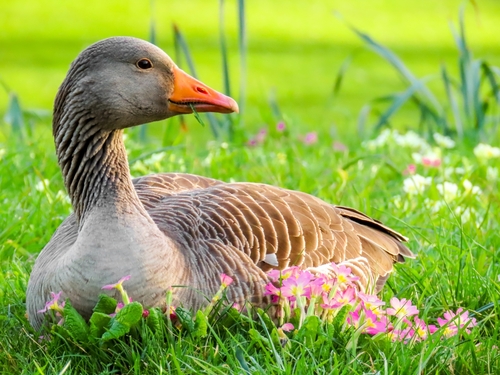 Greylag Goose
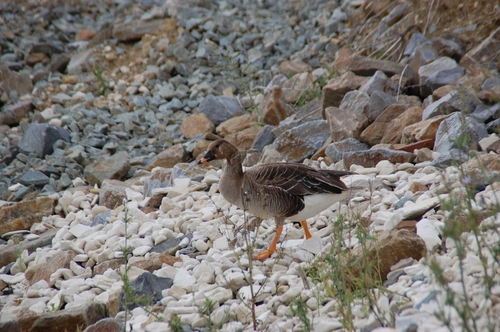 Taiga Bean Goose
In short
The most reliable field mark between Greylag Goose and Taiga Bean Goose is the bill and leg color: Greylag shows a bright orange bill and pink legs, while Taiga Bean Goose has a black-based bill with an orange band and bright orange legs. In flight or at rest, Greylag's pale forewing and rump stand out, contrasting with Taiga Bean's generally darker upperwing. Juvenile Greylags lack the black belly spotting of adults but still show pale wing coverts, while Taiga Bean Goose always has dark brown upperwing-coverts with narrow white fringes. Both are large, bulky geese, but Greylag is slightly heavier and paler overall. Careful attention to bill pattern, leg color, and wing tone is key, especially in mixed flocks or poor light.
Identification tips
- Bill color and pattern: Greylag Goose has a plain orange bill with no black; Taiga Bean Goose shows a black base and tip with an orange band across the middle. This is diagnostic at close range for all ages and seasons.
- Leg color: Greylag has pink legs, while Taiga Bean Goose has bright orange legs and feet. Useful when birds are standing or walking.
- Upperwing in flight (all ages): Greylag shows a pale grey forewing and rump, with light-colored wing coverts contrasting against darker flight feathers. Taiga Bean Goose has dark brown upperwing-coverts with only narrow white fringes, giving a more uniform and dusky wing appearance.
- Juvenile belly and breast: Juvenile Greylags lack the black spotting on the breast and belly seen in adults, but still show the pale wing and rump. Juvenile Taiga Bean Geese are always darker below, lacking the pale underparts of Greylag.
- Neck pattern: Adult Greylag shows a distinctive 'concertina' or folded look to the neck feathers, especially when alert. Taiga Bean's neck is smoother and more uniform.
- Overall plumage tone: Greylag is paler, with mottled grey and white, and a paler breast and belly. Taiga Bean Goose is darker brown overall, with less contrast between body and wing.
- White flank line: Greylag often shows a white line bordering the upper flanks, especially when swimming or at rest. This is absent or much less obvious in Taiga Bean Goose.
- Size and structure: Greylag is bulkier and heavier, with a thicker neck and larger head. Taiga Bean Goose is slightly slimmer and longer-necked, but size is not always reliable due to overlap.
- Habitat context: In Western Europe, Greylag is much more likely in parks, farmland, and urban lakes. Taiga Bean Goose is a scarce winter visitor, usually in wilder, less disturbed wetlands or fields.
- Flock composition: Greylag often associates with domestic geese and can be very tame. Taiga Bean Goose is shyer and less likely to be found in mixed domestic flocks.
- Vocalization: Greylag's call is a deep, nasal cackle, while Taiga Bean Goose gives a sharper honk. Use with caution, as calls overlap and are variable.
- Breast and belly spots: Adult Greylag often shows black spotting on the breast and belly; Taiga Bean Goose lacks this feature.
- Wing coverts (perched or preening): Greylag's wing coverts are light and silvery, contrasting with the rest of the wing. Taiga Bean's are dark brown with only narrow pale fringes.
- Bill structure: Both have fairly long bills, but Greylag's is stouter and more triangular in profile, while Taiga Bean's is slightly longer and more tapered, though this is subtle.
- When in doubt: Focus on bill and leg color first, then look for the pale forewing and rump in flight for Greylag, or the overall darker, more uniform wing of Taiga Bean Goose.
Size
Greylag Goose is the heavier of the two, averaging about 3465 g versus Taiga Bean Goose's 3020 g. Both are large geese, but Greylag is typically a bit bulkier and longer (74–91 cm vs. Taiga Bean's 68–90 cm), though there is overlap. In the field, Greylag often looks more robust and thick-necked, while Taiga Bean can appear slightly slimmer and longer-necked, especially when alert. However, size alone is unreliable due to overlap and variation by sex and subspecies.
Plumage
-
Juvenile/immature birds: Juvenile Greylags lack the black belly spots of adults but still show a pale grey forewing and rump, and their wing coverts are light with contrasting darker flight feathers. Juvenile Taiga Bean Geese have dark brown upperwing-coverts with narrow white fringes, lacking the pale, silvery look of Greylag's upperwing. This upperwing contrast is often visible in flight or when stretching wings on the ground.
-
Adults: Greylag adults have a generally paler, mottled and barred grey and white plumage, with a pale forewing and rump, and a white line bordering the upper flanks. Their neck shows a 'concertina' pattern of feather folds. Taiga Bean Goose adults are overall darker brown, with dark brown upperwing-coverts and only narrow white fringes, giving a more uniform and dusky wing appearance. Both species have some pale feather fringes, but Greylag's are broader and more obvious.
-
Bill and legs: Greylag's bill is orange and unmarked, legs are pink. Taiga Bean's bill is black at base and tip with an orange band, legs and feet are bright orange. This is often the quickest way to separate them at close range.
Behaviour
Both species are social and often seen in flocks, sometimes mixed with other Anser geese. Greylag tends to be more approachable and is often found in parks and farmland, sometimes associating with domestic geese. Taiga Bean Goose is shyer and more likely to be found in wilder, less disturbed habitats, especially during migration and winter. Both graze on grasses and crops, but Greylag is more likely to be seen in urban or semi-urban settings.
Habitat
Greylag Goose is widespread across the Palearctic, breeding in a variety of wetland habitats including lakes, marshes, and even urban parks. It is more likely to be encountered in lowland farmland, reservoirs, and human-altered landscapes. Taiga Bean Goose breeds in northern Europe and Asia, preferring taiga and wetland mosaics, and winters further south in more remote wetlands and agricultural fields. In Western Europe, Greylag is much more common and likely in most lowland habitats, while Taiga Bean Goose is a scarcer winter visitor, usually in less disturbed areas.
Voice
Greylag Goose has a loud, cackling call, often described as "aahng-ung-ung," similar to domestic geese, and flocks can sound like baying hounds. Taiga Bean Goose gives a loud honking, but field separation by voice is difficult unless very familiar with both. Greylag's calls are generally deeper and more nasal, while Bean Goose's honks are sharper, but overlap and individual variation make this a supporting, not primary, field mark.