

Greylag Goose vs Pink-footed Goose
Anser anser versus Anser brachyrhynchus
Play a quiz with Greylag Goose and Pink-footed Goose
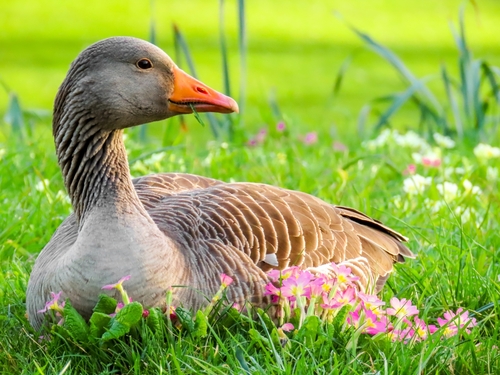 Greylag Goose
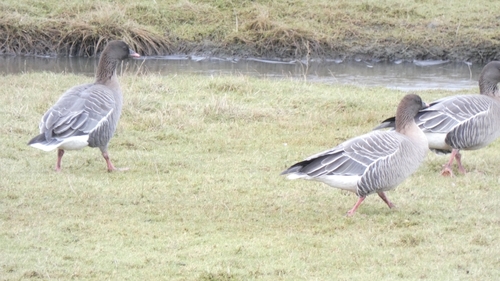 Pink-footed Goose
In short
The most reliable field mark between Greylag Goose and Pink-footed Goose is the bill and leg color: Greylag has a large, deep orange bill and pink legs, while Pink-footed shows a shorter bill with a distinctive pink band and pink feet. In flight or at rest, Greylag is noticeably bulkier and paler, with a pale forewing and rump, while Pink-footed is smaller, darker, and more compact, with a richer brown head and neck. Juvenile Greylags lack the black belly spotting of adults and have greyer legs, but still show a relatively hefty structure and pale wing coverts. Pink-footed Goose, even as a juvenile, maintains its darker, more uniform plumage and the characteristic pink feet. These differences are visible year-round and in all plumages, making them reliable for field separation.
Identification tips
- Bill color and shape: Greylag Goose has a large, deep orange bill that is broad at the base and blunt-tipped. Pink-footed Goose has a much shorter bill with a distinctive pink band in the middle, black at the base and tip. This is visible at close to moderate range and is reliable in all ages and seasons.
- Leg and foot color: Both species have pink legs, but Pink-footed's feet are a brighter, bubblegum pink and stand out on a smaller, darker bird. Greylag's legs are pink but the bird is much larger and paler overall.
- Overall size and structure: Greylag is much larger, bulkier, and longer-necked. Pink-footed is noticeably smaller and more compact, with a shorter neck and a more delicate build. This is especially clear when both species are together but can be judged with experience on lone birds.
- Plumage tone: Greylag is paler, with a greyish-brown body, paler breast and belly (with black spotting in adults), and a pale grey forewing and rump. Pink-footed is darker, with a mid-grey-brown body, richer brown head and neck, and a white rump and vent.
- Wing pattern in flight: Greylag shows a pale grey forewing and rump, creating a strong contrast with darker flight feathers. Pink-footed's upperwing coverts are pale bluish-grey but less contrasting, and the overall wing looks darker and more uniform.
- Tail pattern: Pink-footed has a grey tail with a broad white tip, which can be seen in flight or when preening. Greylag's tail is less distinctly marked, blending more with the rump.
- Neck pattern: Adult Greylag shows a 'concertina' pattern of feather folds on the neck, which is absent in Pink-footed. This is subtle but visible at close range.
- Belly spotting: Adult Greylags have variable black spotting on the breast and belly; juveniles lack this. Pink-footed Goose does not show this spotting at any age.
- Juvenile differences: Juvenile Greylags are paler, lack black belly spots, and have greyer legs but still show the large size and pale wing pattern. Juvenile Pink-footed are darker, with the same bill and foot color as adults.
- Head and neck color: Pink-footed has a richer, darker brown head and neck, contrasting with the paler body. Greylag's head is only slightly darker than the body.
- Voice: Listen for deeper, cackling calls from Greylag versus higher-pitched, shrill honking from Pink-footed, especially in flight or large flocks.
- Flock structure: Pink-footed often forms very large, tightly packed flocks in winter, especially in the UK and northwest Europe. Greylag flocks are often looser and the birds appear bulkier.
- Habitat context: In the UK and northwest Europe, Pink-footed is strictly migratory and appears in large numbers in winter. Greylag may be present year-round, especially in more southerly or lowland areas.
- Pitfalls: Beware of domestic or hybrid Greylags, which may show variable bill and leg color and can be even bulkier. Always check for the combination of bill size, leg color, and overall structure.
- Seasonal context: Both species can be seen together in wintering areas, but Pink-footed is absent as a breeder in most of Europe outside Iceland and Greenland, while Greylag breeds widely across Europe.
Size
Greylag Goose is significantly larger and heavier, averaging about 3465 g compared to Pink-footed Goose's 2505 g [wikidata]. Greylag measures 74–91 cm in length, while Pink-footed is 60–75 cm. In the field, Greylag appears bulkier, with a longer, thicker neck and a more massive body. Pink-footed is more compact, with a shorter neck and a lighter build, which is especially noticeable when the two species are side by side.
Plumage
Juvenile Greylag Geese lack the black spotting on the breast and belly seen in adults and have greyish legs, but still show a pale grey forewing and rump in flight, and a generally paler, more mottled appearance overall. Their wing coverts are light, contrasting with darker flight feathers. Pink-footed Goose, regardless of age, is darker and more uniform, with a mid-grey-brown body, richer brown head and neck, and a white rump and vent. The upper wing-coverts are pale bluish-grey, but the overall effect is darker and less contrasting than Greylag. Pink-footed's tail is grey with a broad white tip, while Greylag's tail is less distinctly marked. Both species have pale upperwing coverts, but Greylag's are more strikingly pale and contrast with the rest of the wing. The bill of Greylag is orange and large, while Pink-footed's is short with a pink band and black base/tip. Pink feet are diagnostic for Pink-footed, while Greylag's are pink but the bird is much larger and paler.
Behaviour
Both species are social and often seen in flocks, but Greylag tends to form larger, more sedentary groups, especially in breeding areas. Pink-footed Goose is highly migratory and forms large, noisy flocks in wintering areas, often grazing in agricultural fields. Greylag's flight is slower and heavier, matching its bulkier build, while Pink-footed appears more agile and compact in flight. Both species graze on land, but Pink-footed is more likely to be seen in very large, tightly packed flocks during migration and winter.
Habitat
Greylag Goose breeds across much of northern and central Europe and is often found in wetlands, lakes, and agricultural land. Pink-footed Goose breeds farther north, in Greenland, Iceland, and Svalbard, and winters mainly in northwest Europe, especially the UK, Ireland, the Netherlands, and Denmark. In winter, both species may overlap in lowland farmland and wetlands, but Pink-footed is more strictly migratory and forms larger, more concentrated flocks in traditional wintering areas. Greylag is more likely to be resident or only locally migratory in parts of its range.
Voice
Greylag Goose has a loud, deep cackling call, reminiscent of domestic geese, often described as 'aahng-ung-ung.' Flocks can sound like baying hounds. Pink-footed Goose produces a medley of high-pitched honking calls, especially in flight, and large flocks can be almost deafening. The difference in pitch and tone is useful: Greylag is deeper and more resonant, Pink-footed is higher-pitched and more shrill.