

Greylag Goose vs Brent Goose
Anser anser versus Branta bernicla
Play a quiz with Greylag Goose and Brent Goose
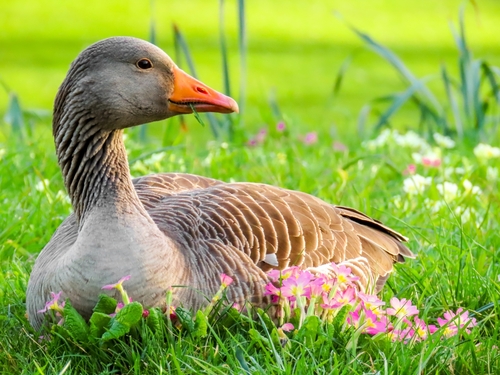 Greylag Goose
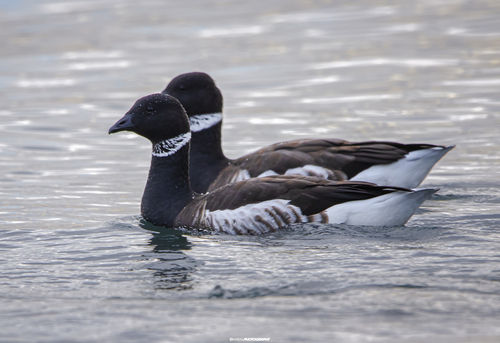 Brent Goose
In short
The most reliable field mark to separate Greylag Goose from Brent Goose is overall size and structure: Greylag is a much larger, bulkier bird with a hefty orange bill and pink legs, while Brent Goose is compact, short-necked, and dark with a stubby black bill and black legs. In flight or at rest, Greylag shows pale grey forewings and rump, contrasting with its darker flight feathers, whereas Brent Goose (all forms) is much darker overall, with a distinctive black head and neck and small white neck patches. Juvenile Greylag lacks the black belly spotting of adults but remains pale and large; Brent Goose juveniles are similar to adults but always much darker and more compact. If you see a goose with a pale, orange-billed face and pink legs, it's a Greylag; a small, dark, black-billed goose with a white undertail is a Brent.
Identification tips
- Size and bulk: Greylag Goose is much larger and heavier than Brent Goose. Even at a distance, Greylag's size is obvious, especially if both species are present.
- Bill color and shape: Greylag has a large, deep orange bill (sometimes pinkish), while Brent has a short, stubby black bill. Bill color is visible even at moderate range.
- Leg color: Greylag's legs are pink; Brent's are black. Leg color is most useful when birds are on land and unobscured.
- Neck and head pattern: Greylag has a plain grey-brown head and neck with a 'concertina' feather pattern; Brent has a black head and neck with a small white patch on each side (sometimes forming a partial collar in some subspecies).
- Body color: Greylag is pale grey-brown with a paler belly and often black belly spots (adults); Brent is much darker, with sooty-brown upperparts and either dark or pale belly depending on subspecies, but always darker than Greylag.
- Under-tail and tail: Brent Goose always shows a pure white under-tail and a very short, black tail. Greylag's tail is longer and pale with a white rump.
- Flight pattern: In flight, Greylag shows pale grey forewings and rump contrasting with darker flight feathers; Brent is uniformly dark above with a white under-tail and short black tail.
- Juvenile differences: Juvenile Greylag lacks black belly spots and has greyish legs, but remains pale and large; juvenile Brent is always dark, with the same white undertail and neck patch as adults.
- Habitat context: Inland, especially on freshwater, Greylag is much more likely. On saltmarsh or tidal flats, especially in winter, Brent is expected.
- Group structure: Greylag often forms loose, noisy flocks or pairs; Brent forms tight, cohesive flocks, especially in flight.
- Voice: Greylag's loud, nasal honking is distinctive and farmyard-like; Brent is quieter, with softer, grating calls.
- Jizz: Greylag appears heavy, long-necked, and slow-moving; Brent is compact, short-necked, and quick-moving.
- White flank line: Greylag shows a white line along the upper flanks, visible at rest; Brent lacks this feature.
- Subspecies variation: Brent Goose subspecies vary in belly color, but all are much darker than Greylag and share the black head/neck and white neck patch.
- When marks fail: In poor light or at great distance, rely on size, bill color, and overall darkness; Greylag is always larger and paler, Brent always smaller and darker.
Size
Greylag Goose is substantially larger: 74–91 cm in length and averaging 3464.5 g in mass [wikidata], making it the largest wild goose in much of its range. Brent Goose is much smaller, at 55–66 cm in length and 0.88–2.2 kg in mass [wikipedia]. In the field, Greylag appears massive and heavy-bodied, while Brent is compact and light, with a notably short neck and tail. This size gap is obvious even at distance or in mixed flocks.
Plumage
-
Juvenile/immature comparison: Juvenile Greylag Goose lacks the black speckling on the breast and belly seen in adults, but remains pale grey-brown overall with a pale forewing and rump, and greyish legs. Juvenile Brent Goose closely resembles adults, always showing a dark sooty-brown body, black head and neck, and white undertail, with a small white neck patch (extent varies by subspecies).
-
Adult comparison: Adult Greylag is pale grey-brown with a paler breast and belly, variable black belly spots, pale grey forewing and rump (conspicuous in flight), and a white line along the upper flanks. The head is slightly darker, and the neck shows a 'concertina' pattern of feather folds. Brent Goose adults are much darker: black head and neck with a small white neck patch, dark sooty-brown upperparts, and either dark or pale belly depending on subspecies. The under-tail is always pure white, and the tail is very short and black. The contrast between the black neck and white neck patch is unique to Brent.
-
In flight: Greylag shows pale forewings and rump, contrasting with dark flight feathers; Brent is uniformly dark above with a striking white undertail and short black tail.
Behaviour
Greylag Geese are often seen grazing in open fields or swimming in lakes and marshes, usually in pairs or family groups, sometimes in large flocks. They tend to be more approachable and less wary than Brent Geese. Brent Geese are typically coastal in winter, feeding on saltmarshes, estuaries, and tidal flats, often in tight, cohesive flocks. Their flight is more agile and compact, matching their smaller size. Greylag's flight is heavy and direct, with slow, deep wingbeats, while Brent's is quicker and more buoyant.
Habitat
Greylag Goose favors inland wetlands, lakes, rivers, and agricultural fields, especially during the breeding season, but can also be found in urban parks. Brent Goose is strongly associated with coastal habitats in winter—saltmarshes, estuaries, and tidal flats—and breeds on high-Arctic tundra. If you see a goose inland on a freshwater lake or field, Greylag is far more likely; a small, dark goose on a tidal estuary is likely Brent.
Voice
Greylag Goose gives a loud, nasal cackling call ('aahng-ung-ung'), often compared to domestic geese, and flocks can sound like baying hounds. Brent Goose is generally quieter, with softer, grating or guttural calls, but these are less distinctive and less likely to be heard at a distance. If you hear a classic farmyard goose honk, it's Greylag.