
Motmot

Grey Teal vs Crested Pigeon

Anas gracilis versus Ocyphaps lophotes

Play a quiz with Grey Teal and Crested Pigeon
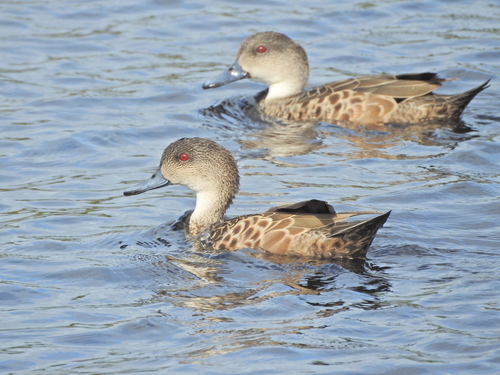
Grey Teal (Anas gracilis) Grey Teal
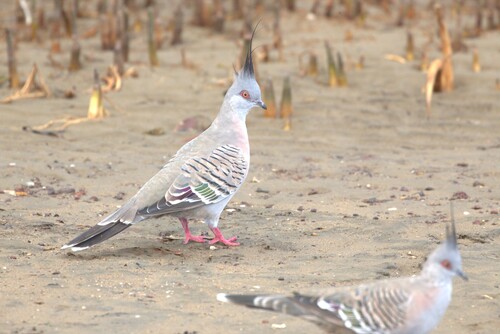
Crested Pigeon (Ocyphaps lophotes) Crested Pigeon

Media

Loading…

In short

The most reliable field mark to separate Grey Teal from Crested Pigeon is overall structure and jizz: Grey Teal is a compact, short-necked dabbling duck with a blue-grey bill and webbed feet, while Crested Pigeon is a slim, long-tailed pigeon with a prominent black crest and orange eye-ring. In flight, Grey Teal shows white and green flashes on the wing, whereas Crested Pigeon has black-barred wings with iridescent bronzing and produces a distinctive whistling sound with its wings. Juvenile Grey Teal can be paler with dull brown eyes, but never show a crest or the pigeon’s wing pattern. Both species can be seen in flocks and open habitats, but their body shape, flight style, and head features are unmistakably different.

Identification tips

  1. Crest: Only Crested Pigeon has a long, slender black crest on the head, held erect both at rest and in motion. Grey Teal never shows a crest at any age.
  2. Bill shape and color: Grey Teal has a blue-grey, flat, spatulate bill typical of ducks; Crested Pigeon has a short, slender, pigeon-like bill.
  3. Eye color: Adult Grey Teal has a crimson iris, especially in males; juveniles have a dull brown eye. Crested Pigeon has a bright orange periorbital ring, visible in all ages.
  4. Wing pattern in flight: Grey Teal (all ages) shows white and green flashes on the wing; Crested Pigeon has black-barred wings with iridescent bronzing (adults) or duller (immatures), but never white/green flashes.
  5. Head pattern: Grey Teal has a plain or slightly streaked face with a dark crown and pale chin/throat/cheek; Crested Pigeon has a uniform grey head with the obvious crest and orange eye-ring.
  6. Tail shape: Crested Pigeon has a long, tapered tail, often cocked upwards when landing; Grey Teal has a short, rounded tail typical of ducks.
  7. Legs and feet: Grey Teal has webbed feet for swimming; Crested Pigeon has unwebbed feet for walking/running.
  8. Body shape and posture: Grey Teal is compact, squat, and sits low in the water; Crested Pigeon is slim, upright, and walks/runs on land.
  9. Flight style: Grey Teal flies low over water with rapid wingbeats; Crested Pigeon takes off with a loud wing whistle and flies directly, often over land.
  10. Vocalizations: Listen for the teal’s quacks and preeps, especially at night; Crested Pigeon’s most obvious sound is the whistling of its wings on takeoff, not a vocal call.
  11. Juvenile confusion: Young Grey Teal are paler, especially on the head, and have dull brown eyes, but still lack any crest or pigeon-like features. Immature Crested Pigeon lacks bronzed wing iridescence but always shows the crest and barred wings.
  12. Habitat context: If the bird is swimming or dabbling on open water, it is a Grey Teal. If it is walking or running on the ground, especially away from water, it is a Crested Pigeon.
  13. Sex and age: Both species have similar plumage in both sexes; only age-related differences are relevant (eye color in Grey Teal, wing iridescence in Crested Pigeon).
  14. Flock behavior: Both can be gregarious, but mixed flocks are unlikely. Watch for context: ducks flock on water, pigeons on land.
  15. Common pitfalls: In poor light, a Grey Teal’s plain face and lack of crest are key; never mistake a pigeon’s upright, crested silhouette for a duck, even if plumage is dull or the bird is at a distance.

Size

Grey Teal is a medium-sized duck, generally smaller and more compact than most domestic ducks, but with a chunky body and relatively short tail. Crested Pigeon is slightly longer in body length (30–34 cm per [wikipedia]), but much slimmer, with a long, tapered tail and a more upright posture. The pigeon’s proportions are more elongated and delicate compared to the teal’s rounded, squat silhouette. Both species are similar in length, but the duck is bulkier and heavier-bodied, while the pigeon is slender and light.

Plumage

Juvenile Grey Teal are paler overall, especially on the head, and have a dull brown eye (not the crimson iris of adults). Their wings in all ages show white and green flashes when spread, but otherwise the plumage is a mottled brown with a plain or slightly streaked face, a dark crown, and a pale chin/throat/cheek. Crested Pigeon immatures are duller than adults and lack the bronzed iridescence on the wings, but still show black wing stripes and the characteristic crest. Adults have grey plumage tinged with brown, pink, and green, a bright orange eye-ring, and iridescent brown, purple, blue, and green on the primaries. The pigeon’s wing pattern is always barred and bronzed, never showing the duck’s white/green flashes. No age or sex of either species can be confused for the other in terms of head pattern: only the pigeon has a crest and orange eye-ring; only the teal has a plain head and (in adults) a crimson iris.

Behaviour

Grey Teal are dabbling ducks, often seen swimming, feeding on the water, or loafing at the water’s edge. They are highly gregarious and may form large flocks, especially after breeding or during moult. Flight is direct and low over water, with rapid wingbeats. Crested Pigeons are terrestrial foragers, often seen walking or running on the ground with their crest erect. When flushed, they take off with a rapid, whistling wingbeat and fly in a strong, direct manner, often landing with their tail cocked upward. Both species can be social, but their movement and posture are entirely different: ducks swim and dabble, pigeons walk and run.

Habitat

Grey Teal are found in open wetlands, lakes, and marshes, usually near freshwater but sometimes at estuaries after breeding. They are widespread in Australia and New Zealand. Crested Pigeon prefers lightly wooded grasslands, rural and urban parks, gardens, and farmlands, often away from water. Their range has expanded with agriculture, and they are now common in many open, human-modified landscapes. While both can be seen in open country, only the teal is routinely found on water.

Voice

Grey Teal are vocal, especially at night: males give a soft 'preep', females a loud quack. Crested Pigeon is usually silent when flushed, but their wings make a distinctive whistling sound on takeoff due to a modified primary feather. During courtship, males give a soft hooting call while bobbing. In the field, the teal’s quacks and preeps are very different from the pigeon’s mechanical wing whistle.

Submit a better description

Use the same sections as the comparison. Your text is published immediately.

The most reliable field mark to separate Grey Teal from Crested Pigeon is overall structure and jizz: Grey Teal is a compact, short-necked dabbling duck with a blue-grey bill and webbed feet, while Crested Pigeon is a slim, long-tailed pigeon with a prominent black crest and orange eye-ring. In flight, Grey Teal shows white and green flashes on the wing, whereas Crested Pigeon has black-barred wings with iridescent bronzing and produces a distinctive whistling sound with its wings. Juvenile Grey Teal can be paler with dull brown eyes, but never show a crest or the pigeon’s wing pattern. Both species can be seen in flocks and open habitats, but their body shape, flight style, and head features are unmistakably different.

  1. Crest: Only Crested Pigeon has a long, slender black crest on the head, held erect both at rest and in motion. Grey Teal never shows a crest at any age.
  2. Bill shape and color: Grey Teal has a blue-grey, flat, spatulate bill typical of ducks; Crested Pigeon has a short, slender, pigeon-like bill.
  3. Eye color: Adult Grey Teal has a crimson iris, especially in males; juveniles have a dull brown eye. Crested Pigeon has a bright orange periorbital ring, visible in all ages.
  4. Wing pattern in flight: Grey Teal (all ages) shows white and green flashes on the wing; Crested Pigeon has black-barred wings with iridescent bronzing (adults) or duller (immatures), but never white/green flashes.
  5. Head pattern: Grey Teal has a plain or slightly streaked face with a dark crown and pale chin/throat/cheek; Crested Pigeon has a uniform grey head with the obvious crest and orange eye-ring.
  6. Tail shape: Crested Pigeon has a long, tapered tail, often cocked upwards when landing; Grey Teal has a short, rounded tail typical of ducks.
  7. Legs and feet: Grey Teal has webbed feet for swimming; Crested Pigeon has unwebbed feet for walking/running.
  8. Body shape and posture: Grey Teal is compact, squat, and sits low in the water; Crested Pigeon is slim, upright, and walks/runs on land.
  9. Flight style: Grey Teal flies low over water with rapid wingbeats; Crested Pigeon takes off with a loud wing whistle and flies directly, often over land.
  10. Vocalizations: Listen for the teal’s quacks and preeps, especially at night; Crested Pigeon’s most obvious sound is the whistling of its wings on takeoff, not a vocal call.
  11. Juvenile confusion: Young Grey Teal are paler, especially on the head, and have dull brown eyes, but still lack any crest or pigeon-like features. Immature Crested Pigeon lacks bronzed wing iridescence but always shows the crest and barred wings.
  12. Habitat context: If the bird is swimming or dabbling on open water, it is a Grey Teal. If it is walking or running on the ground, especially away from water, it is a Crested Pigeon.
  13. Sex and age: Both species have similar plumage in both sexes; only age-related differences are relevant (eye color in Grey Teal, wing iridescence in Crested Pigeon).
  14. Flock behavior: Both can be gregarious, but mixed flocks are unlikely. Watch for context: ducks flock on water, pigeons on land.
  15. Common pitfalls: In poor light, a Grey Teal’s plain face and lack of crest are key; never mistake a pigeon’s upright, crested silhouette for a duck, even if plumage is dull or the bird is at a distance.

Grey Teal is a medium-sized duck, generally smaller and more compact than most domestic ducks, but with a chunky body and relatively short tail. Crested Pigeon is slightly longer in body length (30–34 cm per [wikipedia]), but much slimmer, with a long, tapered tail and a more upright posture. The pigeon’s proportions are more elongated and delicate compared to the teal’s rounded, squat silhouette. Both species are similar in length, but the duck is bulkier and heavier-bodied, while the pigeon is slender and light.

Juvenile Grey Teal are paler overall, especially on the head, and have a dull brown eye (not the crimson iris of adults). Their wings in all ages show white and green flashes when spread, but otherwise the plumage is a mottled brown with a plain or slightly streaked face, a dark crown, and a pale chin/throat/cheek. Crested Pigeon immatures are duller than adults and lack the bronzed iridescence on the wings, but still show black wing stripes and the characteristic crest. Adults have grey plumage tinged with brown, pink, and green, a bright orange eye-ring, and iridescent brown, purple, blue, and green on the primaries. The pigeon’s wing pattern is always barred and bronzed, never showing the duck’s white/green flashes. No age or sex of either species can be confused for the other in terms of head pattern: only the pigeon has a crest and orange eye-ring; only the teal has a plain head and (in adults) a crimson iris.

Grey Teal are dabbling ducks, often seen swimming, feeding on the water, or loafing at the water’s edge. They are highly gregarious and may form large flocks, especially after breeding or during moult. Flight is direct and low over water, with rapid wingbeats. Crested Pigeons are terrestrial foragers, often seen walking or running on the ground with their crest erect. When flushed, they take off with a rapid, whistling wingbeat and fly in a strong, direct manner, often landing with their tail cocked upward. Both species can be social, but their movement and posture are entirely different: ducks swim and dabble, pigeons walk and run.

Grey Teal are found in open wetlands, lakes, and marshes, usually near freshwater but sometimes at estuaries after breeding. They are widespread in Australia and New Zealand. Crested Pigeon prefers lightly wooded grasslands, rural and urban parks, gardens, and farmlands, often away from water. Their range has expanded with agriculture, and they are now common in many open, human-modified landscapes. While both can be seen in open country, only the teal is routinely found on water.

Grey Teal are vocal, especially at night: males give a soft 'preep', females a loud quack. Crested Pigeon is usually silent when flushed, but their wings make a distinctive whistling sound on takeoff due to a modified primary feather. During courtship, males give a soft hooting call while bobbing. In the field, the teal’s quacks and preeps are very different from the pigeon’s mechanical wing whistle.

Discard your changes?

You have unsaved edits. If you leave now, those changes will be lost.

Grey Teal · Crested Pigeon · My Tricky Birds