

Grey-rumped Swift vs White-tipped Swift
Chaetura cinereiventris versus Aeronautes montivagus
Play a quiz with Grey-rumped Swift and White-tipped Swift
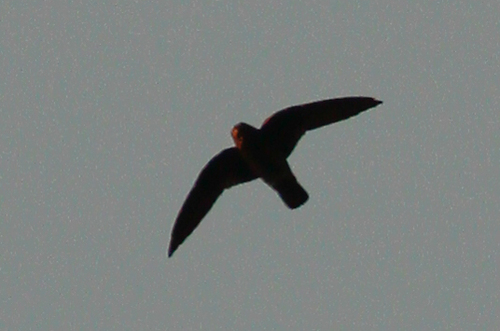 Grey-rumped Swift
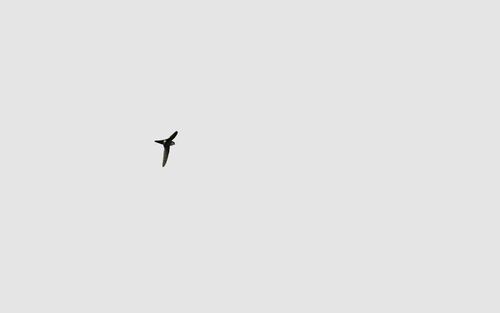 White-tipped Swift
In short
The most reliable field mark to separate Grey-rumped Swift from White-tipped Swift is the presence of a broad pale gray rump on the former versus the distinctive white-tipped tail and white throat of the latter. Juvenile and adult Grey-rumped Swifts always show a contrasting gray rump in flight, while White-tipped Swifts show white tail tips (often visible from below or above) and prominent white on the throat and upper breast, especially in males. Structure is also helpful: Grey-rumped Swift is smaller, with a short, square tail and bulging, slightly hooked wings, while White-tipped Swift is larger, with a longer, slightly notched tail and slim, pointed wings. Both species are aerial and fast, but their flight profiles and key plumage patches are quite different if seen well.
Identification tips
- Gray rump (all ages, all sexes): Only Grey-rumped Swift shows a broad pale gray rump and uppertail coverts, clearly contrasting with the rest of the dark upperparts. This is visible in flight from above and sometimes from below. White-tipped Swift never shows a gray rump.
- White tail tips (all ages, best in adult males): White-tipped Swift has broad white tips to the tail feathers, visible from above and below, especially in adult males. Females and juveniles may have reduced or absent tail tips, but some white is usually visible. Grey-rumped Swift's tail is uniformly dark and square.
- White throat and upper breast (adults, especially males): White-tipped Swift shows a bright white throat, sides of the neck, and upper breast, sharply set off from the dark underparts. Grey-rumped Swift has uniformly gray underparts, with no white throat.
- White patches around legs (adults): White-tipped Swift has white patches around the legs, visible from below in good light. Grey-rumped Swift lacks these patches.
- Tail shape: Grey-rumped Swift has a short, square tail, while White-tipped Swift's tail is longer and slightly notched. This is especially apparent in flight.
- Wing shape: Grey-rumped Swift's wings bulge in the middle and are somewhat hooked at the end, giving a compact look. White-tipped Swift has slim, pointed wings, contributing to a more streamlined, elongated appearance.
- Size: White-tipped Swift is noticeably larger and heavier than Grey-rumped Swift. This is most apparent in direct comparison or in mixed flocks.
- Sex differences (White-tipped Swift): Female White-tipped Swifts are browner, with a paler lower back and rump, duller white throat, and sometimes reduced or absent white tail tips. Males are blacker with brighter white.
- Juvenile marks: Both species' juveniles have pale fringes to body or wing feathers, but the key marks (gray rump for Grey-rumped, white tail tips and throat for White-tipped) remain diagnostic.
- Underpart contrast: Grey-rumped Swift has lighter gray underparts, but never the sharp white of White-tipped Swift's throat and breast.
- Flight jizz: Grey-rumped Swift appears compact, with a protruding head and short tail; White-tipped Swift is more elongated, with a longer, notched tail and pointed wings.
- Range context: If in Central America or the Caribbean (outside Trinidad, Tobago, Grenada), only Grey-rumped Swift is possible. In the Andes or Guiana Shield, check both species, but note local abundance.
- Vocalizations: If you hear a bright 'tsip' or burry 'trrreeew' notes, Grey-rumped Swift is likely. White-tipped Swift's voice is not described here.
- Plumage pitfalls: Beware of pale fringes on juveniles, which can look like pale patches but do not form a true rump or tail tip. Always look for the location and shape of pale areas.
- Sex/age confusion: Female and juvenile White-tipped Swifts may lack obvious white tail tips and have duller throats, but the notched tail and white throat (even if dull) usually separate them from Grey-rumped Swift.
Size
Grey-rumped Swift is noticeably smaller, averaging about 10.5 cm in length and weighing around 17 g. White-tipped Swift is larger, at 12–13 cm and 17–33 g. This size difference is often visible in mixed flocks or when seen near other swifts, but can be subtle at a distance. The White-tipped Swift's longer, more notched tail and more elongated wings also add to its larger appearance in flight.
Plumage
- Juveniles: Both species' juveniles resemble adults but have pale fringes to body or wing feathers. However, the key marks remain: Grey-rumped Swift juveniles retain the broad gray rump, while White-tipped Swift juveniles show white tail tips and white throat, though the tail tips may be reduced in females and juveniles.
- Adults: Grey-rumped Swift adults have glossy black upperparts with a wide gray rump and uppertail coverts, lighter gray underparts, and a short square tail. White-tipped Swift adults (especially males) are blackish brown above with a white throat, white upper breast, white patches around the legs, and broad white tips to the tail feathers. Females are browner, with duller white on the throat and sometimes reduced or absent white tail tips.
- Flight views: The gray rump of Grey-rumped Swift is conspicuous from above and often from below; White-tipped Swift's white tail tips are visible in both dorsal and ventral views, and the white throat/upper breast forms a strong contrast with the dark underparts. The rest of the underparts are darker in White-tipped Swift, with only the white patches around the legs breaking up the color.
Behaviour
Both species are fast-flying aerial insectivores, often seen in flocks and sometimes with other swifts. White-tipped Swift is known to forage low over forest or at ridge-top level in canyons, sometimes in single-species flocks up to 50 birds. Grey-rumped Swift is also highly aerial and may nest in chimneys or similar structures. In direct comparison, White-tipped Swift may appear more elongated and agile, with a more notched tail and pointed wings, while Grey-rumped Swift appears more compact and square-tailed.
Habitat
Both species can be found over forests and open areas, but their ranges overlap only in parts of South America. Grey-rumped Swift is widespread from Central America through most of South America (except Chile, French Guiana, Suriname, and Uruguay), including Trinidad, Tobago, and Grenada. White-tipped Swift is found in the Andes and adjacent lowlands of northern and central South America, including French Guiana and Suriname (where Grey-rumped is absent), but not in Central America or the Caribbean. Local abundance may differ, so knowing the regional checklist can help.
Voice
Grey-rumped Swift gives a bright repeated short 'tsip' and a series of 3–4 slightly downslurred burry notes 'trrreeew-trrreeew-trrreeew.' White-tipped Swift's voice is not described in the provided notes, so vocalization is not a reliable separator based on this information.