

Grey-rumped Swift vs Costa Rican Swift
Chaetura cinereiventris versus Chaetura fumosa
Play a quiz with Grey-rumped Swift and Costa Rican Swift
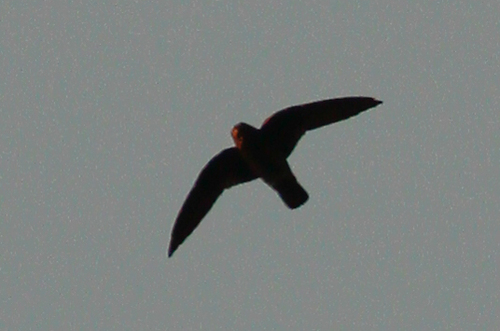 Grey-rumped Swift
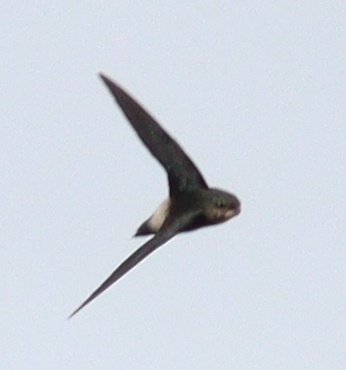 Costa Rican Swift
In short
The most reliable field mark between Grey-rumped Swift and Costa Rican Swift is the color and contrast of the rump and undertail coverts in flight: Grey-rumped Swift shows a broad, pale gray rump that stands out against darker upperparts, while Costa Rican Swift has a paler grayish rump but with dull black uppertail coverts, making the rump appear less cleanly set off. Both are small Chaetura swifts with similar shapes, but Costa Rican Swift is slightly larger and darker overall, with a dusky head and sooty-black upperparts with a blue gloss. Juvenile Grey-rumped Swifts show pale fringes on the wing feathers, which Costa Rican Swift lacks. Both species overlap in Costa Rica and Panama, so careful attention to rump and undertail contrast is key.
Identification tips
- Focus on the rump in flight: Grey-rumped Swift shows a broad, pale gray rump that stands out against the rest of the upperparts; Costa Rican Swift's rump is also pale but less sharply set off, and its dull black uppertail coverts reduce the contrast.
- Check the undertail coverts: In Grey-rumped Swift, undertail coverts are usually darker than the rump (sometimes black, sometimes pale depending on subspecies), while Costa Rican Swift's are consistently dull black, blending with the tail.
- Look for pale wing fringes in juveniles: Juvenile Grey-rumped Swifts have pale edges to wing feathers, creating a subtly scaly look—Costa Rican Swift juveniles do not show this feature.
- Assess head color: Costa Rican Swift has a dusky head that is less glossy than the back, while Grey-rumped Swift's head is glossy black like the upperparts.
- Upperparts gloss: Costa Rican Swift often shows a blue gloss on sooty-black upperparts; Grey-rumped Swift is glossy black, sometimes with a steely blue gloss in some subspecies, but usually less so than Costa Rican Swift.
- Underparts shade: Grey-rumped Swift has lighter gray underparts than the rump, with the undertail coverts often darker; Costa Rican Swift's throat and breast are pale grayish, but the rest of the underparts are not as distinctly marked.
- Tail shape: Both species have short, square tails; tail shape is not a useful separator.
- Size: Costa Rican Swift is slightly larger (about 0.5 cm longer), but this is rarely obvious unless seen together.
- Flight style: Both have similar flight patterns—rapid, direct, and stiff-winged—so do not rely on flight jizz alone.
- Range context: Outside Costa Rica and Panama, a Chaetura swift with a pale rump is almost certainly Grey-rumped Swift. In Costa Rica and Panama, both occur, so careful scrutiny is needed.
- Subspecies variation: Some Grey-rumped Swift subspecies have darker rumps or undertail coverts, but the broad pale rump is usually retained; always check for this feature.
- Plumage pitfalls: Lighting can affect how pale the rump appears; try to view birds in good light and from below for best contrast.
- Voice: Calls are similar and not reliable for separation.
- Sex: Both species are sexually monomorphic—sex cannot be determined by plumage or size.
- Habitat: Both use similar habitats in areas of overlap, so habitat alone is not diagnostic.
Size
Grey-rumped Swift averages about 10.5 cm (4.1 in) in length and weighs around 17 g, while Costa Rican Swift is marginally larger at about 11 cm (4.3 in). The difference is subtle and rarely diagnostic in the field, but Costa Rican Swift may appear slightly bulkier if seen side by side. Both species have similar proportions: short, square tails and wings that bulge in the middle and hook at the end.
Plumage
- Juvenile/immature birds: Grey-rumped Swift juveniles have pale fringes on many wing feathers, creating a subtly scaled look in good light—this is not described for Costa Rican Swift, making it a useful mark if seen well.
- Adults: Both species have a pale gray rump, but in Grey-rumped Swift it is broad and contrasts strongly with glossy black upperparts and darker uppertail coverts. Costa Rican Swift's rump is pale grayish but less sharply defined, and its uppertail coverts are dull black, blending more with the back and tail. The head of Costa Rican Swift is dusky, while Grey-rumped Swift's head is glossy black like the back. Underparts in Grey-rumped Swift are lighter gray than the rump, with darker undertail coverts; Costa Rican Swift has pale grayish throat and breast, but the belly and undertail are not as sharply marked. Subspecies variation in Grey-rumped Swift can affect undertail coverts (sometimes pale, sometimes black), but the broad pale rump remains a key mark.
Behaviour
Both species share the typical Chaetura swift flight style: rapid, direct, and often high overhead, with quick, stiff wingbeats and little gliding. Structure and flight jizz are nearly identical, so behavior alone is not diagnostic. Both may nest in chimneys or similar structures and forage in flocks, sometimes together.
Habitat
Grey-rumped Swift is much more widespread, found from Honduras south through most of South America and on several Caribbean islands. Costa Rican Swift is restricted to Costa Rica and Panama. In Costa Rica and Panama, both species can occur together, often in lowland and foothill forests and open areas. Outside these countries, any Chaetura swift with a pale rump is almost certainly Grey-rumped Swift.
Voice
Both species have similar vocalizations: short, bright 'tsip' notes and series of drawn-out, slightly downslurred burry calls. There is no clear evidence of a diagnostic difference in voice between these two, so vocalizations are not a reliable separator in the field.