

Grey-rumped Swallow vs Banded Martin
Pseudhirundo griseopyga versus Neophedina cincta
Play a quiz with Grey-rumped Swallow and Banded Martin
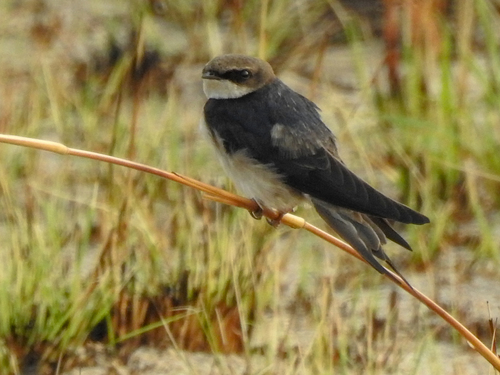 Grey-rumped Swallow
 Banded Martin
In short
The most reliable way to separate Grey-rumped Swallow from Banded Martin is by looking for the Banded Martin's bold dark breast band and white underwing coverts, which are absent in Grey-rumped Swallow. In flight or perched, Banded Martin shows a square tail and a distinct white supercilium, while Grey-rumped Swallow lacks both features. Juvenile Banded Martins have a paler breast band and golden feather tips above, but still show the breast band. Both species are similar in size and often overlap in range and habitat, so careful attention to underpart pattern and tail shape is crucial for a confident ID.
Identification tips
- Look for a dark breast band: Banded Martin always shows a strong dark breast band, even in juveniles (though paler), while Grey-rumped Swallow never has a breast band. This is the single most reliable field mark at all ages and seasons.
- Check for a white supercilium: Banded Martin has a distinct white stripe above the eye, which is lacking in Grey-rumped Swallow. This is visible both perched and in good flight views.
- Examine the underwing coverts: Banded Martin has white underwing coverts, which can be seen in flight and contrast with the earth-brown upperparts. The underwing pattern of Grey-rumped Swallow is not described as contrasting or white.
- Tail shape: Banded Martin has a square tail, which is a good structural mark in flight or when perched with the tail spread. Grey-rumped Swallow does not have a square tail.
- Upperpart color and gloss: Banded Martin is earth-brown above, with some variation among subspecies. Grey-rumped Swallow's upperparts are not described in detail, but the name suggests a grey rump, which may be visible in good views.
- Juvenile marks: Young Banded Martins show a paler breast band and golden tips to the upperpart feathers, but the band is always present. Grey-rumped Swallow juveniles are not described as having any breast band or golden feather tips.
- Throat color: Banded Martin has a white throat, which can help distinguish it from other brownish swallows, but is not described for Grey-rumped Swallow.
- Flocking behavior: Banded Martin is less gregarious than other swallows, often seen in pairs or small groups. If you see a large, tight flock, consider Grey-rumped Swallow, but this is not a strong separator between these two species.
- Habitat context: Both species use open habitats near water, so habitat is not a reliable separator, but Banded Martin avoids the driest regions.
- Size: Both are medium-sized swallows; do not rely on size for separation.
- Sex differences: Both species are sexually monomorphic; do not use sex for identification.
- Seasonal movements: Some Banded Martin subspecies are migratory, but both species can be found in overlapping areas for much of the year.
- Vocalizations: No diagnostic calls or songs are described in the sources; do not use voice for separation.
- Confusion with other swallows: Banded Martin is easily distinguished from sand martins by its square tail and white underwings, but when comparing only with Grey-rumped Swallow, focus on the breast band and supercilium.
- When in doubt: If you cannot see the underparts clearly, try to get a look at the face for the supercilium or the tail shape in flight.
Size
Both species are similar in overall size, with Banded Martin measuring 15–17 cm in length. No direct measurement is given for Grey-rumped Swallow, but both are medium-sized swallows and unlikely to be reliably separated by size alone in the field. Sexes are similar in both species.
Plumage
- Juvenile/immature birds: Young Banded Martins have a paler breast band and golden tips to their upperpart feathers, but the breast band is always present, which is never seen in Grey-rumped Swallow of any age. Juvenile plumage in Grey-rumped Swallow is not described as distinctive, so the lack of a breast band remains diagnostic at all ages.
- Adults: Adult Banded Martins have earth-brown upperparts, a white supercilium, white underparts with a strong dark breast band, and white underwing coverts. Grey-rumped Swallow lacks the breast band and supercilium, and instead has a grey rump (as its name suggests), but details of its underwing pattern are not specified. The Banded Martin's white underwing coverts are a useful mark in flight.
- Tail: Banded Martin has a square tail, while Grey-rumped Swallow's tail shape is not described, but it lacks the square look.
- Throat: Banded Martin has a white throat; Grey-rumped Swallow's throat is not described as contrasting.
Behaviour
Banded Martin is less gregarious than other swallows and is typically seen in pairs or small flocks. No specific behavioral notes are provided for Grey-rumped Swallow, but both species are aerial insectivores and may be seen flying over open habitats. Banded Martin's tendency to be less social may be a subtle clue if flocking behavior is observed.
Habitat
Both species are widespread across sub-Saharan Africa and can occur in similar open habitats such as farmland, grassland, and savannah, usually near water. Banded Martin is absent from the driest parts of western South Africa and southern Namibia, but otherwise overlaps broadly with Grey-rumped Swallow. Habitat alone is not a reliable separator, but Banded Martin's preference for open areas near water may be slightly more pronounced.