
Grey Plover vs Common Ringed Plover
Pluvialis squatarola versus Charadrius hiaticula
Play a quiz with Grey Plover and Common Ringed Plover
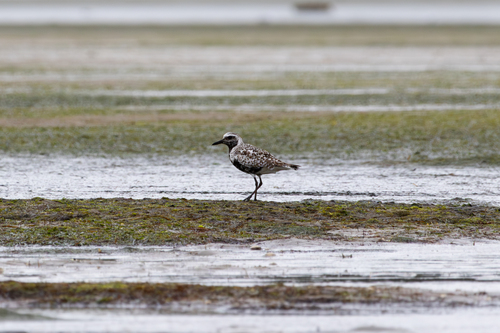 Grey Plover
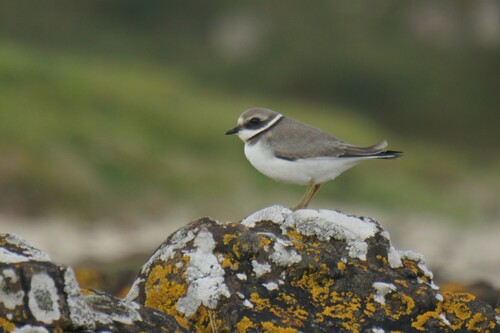 Common Ringed Plover
In short
The most reliable field mark for separating Grey Plover from Common Ringed Plover, especially in flight, is the presence of solid black axillaries (underwing 'armpit' feathers) in all ages of Grey Plover—never shown by Common Ringed Plover. Juvenile and non-breeding Grey Plovers also show a larger, heavier bill and bulkier structure compared to the daintier, short-billed Ringed Plover. On the ground, Grey Plover is much larger and longer-legged, with plain grey upperparts in winter, while Ringed Plover is compact, with a distinct face pattern and single black breast band. Always check for the black underwing mark in flight and compare overall size and bill shape when birds are at rest.
Identification tips
- Black axillaries in flight (all ages): Grey Plover always shows solid black axillaries and inner underwing coverts in flight—this is the single most reliable mark. Ringed Plover never shows black here; its underwing is entirely white.
- Size and structure: Grey Plover is much larger, taller, and bulkier than Ringed Plover. If seen together, the size difference is obvious, but even singly, Grey Plover appears long-legged and upright, while Ringed Plover is squat and compact.
- Bill shape and size: Grey Plover has a long, thick, heavy all-black bill (24–34 mm), while Ringed Plover's bill is short, fine, and orange with a black tip in adults (dark in juveniles). Bill size is a good check at any distance.
- Breast pattern: Grey Plover in breeding plumage has a solid black face, throat, breast, and belly with a sharp white border; Ringed Plover always has a single, neat black breast band, never a solid black belly.
- Face pattern: Ringed Plover shows a clear white forehead, black mask, and brown cap, giving a striking 'bandit' look. Grey Plover lacks this pattern, especially in non-breeding plumage, where the face is plain greyish.
- Upperparts in winter/juvenile: Grey Plover is plain grey above in winter, with subtle pale spots in juveniles. Ringed Plover is brownish above, with a more contrasting face and wing panel.
- Leg color: Grey Plover has black legs in all plumages. Adult Ringed Plover has bright orange legs; juveniles have dull yellowish-grey legs. Leg color is useful at close range.
- Tail and rump: In flight, Grey Plover has a white rump and tail with black barring. Ringed Plover has a less contrasting tail and no white rump patch.
- Behavior: Grey Plover is often solitary or in small groups, stands tall, and is wary. Ringed Plover is more likely to be in flocks, runs with quick stops and starts, and is less upright.
- Habitat context: On wide, open tidal flats, especially if alone or with larger waders, suspect Grey Plover. On small beaches, gravel, or mixed with other small waders, Ringed Plover is more likely.
- Juvenile confusion: Juvenile Grey Plover may look superficially similar to Ringed Plover due to pale-edged feathers, but always check for size, bill, and black axillaries in flight.
- Breeding vs non-breeding: Only Grey Plover ever shows a completely black belly and breast in breeding plumage; Ringed Plover never does.
- Bill color in juveniles: Juvenile Ringed Plover has a dark bill, which can cause confusion, but the bill is always much shorter and finer than Grey Plover's.
- Leg color in juveniles: Juvenile Ringed Plover's legs are dull yellowish-grey, not bright orange, but still never black like Grey Plover.
- Mixed flocks: If unsure, scan for the largest, most upright bird with a heavy bill and check for black axillaries if any bird takes flight.
Size
Grey Plover is substantially larger: 27–30 cm in length with a 71–83 cm wingspan and weighing 190–280 g, versus Common Ringed Plover's 17–19.5 cm length, 35–41 cm wingspan, and much lighter build. Grey Plover appears tall, long-legged, and robust, while Ringed Plover is small, compact, and low to the ground. The bill of Grey Plover is noticeably longer and heavier, while Ringed Plover's bill is short and fine, with a distinct orange and black coloration in adults.
Plumage
- In flight (all ages): Grey Plover always shows solid black axillaries and inner underwing coverts, a unique feature among plovers. Ringed Plover has all-white underwings without black axillaries.
- Juvenile/first-winter: Juvenile Grey Plover is similar to adult winter but with blacker back feathers edged creamy-white; still shows black axillaries in flight. Juvenile Ringed Plover is duller than adults, with a less distinct, often incomplete breast band, dark bill, and dull yellowish-grey legs, but never shows black axillaries.
- Adult breeding: Grey Plover has striking black face, neck, breast, and belly with a white border and rump; Ringed Plover has a single black neck band, white forehead, and black mask, with no extensive black below.
- Adult non-breeding: Grey Plover is plain grey above, grey-speckled on the breast, white below, and still shows black axillaries in flight. Ringed Plover remains brownish above, with a clear face pattern and single breast band.
Behaviour
Grey Plover often stands upright, appearing alert and tall, and can be seen singly or in small groups, especially on open coastal flats. It tends to be wary and quick to flush. Common Ringed Plover is more likely to be seen in tight flocks, often running with quick, short bursts and pausing to feed. Its feeding is more frenetic and close to the ground, and it is less likely to stand tall for long periods.
Habitat
Both species occur on coastal mudflats and sandy shores outside the breeding season, but Grey Plover is more strictly coastal and favors wide, open tidal flats. Common Ringed Plover can also be found inland on gravel, shingle, or sandy riverbanks, and breeds farther south and in a wider variety of open habitats. In winter, Ringed Plover is common on small beaches and estuaries, sometimes mixing with other small waders.