

Grey Partridge vs Rock Partridge
Perdix perdix versus Alectoris graeca
Play a quiz with Grey Partridge and Rock Partridge
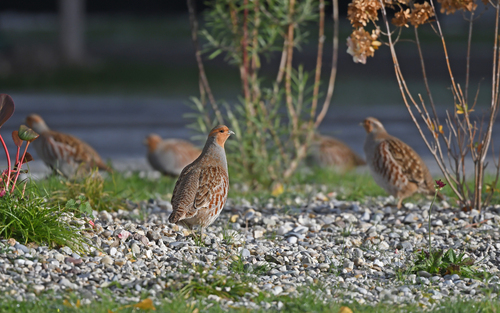 Grey Partridge
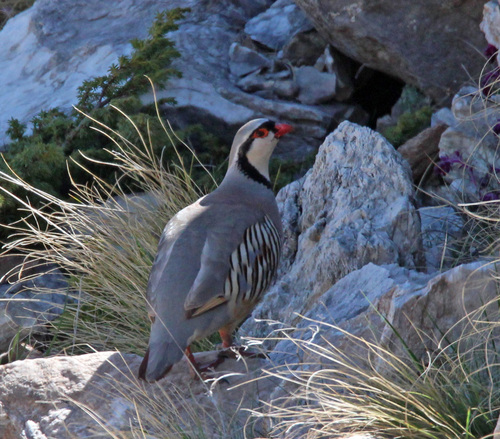 Rock Partridge
In short
The most reliable field mark to separate Grey Partridge from Rock Partridge is the presence of a sharply defined black gorget and white face on Rock Partridge, versus the plain, orange-buff face and lack of a dark throat patch on Grey Partridge. Juvenile Grey Partridges are mostly yellow-brown and lack the bold face and underpart markings of adults, while Rock Partridge juveniles quickly show the contrasting face pattern. In flight, both species have rounded wings and fly only short distances, but Grey Partridge often calls with a distinctive 'rick rick rick' as it rises. Rock Partridge is substantially heavier and bulkier than Grey Partridge, which can be apparent when seen side by side.
Identification tips
- Face Pattern (All Ages): Rock Partridge always shows a striking white face with a sharply defined black gorget (throat patch), even in young birds. Grey Partridge has a plain orange-buff face with no black throat patch at any age.
- Juvenile Plumage: Juvenile Grey Partridges are overall yellow-brown and lack any strong facial or underpart markings, while juvenile Rock Partridges quickly develop the contrasting face and gorget.
- Belly Patch (Adults): Adult Grey Partridges have a dark horseshoe-shaped belly patch, larger in males; Rock Partridge lacks this feature entirely.
- Flank Pattern: Rock Partridge has rufous-streaked flanks, which are absent in Grey Partridge.
- Back Color: Grey Partridge has a brown back, while Rock Partridge's back is greyer, especially compared to the similar Chukar.
- Underparts: Grey Partridge shows a grey breast and plain buff underparts; Rock Partridge has a grey breast and buff belly, but the bold face and gorget dominate the impression.
- Size and Bulk: Rock Partridge is much heavier and bulkier (over 600 g) than Grey Partridge (typically 320–455 g), which can be apparent in direct comparison or with experience.
- Flight Behavior: Both species fly short distances on rounded wings, but Grey Partridge often calls 'rick rick rick' as it flushes, while Rock Partridge is quieter and prefers to run.
- Voice: Listen for the harsh, simple calls of Grey Partridge versus the complex, chattering 'ga-ga-ga-ga-chakera' of Rock Partridge.
- Habitat: Grey Partridge is almost always in lowland farmland or grassland, while Rock Partridge is associated with rocky hillsides and mountainous terrain.
- Sex Differences: Both sexes are similar in both species, but female Grey Partridges are slightly duller and have a smaller belly patch; this is not useful at distance.
- 'Cross of Lorraine' (In Hand): Female Grey Partridges have two transverse bars on the tertiary coverts after 16 weeks, but this is not visible in the field.
- Confusion with Chukar: Rock Partridge is very similar to Chukar, but compared to Grey Partridge, the face and gorget are always diagnostic.
- Seasonal Variation: There is little seasonal change in plumage for either species; age-related differences (especially in Grey Partridge juveniles) are more important.
- Pitfalls: Do not rely on overall brown or grey tones, as both can appear similar in poor light; always look for the face pattern and gorget for a confident identification.
Size
Rock Partridge is significantly larger and heavier than Grey Partridge. Rock Partridge averages around 632.5 g in body mass [wikidata], while Grey Partridge typically weighs between 320–455 g (with some subspecies reaching up to 600 g) [wikipedia]. Both species are similarly rotund, but Rock Partridge appears bulkier and more robust in the field. Length and wingspan are only available for Grey Partridge (29–31 cm long, 45–48 cm wingspan), but Rock Partridge's greater mass is usually evident in direct comparison.
Plumage
- Juveniles/Immatures: Juvenile Grey Partridges are mostly yellow-brown overall and lack the distinctive face and underpart markings of adults. This plainness can make them confusing, but they never show the bold black-and-white facial pattern or gorget of Rock Partridge at any age. Juvenile Rock Partridges, while less crisply marked than adults, develop the contrasting white face and black throat patch early, making this a key separation point even in young birds.
- Adults: Adult Grey Partridges have a plain orange-buff face, grey breast, and a brown back. Both sexes are similar, but females are duller and have a smaller dark belly patch. The 'cross of Lorraine' (two transverse bars on the tertiary coverts) is present in females after about 16 weeks, but this is only visible in the hand. Adult Rock Partridges have a grey back, white face with a sharply defined black gorget, and rufous-streaked flanks. Their underparts are buff, and the breast is grey. The face pattern and gorget are the most obvious field marks. Both species have rounded wings and similar flight silhouettes, but the plumage differences are striking when seen well.
Behaviour
Both species are ground-dwelling gamebirds that prefer to run when disturbed, only flying short distances on rounded wings if necessary. Grey Partridge is more likely to flush with a noisy call, while Rock Partridge tends to run uphill and only take flight as a last resort. In flight, both show rapid, whirring wingbeats and drop quickly back to cover. The difference in bulk may be apparent in flight, with Rock Partridge appearing heavier and more robust.
Habitat
Grey Partridge is typically found in lowland farmland, grasslands, and field edges, especially in areas with cereal crops. Rock Partridge, by contrast, is native to southern Europe and favors rocky hillsides, open mountain slopes, and scrubby terrain. While both can be found in open country, the presence of rocky or mountainous habitat strongly favors Rock Partridge, whereas agricultural or lowland settings are more typical for Grey Partridge.
Voice
Grey Partridge gives a harsh, high-pitched 'kieerr-ik' and, when flushed, a repeated 'rick rick rick.' Rock Partridge has a much more complex and noisy song, described as 'ga-ga-ga-ga-chakera-chakera-chakera.' These vocalizations are quite different, and the simpler, harsher calls of Grey Partridge are unlikely to be confused with the more elaborate phrases of Rock Partridge.