

Grey Nightjar vs Savanna Nightjar
Caprimulgus jotaka versus Caprimulgus affinis
Play a quiz with Grey Nightjar and Savanna Nightjar
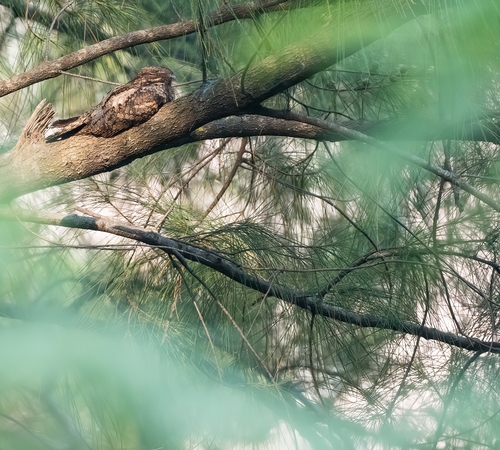 Grey Nightjar
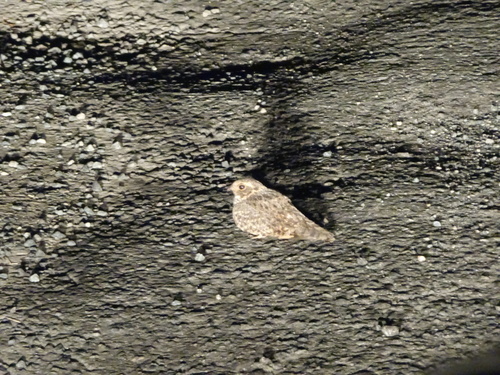 Savanna Nightjar
In short
The most reliable field mark between Grey Nightjar and Savanna Nightjar is the presence and placement of white patches on the wings and tail, especially in adult males. Grey Nightjar males show a white patch on the first primary and white bars on the second to fourth primaries, as well as a white subterminal patch on the outer tail feathers—features absent in female Grey Nightjars and all Savanna Nightjars except adult males, who have white patches but with different patterning. Both species are cryptically patterned, but subtle differences in the arrangement and color of vermiculations, as well as the extent and tone of white or reddish tints, are useful with good views. In flight, the Grey Nightjar is typically silent and shows slow, gliding wingbeats, while Savanna Nightjar is more likely to be detected by its loud, booming call. Age and sex are critical: females and immatures of both species lack most white patches, making separation much more challenging and reliant on fine plumage and structural details.
Identification tips
- White patches on wings (adult males): Look for a white circular patch on the first primary and white bars on the second to fourth primaries in Grey Nightjar males. Savanna Nightjar males have white in the wings, but not in this precise pattern; the patches are less sharply defined and not confined to specific primaries.
- White subterminal tail patch (adult males): Grey Nightjar males show a prominent white patch near the tip of the outer tail feathers. This is absent in female Grey Nightjars and all Savanna Nightjars except adult males, where the white is less extensive and less sharply defined.
- Throat patch: Both species' males have a white throat patch, but in Grey Nightjar it is more conspicuous and sharply defined. Female Grey Nightjars have a smaller, brown-tinged throat patch; female Savanna Nightjars have a subtle, less contrasting patch.
- Absence of white in females/immatures: Female and immature Grey Nightjars lack white in the wings and tail, as do all female and juvenile Savanna Nightjars. In these ages, rely on subtle differences in overall tone and pattern.
- Reddish tinge (female/immature Savanna Nightjar): Female and immature Savanna Nightjars often show a reddish or rufous tinge to their plumage, especially compared to the colder grey-brown of Grey Nightjar.
- Crown and scapular pattern: Grey Nightjar has a prominent black crown stripe and black scapulars with brownish-yellow spots, while Savanna Nightjar is more uniformly vermiculated and lacks the strong crown stripe.
- Facial pattern: Grey Nightjar shows a more distinct supercilium and ear-coverts with yellowish-brown and black streaks; Savanna Nightjar's face is plainer.
- Flight style: Grey Nightjar is silent in flight, with slow, gliding wingbeats and frequent hovering. Savanna Nightjar may be more direct and is often detected by its call.
- Vocalization: If you hear a loud, booming call at night (especially in urban areas), it is almost certainly Savanna Nightjar. Grey Nightjar is typically silent in flight.
- Habitat context: In urban areas, especially on flat rooftops, Savanna Nightjar is more likely. Grey Nightjar prefers grassy slopes and wooded areas.
- Resting posture: Grey Nightjar often rests parallel to branches, blending in closely; Savanna Nightjar also relies on camouflage but may be found on open ground or roofs.
- Underpart barring: Grey Nightjar has more distinct horizontal barring on the chest and a paler, more finely barred belly. Savanna Nightjar is more uniformly mottled below.
- Eye and bill structure: Both have large eyes and wide gapes, but these features are not reliably separable in the field.
- Size: Not a reliable separator; both are medium-sized nightjars with overlapping measurements.
- Seasonal movement: Grey Nightjar is migratory in the north of its range, so timing and location may help; Savanna Nightjar is more resident and adaptable to urban settings.
Size
Both species are medium-sized nightjars with overlapping size ranges. The Savanna Nightjar is documented at 20–26 cm in length, with a body mass of 54–110 g (mean 82.5 g) and a wingspan of about 64 cm [wikidata, wikipedia]. No direct measurements are available for Grey Nightjar in the provided notes, but it is described as medium-sized and similar in structure to Savanna Nightjar. In the field, size is not a reliable separator between these two, as both have large heads, long tails, and similar overall proportions.
Plumage
Plumage separation depends heavily on age and sex.
- Adult males: Grey Nightjar males have a prominent white patch on the first primary, white bars on the second to fourth primaries, and a white subterminal patch on the outer tail feathers. Savanna Nightjar males also have white patches on the throat, tail, and wings, but the pattern differs: the wing patches are less distinctly placed on the primaries, and the tail patch is not as sharply defined as in Grey Nightjar.
- Females and immatures: Both species' females and juveniles lack white patches on the tail and flight feathers. Female Grey Nightjars may have a smaller, brown-tinged throat patch and no white in the wings or tail, while female Savanna Nightjars show a subtle throat patch, a reddish tinge to the plumage, and lack white tail patches. Juvenile Savanna Nightjars resemble adult females: mottled, with no white patches and a more reddish overall tone.
- Upperparts: Grey Nightjar shows intricate grayish-white and dark brown vermiculations with a prominent black crown stripe and brownish-yellow scapular spots. Savanna Nightjar is more uniformly vermiculated grey-brown, with less contrast and a generally duller appearance.
- Underparts: Both are barred and mottled, but Grey Nightjar tends to have more distinct horizontal barring on the chest and a paler, more finely barred belly.
- Facial pattern: Both have large eyes and facial rictal bristles, but Grey Nightjar's supercilium and ear-coverts are more distinctly marked with yellowish-brown and black streaks.
Behaviour
Both species are nocturnal and forage for insects at dusk and night, using aerial sallies. Grey Nightjar is described as silent in flight, with slow wingbeats and frequent gliding or hovering, often flying in circles but capable of sharp, erratic turns when chasing prey. During the day, it rests parallel to branches or on grassy slopes, blending in with its surroundings. Savanna Nightjar also hunts by sallying, with large eyes and a wide gape for catching insects, and is noted for its booming, loud call at night, especially in urban areas. It is more likely to be heard than seen in some contexts. Both species rest during the day and rely on camouflage.
Habitat
Grey Nightjar breeds in East Asia from southeastern Russia through China, Korea, and Japan, south to northern Indochina and the Himalayas. It is migratory in the north, wintering south to Java, but resident in warmer southern areas. Savanna Nightjar occupies South and Southeast Asia, with some populations expanding into urban areas (e.g., Taiwan). Both species prefer open or semi-open habitats for nesting, but Savanna Nightjar is more likely to be found in open rocky soils, exposed ground, or even flat urban rooftops, while Grey Nightjar is more associated with grassy slopes and wooded areas.
Voice
Grey Nightjar is described as silent in flight and no specific call is detailed in the notes. Savanna Nightjar, by contrast, is famous for its extremely loud, booming call (up to 90 decibels), especially during the breeding season and in urban environments, making it much more likely to be detected by ear than by sight. This difference is often diagnostic at night.