

Grey-headed Kingfisher vs Brown-hooded Kingfisher
Halcyon leucocephala versus Halcyon albiventris
Play a quiz with Grey-headed Kingfisher and Brown-hooded Kingfisher
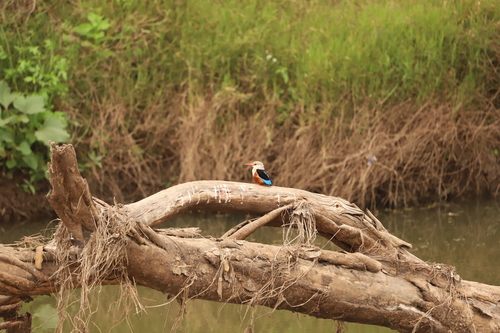 Grey-headed Kingfisher
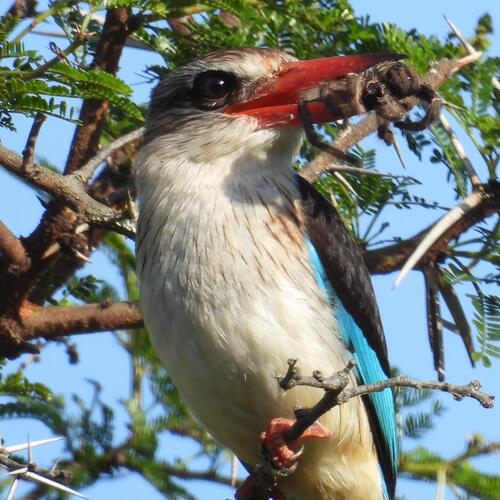 Brown-hooded Kingfisher
In short
The most reliable way to separate Grey-headed Kingfisher from Brown-hooded Kingfisher is by head and underpart color: Grey-headed has a pale grey head and rich chestnut underparts, while Brown-hooded shows a brown, streaked head and buffy, streaked underparts. Both species have blue in the wings and rump, but the shade and extent differ. Bill color is also a key mark: Grey-headed's bill is all red, while Brown-hooded's is red with a brown tip. Juveniles of Brown-hooded are duller and more scalloped below, which can cause confusion, but the head color and bill pattern remain useful. Both are dry-country kingfishers often away from water, but their subtle differences in plumage and structure are critical for field ID.
Identification tips
- Head color is the single most reliable mark: Grey-headed Kingfisher has a pale grey head (all ages), while Brown-hooded Kingfisher shows a brown, streaked head. This is visible both perched and in flight.
- Underparts: Grey-headed has rich chestnut underparts (all ages), never streaked or scalloped. Brown-hooded has buffy to tawny underparts, usually streaked (especially in females and juveniles), and juveniles are distinctly scalloped and duller below.
- Bill color: Grey-headed's bill is long, sharp, and entirely red. Brown-hooded's bill is red but always tipped brown; this is visible at close range and in good light.
- Mantle and back: Grey-headed has a black mantle and back, contrasting with the grey head. Brown-hooded's upperparts are brownish-black with a broad buffy collar above the mantle.
- Wing and rump color: Both species show blue in the wings and rump, but Grey-headed's is described as 'bright blue' and more extensive, while Brown-hooded has turquoise secondaries and an azure-blue rump. In poor light, this can be subtle, but the difference in shade may be apparent in direct comparison.
- Sexual dimorphism: Brown-hooded females have darker upperparts and more streaked underparts than males; Grey-headed is sexually monomorphic (sexes look alike).
- Juvenile confusion: Brown-hooded juveniles are duller, with scalloped whitish underparts and a brown head; Grey-headed juveniles still show the pale grey head and chestnut underparts, lacking scalloping.
- Flight views: In both, blue in the wings and rump is visible, but head and underpart color remain the best marks. No distinctive upperwing panels or 'W' marks are noted for either species.
- Voice: If heard, Grey-headed's song is a series of ascending and descending notes, while Brown-hooded gives a trill; calls are not always diagnostic but may support visual ID.
- Habitat overlap: Both occur in similar dry habitats, so do not rely on habitat alone. Grey-headed's broader range may be relevant in some regions.
- Behavior: Both perch quietly, but Brown-hooded is more likely to forage on the ground and tackle larger prey. This is not a primary field mark.
- Size: Brown-hooded is slightly larger and heavier, but this is not a reliable field mark without direct comparison.
- Subspecies variation: Grey-headed subspecies may show a darker grey head or paler chestnut underparts, but the head remains grey, not brown. Brown-hooded subspecies vary in shade and streaking but always have a brown head.
- Pitfalls: Poor light or distant views can make the head color appear ambiguous; always check for bill color and underpart tone as backup marks.
- Summary: Prioritize head color (grey vs brown), underpart color and pattern (chestnut and plain vs buffy and streaked/scalloped), and bill color (all red vs red with brown tip) for the most reliable separation in all ages and seasons.
Size
Both species are similar in size, with Grey-headed Kingfisher averaging 21 cm in length and Brown-hooded Kingfisher slightly longer at about 22 cm. Brown-hooded is marginally heavier (body mass ~64 g), but this difference is not readily apparent in the field. Structure and jizz are broadly similar, so size alone is not a reliable separator.
Plumage
Juvenile and immature birds are most easily confused. Brown-hooded Kingfisher juveniles are duller overall, with scalloped whitish underparts and a brown, streaked head; their underparts are more streaked than adults, especially in females. Grey-headed Kingfisher of all ages shows a pale grey (not brown) head and rich chestnut underparts, lacking the streaking and scalloping of Brown-hooded. In adults, Grey-headed has a black mantle and back, bright blue rump, wings, and tail, and a long, all-red bill. Brown-hooded adults have a brown head with blackish streaks, a buffy collar, brownish-black wing coverts, turquoise secondaries, and an azure-blue rump. The bill is red with a brown tip, not solid red. Underparts are tawny and streaked, especially in females, with a buffy belly. In flight, both show blue in the wings and rump, but the head and underpart color remain the best marks.
Behaviour
Both species are typically seen alone or in pairs, perching quietly while scanning for prey. They hunt mostly insects and small vertebrates, often from a low perch. Brown-hooded Kingfisher is noted for foraging on the ground and can tackle larger prey like snakes and lizards. Grey-headed Kingfisher is more likely to be seen perched for long periods, bobbing its head before diving. Both nest in burrows in banks and are aggressive in nest defense.
Habitat
Both species occupy similar habitats: dry woodland, scrub, forest edge, and even cultivated or suburban areas. Grey-headed Kingfisher has a broader range, extending into the Arabian Peninsula and islands off Africa, while Brown-hooded is restricted to Sub-Saharan Africa. Both are found away from water more often than many kingfishers, so habitat is not a strong separator.
Voice
Grey-headed Kingfisher gives a succession of notes that ascend, descend, then ascend again, becoming more strident, and a sharp 'tchk, tchk, tchk' as a warning. Brown-hooded Kingfisher's song is a tiiiu or ki-ti-ti-ti trill, often given with wing vibrations, and a sharp 'cheerit' when alarmed. Calls are not diagnostic at distance but can help with experience.
Grey-headed Kingfisher · Brown-hooded Kingfisher · My Tricky Birds