

Grey-headed Elaenia vs Greenish Elaenia
Myiopagis caniceps versus Myiopagis viridicata
Play a quiz with Grey-headed Elaenia and Greenish Elaenia
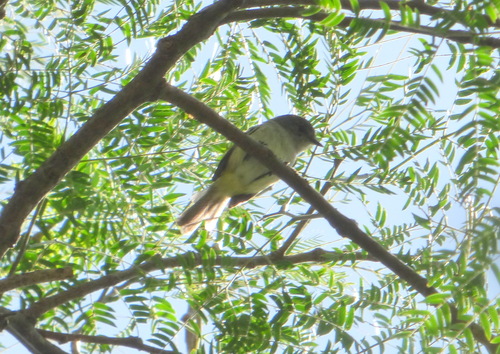 Grey-headed Elaenia
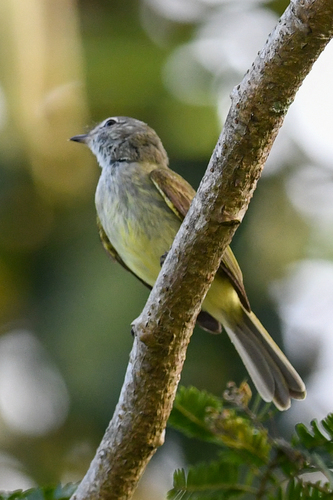 Greenish Elaenia
In short
The most reliable field mark between Grey-headed Elaenia and Greenish Elaenia is the color and contrast of the crown and wing markings in adults: Grey-headed shows a medium gray crown with a partially hidden white stripe, while Greenish has a greenish olive crown with a faint gray tinge and a concealed yellow stripe. Both species have wing bars, but Grey-headed's are white and Greenish's are yellowish. Females of Grey-headed are brighter and greener above than males, but still show a gray crown, unlike Greenish. Structure and behavior are very similar, so careful attention to subtle plumage differences—especially crown and wing bar color—is key. Habitat overlap is possible in southern Brazil and adjacent regions, but Greenish Elaenia is much more widespread.
Identification tips
- Crown color and stripe: Grey-headed Elaenia always shows a medium gray crown (both sexes), with a partially concealed white (male) or pale yellow (female) stripe; Greenish Elaenia has a greenish olive crown with a faint gray tinge and a hidden yellow stripe (larger in males). This is the best mark in good light.
- Wing bar color: Grey-headed has two crisp white wing bars on blackish wings; Greenish has two yellowish wing bars on dusky wings. This difference is visible in perched birds and sometimes in flight.
- Upperparts shade: Grey-headed is olive gray (male) or bright greenish olive (female) above; Greenish is always olive-green above, sometimes brighter or duller depending on subspecies, but never as gray as male Grey-headed.
- Tail color: Grey-headed's tail is grayish; Greenish's is dusky olive. This is subtle and best used in combination with other marks.
- Underparts: Both are pale below, but Greenish often shows more yellow on the belly and undertail coverts, especially in some subspecies; Grey-headed females may have a pale yellow wash, but males are more grayish white.
- Facial pattern: Both have a whitish loral spot or streak and a pale supercilium, but Greenish's is more pronounced (whitish gray supercilium, partial white eyering), while Grey-headed's is more indistinct.
- Iris color: Grey-headed has a brown iris, with males showing a white ring; Greenish has a dark brown to reddish brown iris. This is rarely visible in the field.
- Bill and legs: Both have a short dark bill with a paler base and dark legs; not useful for separation.
- Sex differences: Only Grey-headed shows strong sexual dimorphism in upperpart brightness and crown stripe color; Greenish sexes are nearly identical except for the size of the yellow crown stripe.
- Juvenile/immature separation: No unique juvenile marks are described for either species; rely on adult-like crown and wing bar color.
- Size: Greenish Elaenia averages slightly heavier, but this is not a practical field mark.
- Habitat: In southern Brazil, Paraguay, and northern Argentina, both may occur together in similar wooded habitats; elsewhere, Greenish is much more widespread.
- Voice: If heard, Grey-headed's song starts with high notes and accelerates to a trill; Greenish's voice is not described here, so use with caution.
- Geographic context: Outside the southern cone (Argentina, Paraguay, southern Brazil, Bolivia), Greenish is far more likely; Grey-headed is restricted to the southeast and adjacent regions.
- Pitfalls: Females of Grey-headed can appear quite green above, approaching Greenish, but always retain a gray crown. Wing bar color (white vs yellowish) is a critical supporting mark.
Size
Both species are similar in length (12–14 cm for Grey-headed, 13–14 cm for Greenish), but Greenish Elaenia averages slightly heavier (14.0 g vs 10.5 g). This difference is subtle and not easily judged in the field. Structurally, both are typical Myiopagis elaenias with no strong differences in bill or tail shape noted in the sources.
Plumage
- Adults (both sexes):
- Grey-headed Elaenia: Medium gray crown with a partially concealed white stripe; upperparts olive gray (male) or bright greenish olive (female); wings black with white edges on inner flight feathers and white-tipped coverts forming two white wing bars; tail grayish; underparts pale gray to grayish white, sometimes with a pale yellow wash in females.
- Greenish Elaenia: Greenish olive crown with faint grayish tinge and a partially hidden bright yellow stripe (larger in males); upperparts olive-green; wings dusky with yellowish edges on inner flight feathers and yellowish tips on coverts forming two yellowish wing bars; tail dusky olive; underparts pale grayish white with variable light olive streaks on breast, belly and undertail coverts pale yellow.
- Juvenile/immature plumage: Not specifically described for either species in the notes, so separation relies on adult-like features.
- Sex differences: Grey-headed females are greener above and have a pale yellow crown stripe, but still show a gray crown; Greenish sexes are similar, with males having a slightly larger yellow crown stripe.
Behaviour
Both species are canopy-dwelling flycatchers, typically seen sallying for insects from high perches. No diagnostic differences in foraging style, flight pattern, or posture are described. Both can be overlooked due to their unobtrusive behavior.
Habitat
Grey-headed Elaenia is found in Argentina, Bolivia, Brazil, and Paraguay, mainly in the canopy of dry forests, gallery forests, cerradão, and semi-deciduous woodlands, sometimes in Eucalyptus plantations. Greenish Elaenia is much more widespread, occurring from Mexico through all of Central America and most of South America (except Chile and French Guiana), in a wide range of wooded habitats. In areas of overlap (southern Brazil, Paraguay, northern Argentina), habitat can be similar, so not diagnostic.
Voice
Grey-headed Elaenia gives a series starting with 2–4 very high notes, then gliding down and accelerating to a long trill, often ending with lilting notes. Greenish Elaenia's voice is not described in the notes, so vocal differences cannot be reliably used for separation based on this information.