

Grey-fronted Dove vs Fork-tailed Palm Swift
Leptotila rufaxilla versus Tachornis squamata
Play a quiz with Grey-fronted Dove and Fork-tailed Palm Swift
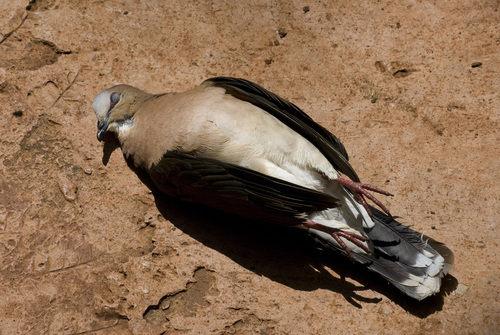 Grey-fronted Dove
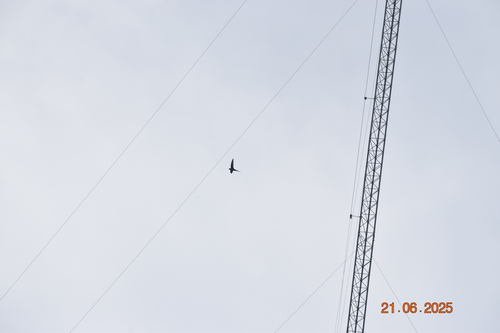 Fork-tailed Palm Swift
In short
The most reliable field mark is overall structure and flight style: Fork-tailed Palm Swift is a tiny, slender, fast-flying bird with a deeply forked tail and long, narrow wings, while Grey-fronted Dove is a much larger, heavy-bodied, ground-dwelling pigeon with broad wings and a rounded tail. Juvenile plumage is not likely to cause confusion, as both species' young resemble their respective adults and do not share distinctive upperwing patterns. In flight, the swift's scythe-like wings and forked tail are unmistakable, while the dove shows broad, rounded wings and a square-tipped tail with white corners. Perched, the dove is robust with a pigeon-like bill and red legs, while the swift is rarely seen perched and would appear tiny and delicate if so. Habitat and behavior are also strong clues: doves walk on the ground or low perches, swifts are almost always seen on the wing.
Identification tips
- Size is a major clue: If the bird is pigeon-sized or larger, it's a Grey-fronted Dove; if it's tiny and swallow-like, it's a Fork-tailed Palm Swift.
- Tail shape: Fork-tailed Palm Swift has a long, deeply forked tail visible even at a distance, especially in flight. Grey-fronted Dove's tail is broad, square-tipped, with white corners on the outer feathers.
- Flight style: Swifts are almost always seen flying rapidly with stiff, scythe-shaped wings and erratic, acrobatic movements. Doves fly with strong, direct wingbeats but are not agile or erratic; they often flush from the ground.
- Perched posture: Doves perch upright on the ground or low branches, showing a robust, round body and short neck. Swifts rarely perch, but if seen, they cling vertically to palm fronds or wires, appearing slender and flat-chested.
- Bill shape: Grey-fronted Dove has a short, thick, pigeon-like bill; Fork-tailed Palm Swift has a tiny, almost invisible bill suited for catching insects.
- Leg color: Grey-fronted Dove has red legs and feet, which are visible when perched or walking. Swifts' legs are so short they're almost never seen; they do not walk on the ground.
- Facial pattern: Doves have a grayish to bluish forehead, bare red skin around the eye, and a pinkish white throat. Swifts have a plain grayish brown face with a pale, mottled throat, lacking any bare skin or strong color contrasts.
- Upperparts: Dove is olive-brown with faint bronze or purplish on the mantle; swift is blackish brown with a greenish gloss and pale gray feather edges.
- Underparts: Dove has a grayish pink breast fading to white belly; swift is pale below with brown mottling, especially on the sides and undertail.
- Juvenile confusion: Juvenile doves have rusty bars on the breast and rusty-edged upperparts; juvenile swifts have buffy feather edges but no barring. These marks are not likely to overlap in the field.
- Habitat context: Doves are found on the ground or low in dense forest or woodland; swifts are seen flying high over open areas with palms, rarely near the ground.
- Social behavior: Swifts often fly in small flocks; doves are usually solitary or in pairs.
- Voice: Not diagnostic with current notes, but doves often give soft coos, while swifts give high, rapid twittering calls (not described in detail here).
- Sex differences: Dove females are browner and more olive than males, but still much larger and differently shaped than any swift. Swifts show no sexual dimorphism.
- If in doubt, watch for landing: A bird that lands on the ground is a dove; a bird that never lands except briefly on palm fronds or wires is a swift.
Size
Grey-fronted Dove is significantly larger: about 28 cm (11 in) long and weighing 115–183 g [wikipedia]. Fork-tailed Palm Swift is much smaller, only about 13 cm (5.1 in) long and 9–13.6 g [wikipedia]. The dove is more than twice as long and nearly ten times heavier than the swift. This size gap is obvious even at a distance.
Plumage
- Juveniles: Grey-fronted Dove juveniles have rust and drab brown bars on the breast and rusty-edged upperparts; Fork-tailed Palm Swift juveniles are similar to adults but with a buff tinge to the head and buffy feather edges on the upperparts. Neither has a distinctive wing pattern in flight that could cause confusion between the two.
- Adults: Grey-fronted Dove shows a grayish to bluish forehead, bluish gray crown, olive-brown upperparts with faint bronze or purplish on the mantle, and a tail with olive-brown central feathers and blackish outer feathers with obvious white tips. The breast is grayish pink, belly white, and the eye is surrounded by bare red skin. Fork-tailed Palm Swift adults are blackish brown above with a greenish gloss, pale gray feather edges, and a slightly paler rump. The underparts are pale with light brown mottling, throat very pale brownish white with dusky mottling, and undertail coverts blackish brown with pale edges. The swift's tail is deeply forked and dark, lacking the white corners of the dove.
Behaviour
Grey-fronted Dove is terrestrial or low-perching, walking on the ground or low branches, moving slowly and deliberately. Fork-tailed Palm Swift is almost always seen in rapid, agile flight, rarely perching except briefly on palm fronds or wires. The swift forages for insects on the wing, often in small flocks, while the dove forages for seeds and fruit on the ground. The dove's flight is direct and strong but not acrobatic, while the swift is highly maneuverable and fast.
Habitat
Grey-fronted Dove is found in forests and woodland, often on the ground or in dense undergrowth, and is generally shy and inconspicuous. Fork-tailed Palm Swift is closely tied to open areas with palm trees, including savannas, palm swamps, riparian forest, and even urban areas with decorative palms. The swift is usually seen flying high above or around palms, rarely if ever on the ground.
Grey-fronted Dove · Fork-tailed Palm Swift · My Tricky Birds