

Grey Flycatcher vs Western Flycatcher
Empidonax wrightii versus Empidonax difficilis
Play a quiz with Grey Flycatcher and Western Flycatcher
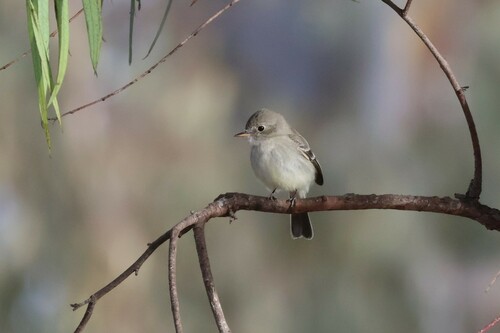 Grey Flycatcher
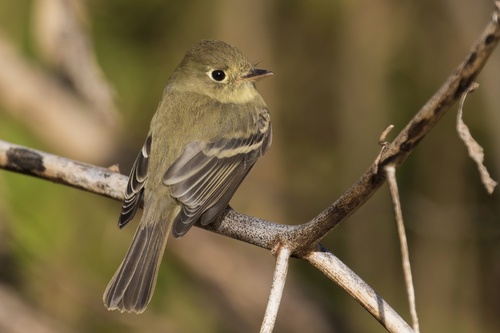 Western Flycatcher
In short
The most reliable field mark to separate Grey Flycatcher from Western Flycatcher is the overall color tone and facial pattern: Grey Flycatcher is noticeably paler and grayer above, with a subtle, thin eye ring and a long, narrow bill, while Western Flycatcher is more olive above, with a bright yellowish belly, a bold teardrop-shaped eye ring, and a short, broad bill. Juvenile Grey Flycatchers show buffy wing bars and brownish breasts, but Western Flycatcher juveniles are not described in detail here. Structure is also key: Grey Flycatcher has a longer tail and bill, giving it a more attenuated look, whereas Western Flycatcher appears compact and short-tailed. Voice and habitat can help, but subtle plumage and shape differences are the most consistent field clues.
Identification tips
- Upperparts color: Grey Flycatcher is pale gray above (sometimes with a faint olive tinge), while Western Flycatcher is distinctly olive-gray, especially on the back and crown. This is most apparent in good light.
- Underparts: Grey Flycatcher is whitish below, with only a slight yellow wash in fresh plumage. Western Flycatcher is strongly yellowish below, especially on the belly and lower flanks.
- Eye ring: Grey Flycatcher’s eye ring is thin and inconspicuous, blending into the face. Western Flycatcher has a bold, teardrop-shaped white eye ring that stands out, especially in shaded woods.
- Bill shape and color: Grey Flycatcher has a long, narrow bill with a pale lower mandible extending most of its length. Western Flycatcher’s bill is shorter and broader, with less obvious pale coloration.
- Tail length: Grey Flycatcher has a noticeably longer tail, giving it a stretched, attenuated look when perched. Western Flycatcher’s tail is short, making the bird appear more compact.
- Facial pattern: Grey Flycatcher has a pale supraloral band (above the bill), but it is subtle. Western Flycatcher’s facial contrast comes mainly from the bold eye ring.
- Wing bars: Both species have white wing bars, but in Grey Flycatcher they are often less bright; in juveniles, Grey Flycatcher’s wing bars are buffy, while Western’s are not described here.
- Juvenile plumage: Juvenile Grey Flycatchers show more olive and yellow on the upperparts, buffy wing bars, and brownish breasts. Western Flycatcher juveniles are not detailed, but should be even more yellow below and olive above.
- Behavior: Grey Flycatcher often forages lower and in more open, arid habitats, sometimes appearing sluggish. Western Flycatcher is more active in shaded, moist woods.
- Habitat: In breeding season, Grey Flycatcher is almost always in dry, open shrubland or pinyon-juniper woodland; Western Flycatcher is in moist, wooded areas, often near water.
- Voice: Grey Flycatcher’s song is a strong, two-syllable chuwip or wilip; Western Flycatcher’s is a rapid, variable series of notes (pseet, ptsick, seet). Calls can overlap, but the song is distinctive if heard.
- Seasonal context: In migration, both can occur in similar areas, but habitat preference usually holds. In winter, Grey Flycatcher stays in arid, open country; Western Flycatcher winters in Mexico.
- Jizz in flight: Grey Flycatcher’s longer tail and bill can make it look more elongated in flight, while Western Flycatcher is compact and short-tailed.
- Pitfalls: Overcast light can make Western Flycatcher look grayer than it is, and fresh-plumaged Grey Flycatchers can show a faint yellow wash below. Always check multiple marks.
- When in doubt: If the bird is in dry sagebrush or open pinyon-juniper and looks pale and long-tailed, favor Grey Flycatcher. If it’s in a moist, shady forest with a bold eye ring and yellow belly, it’s almost certainly Western.
Size
Grey Flycatcher is slightly larger than Western Flycatcher, with a typical mass of 12.5 g and a length of about 15 cm. Western Flycatcher is not given a mass here, but is generally smaller and more compact, with a shorter tail and bill. In the field, Grey Flycatcher often looks longer and slimmer, while Western Flycatcher appears more rounded and petite.
Plumage
For adults, Grey Flycatcher is pale gray above with only a faint olive tinge after molt, and underparts are whitish with a slight yellow wash in fresh plumage. Its eye ring is thin and inconspicuous, and the supraloral area (above the bill) is pale but not bold. Western Flycatcher, by contrast, is olive-gray above with a strong yellow wash on the underparts and a bold, teardrop-shaped white eye ring. Both have white wing bars, but Grey Flycatcher’s are often less contrasting. Juvenile Grey Flycatchers have buffy wing bars and brownish breasts, with more olive and yellow tones overall, but still tend to be paler than Western. No detailed juvenile marks are given for Western Flycatcher here, but adults and likely young birds share the strong yellow belly and bold eye ring. In all ages, Western Flycatcher is more colorful and contrasting, especially on the face.
Behaviour
Both species are classic Empidonax flycatchers, sallying from low perches to catch insects. Grey Flycatcher often forages from shrubs or low branches in open, arid habitats, and may appear more deliberate and less active than Western Flycatcher. Western Flycatcher is more likely to be seen in shaded, moist woods, often near water, and may seem more active and agile in dense foliage. Both species flick their tails, but the longer tail of Grey Flycatcher can make its tail movements more obvious.
Habitat
Grey Flycatcher is typical of arid western North America, especially the Great Basin, favoring sagebrush, pinyon-juniper woodlands, and open pine forests with sparse understory. Western Flycatcher prefers coniferous or mixed forests, especially near running water, and is more likely in moist, shaded woodlands from the Pacific Coast to the Rockies. Overlap can occur in migration, but breeding habitats are usually distinct: dry, open shrubland for Grey, and moist, wooded areas for Western.
Voice
Grey Flycatcher’s song is a strong, two-syllable note (chuwip or wilip), sometimes with a high-pitched teeap or seep. Calls are dry pit or wit notes. Western Flycatcher’s song is a rapid series of notes (pseet, ptsick, seet), with the Pacific birds giving a distinctive higher-first-syllable ptsick or ptik. The typical call is a loud pit pete or tse-seet, sometimes a rising tsweep. Voice is a strong separator if heard well, but both species can give short, dry calls that are easily confused.