

Grey-crowned Rosy-Finch vs Brown-capped Rosy-Finch
Leucosticte tephrocotis versus Leucosticte australis
Play a quiz with Grey-crowned Rosy-Finch and Brown-capped Rosy-Finch
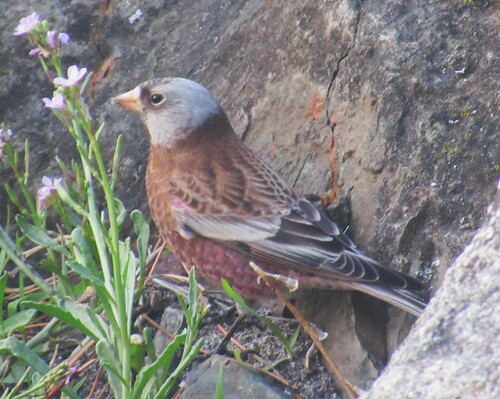 Grey-crowned Rosy-Finch
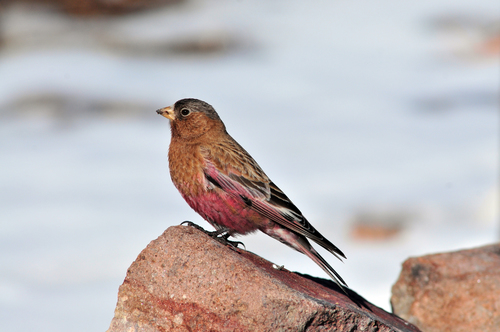 Brown-capped Rosy-Finch
In short
The most reliable field mark to separate Grey-crowned from Brown-capped Rosy-Finch is the head pattern: Grey-crowned always shows a distinct gray nape and hindcrown, contrasting with a blackish forehead and throat, while Brown-capped is uniformly brown on the head, lacking the gray crown patch. Both species are medium-large, pink-tinged finches with brown backs and blackish legs, but the head color difference is visible even at a distance. In all plumages, check for the extent and color of the crown and nape. Both species can show pink on the underparts and wings, but the distribution and intensity of pink is not as diagnostic as the head pattern. Habitat can help: Grey-crowned is found farther north and west in remote alpine areas, while Brown-capped is restricted to the central Rockies.
Identification tips
- Head pattern is key: Grey-crowned always shows a pale gray nape and hindcrown, contrasting with a blackish forehead and throat; Brown-capped's head is uniformly brown, sometimes with a blackish or grayish-brown forehead, but never with a contrasting gray crown. This mark works for all ages and seasons.
- Check for gray on the head: Any clear gray patch on the crown or nape rules out Brown-capped. If the head is entirely brown, with no gray, suspect Brown-capped.
- Forehead color: Both can show a dark (blackish) forehead, but only Grey-crowned has the gray nape. Brown-capped's forehead may be blackish or grayish-brown, but the rest of the crown remains brown.
- Pink on underparts: Both species have pink on the belly, rump, and wings, but this is variable and overlaps. Males are brighter pink; females and immatures duller. Do not rely on pink intensity alone.
- Bill color (seasonal): Brown-capped has a yellow bill in winter, black in summer; Grey-crowned's bill color is not specified as changing. This is a subtle mark and may not be visible at a distance.
- Tail and leg color: Both have long, notched or forked tails and black legs. Not useful for separation.
- Size and structure: Both are medium-large, chunky finches with similar proportions. Only the largest Grey-crowned subspecies are notably bigger, but these are range-restricted.
- Juvenile/female confusion: Both sexes and ages are similar within each species, so head pattern remains the best mark. No distinctive juvenile wing pattern is described for either.
- Flock composition: Both species may join mixed flocks with other rosy-finches and ground-foraging birds. Flock composition is not a reliable clue.
- Habitat and range: In the central Rockies, especially Colorado, Brown-capped is expected. In Alaska, western Canada, or the northwestern US, especially in very high or remote alpine areas, expect Grey-crowned.
- Seasonal movement: In winter, Brown-capped may descend to lower elevations and visit feeders; Grey-crowned forms large flocks on the plains but returns to alpine regions early in spring.
- Approachability: Both species are tame and allow close approach. Not a useful separator.
- Voice: Both give buzzy calls; not reliably separable in the field.
- Subspecies confusion: Some Grey-crowned subspecies (e.g., L. t. wallowa) have more extensive gray on the head, but all have at least some gray nape/crown. Brown-capped never shows a gray nape.
- When in doubt: Focus on the head pattern first, then use range and habitat as supporting clues. If you see a rosy-finch with a gray nape/crown, it's Grey-crowned; if the head is all brown, it's Brown-capped.
Size
Both species are similar in size and structure, being medium-large rosy-finches with long, notched or forked tails and relatively long wings. Grey-crowned Rosy-Finch typically measures 140–160 mm in length with a wingspan of about 33 cm, and weighs 22–60 g. Brown-capped Rosy-Finch is described as medium-sized but no precise measurements are given; it is not notably larger or smaller than Grey-crowned. The largest Grey-crowned subspecies (Pribilof/Aleutian) are much bigger, but those are outside the range of Brown-capped and unlikely to be confused in the field. Both have short black legs and a similar overall build.
Plumage
- Juvenile/First-year/Immature: Both species' juveniles and females resemble adults in overall pattern, so the head color remains the key mark at all ages. No distinctive juvenile upperwing pattern is described for either species; focus on head and body color.
- Adult breeding: Grey-crowned: Brown back and breast, bright pink on belly, flanks, and wings, black forehead and throat, and a clear gray nape and hindcrown. Brown-capped: Brown head, back, and breast, pink on belly and rump (and some pink on wings/tail), but head is uniformly brown without a gray crown. Forehead can be blackish or grayish-brown, but never with a contrasting gray nape. Bill color differs seasonally in Brown-capped (yellow in winter, black in summer), but this is subtle at a distance. Both sexes are similar, but female Brown-capped shows less pink.
- Nonbreeding: Both species are duller, but the head pattern persists: Grey-crowned always shows the gray crown/nape, Brown-capped always lacks it.
Behaviour
Both species forage on the ground in alpine or tundra habitats, often in flocks, and may fly to catch insects. They are both approachable and show little fear of humans. In winter, both may join mixed-species flocks with other rosy-finches and ground-foraging birds. Nesting behavior is similar, with cup nests built in sheltered locations on cliffs or in crevices. Brown-capped may reuse cliff swallow nests, while Grey-crowned sometimes uses mine shafts or abandoned buildings. Both develop throat pouches for feeding chicks. Behavioral differences are not reliable for field separation.
Habitat
Habitat is a useful supporting clue. Grey-crowned Rosy-Finch breeds in remote, rocky alpine zones from Alaska through western Canada to the northwestern US, often at extremely high elevations and in barren, snowfield-rich terrain. Brown-capped Rosy-Finch is restricted to the central Rocky Mountains of the US, breeding on mountain peaks and alpine snowfields. In winter, Brown-capped descends to lower elevations and may visit feeders, while Grey-crowned forms large flocks on the western plains. If you are in the central Rockies, especially Colorado, Brown-capped is more likely; farther north or west, especially in very high, remote, or coastal ranges, expect Grey-crowned.
Voice
Both species give buzzy calls; Grey-crowned's is described as a 'chew.' There is no detailed comparison of vocalizations in the notes, and calls are not considered reliably separable in the field.
Grey-crowned Rosy-Finch · Brown-capped Rosy-Finch · My Tricky Birds