

Grey-chinned Minivet vs Ashy Minivet
Pericrocotus solaris versus Pericrocotus divaricatus
Play a quiz with Grey-chinned Minivet and Ashy Minivet
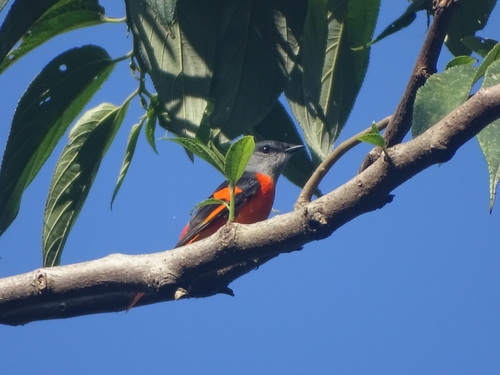 Grey-chinned Minivet
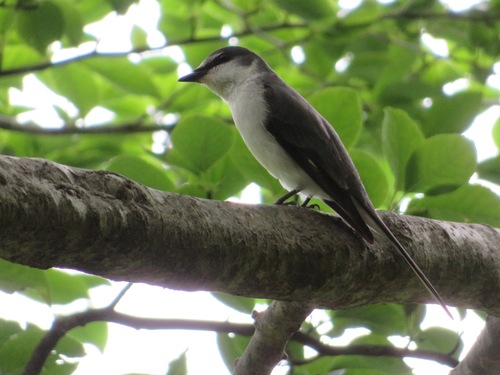 Ashy Minivet
In short
The most reliable field mark between Grey-chinned Minivet and Ashy Minivet is the presence or absence of bright orange or yellow in the plumage: Grey-chinned Minivet (adult male) shows bold orange on the underparts, lower back, and wing edges, while Ashy Minivet is strictly grey, white, and black in all plumages. Immature Grey-chinned Minivets resemble females but have yellow-olive bars on the back, which Ashy Minivet never shows. In flight, Ashy Minivet stands out with a white band across the flight feathers and white outer tail feathers, features lacking in Grey-chinned. Ashy Minivet is also noticeably heavier and longer. Use these color and pattern differences first, especially on perched or flying birds, and pay close attention to the head and wing patterns for age and sex distinctions.
Identification tips
- Check for orange or yellow in plumage: Any orange (male) or bright yellow (female/immature) on the underparts, lower back, or wing edges indicates Grey-chinned Minivet; Ashy Minivet never shows these colors at any age.
- Look for white wing and tail panels: Ashy Minivet has a bold white band across the flight feathers and white outer tail feathers, visible in flight and often when perched. Grey-chinned Minivet lacks these white panels.
- Head pattern in males: Ashy Minivet males have a striking black cap, white forehead, and white face, with a black nape. Grey-chinned Minivet males have a dark grey head and mantle, pale grey chin, and orange-yellow throat.
- Head pattern in females: Female Ashy Minivet shows a grey cap, black band between bill and eye, and a narrow white band above it. Female Grey-chinned Minivet has a more uniform grey head with bright yellow underparts and wing edges.
- Back pattern in immatures: Immature Grey-chinned Minivets have yellow-olive bars on the back—unique among these two. Ashy Minivet immatures remain grey and white.
- Underparts color: Grey-chinned Minivet (male) has orange, female has yellow; Ashy Minivet is always whitish below.
- Bill and legs: Both species have black bills and legs; not a useful separator.
- Size and structure: Ashy Minivet is heavier and slightly longer, but size overlap means this is only a supporting feature. Ashy Minivet may appear more robust and longer-tailed.
- Flight jizz: Ashy Minivet's white wing and tail panels can flash conspicuously in flight, while Grey-chinned Minivet's flight is more uniform, with colored (orange/yellow) edges if seen well.
- Habitat and context: In montane forests of the Himalayas to Southeast Asia, Grey-chinned Minivet is expected. In lowland or open areas, especially during migration or in large flocks, Ashy Minivet is more likely—especially outside the regular range of Grey-chinned.
- Season and range: Ashy Minivet is a migrant in South and Southeast Asia, rare in South Asia, and more likely outside the breeding season. Grey-chinned Minivet is a resident in montane forests.
- Mixed flocks: Both species may join mixed-species flocks, so presence with other minivets does not separate them.
- Vocalizations: If you hear a high-pitched, metallic trill, suspect Ashy Minivet. Lack of this call is not diagnostic for Grey-chinned.
- Sex confusion: Female Ashy Minivet can be confused with female Grey-chinned, but always lacks yellow or orange and has a distinctive facial pattern (black band between bill and eye, narrow white band above).
- Immature confusion: If you see yellow-olive bars on the back, it's an immature Grey-chinned; if not, and the bird is strictly grey, white, and black, consider Ashy Minivet.
Size
Ashy Minivet is both longer (18.5–20 cm vs. 17–19 cm) and significantly heavier (24 g vs. 14 g) than Grey-chinned Minivet. This difference is most apparent when seen side by side or when familiar with both species, as Ashy Minivet can look more robust and longer-tailed. However, overlap in length means size alone is not always diagnostic, especially at a distance or with lone birds.
Plumage
-
Immature/juvenile birds: Immature Grey-chinned Minivets resemble adult females but have distinctive yellow-olive bars on the back—a feature not present in Ashy Minivet at any age. Ashy Minivet immatures are not described as having any yellow or olive tones, remaining within grey, white, and black.
-
Adult males: Grey-chinned Minivet males have a dark grey head and mantle, a pale grey chin, orange-yellow throat, blackish wings, and extensive orange on the underparts, lower back, and wing edges. Ashy Minivet males are grey above, whitish below, with a black cap, white forehead, white face, a white band across the flight feathers, and white outer tail feathers—no orange or yellow at all.
-
Adult females: Female Grey-chinned Minivets replace the male's orange with bright yellow, but otherwise share the same pattern. Female Ashy Minivets have a grey cap (not black), a black band between bill and eye, and a narrow white band above it, but remain grey and white overall. Both sexes of Ashy Minivet lack any orange or yellow.
-
Wing pattern in flight: Ashy Minivet of all ages shows a white band across the flight feathers and white outer tail feathers, which are absent in Grey-chinned Minivet. Grey-chinned Minivet's wing edges may show orange or yellow (depending on sex), but never a white panel or tail.
Behaviour
Both species forage actively in the canopy and may join mixed-species flocks. Ashy Minivet is noted for forming large flocks during migration and is a long-distance migrant, whereas Grey-chinned Minivet is more resident in montane forests. Foraging behavior is similar: both are agile and often seen sallying for insects among treetops.
Habitat
Grey-chinned Minivet is typically found in montane forests from the Himalayas through Southeast Asia, usually at elevations of 1,000–2,000 m. Ashy Minivet breeds in northeast Asia and migrates widely, wintering in South and Southeast Asia, including more open areas with scattered trees as well as forests. In South Asia, Ashy Minivet is rare and mainly a migrant, while Grey-chinned is a regular resident in suitable forested habitats.
Voice
Ashy Minivet gives a high-pitched, metallic trill. No distinctive vocalization is described for Grey-chinned Minivet in the provided notes, so voice is not a reliable separator unless Ashy Minivet's call is heard clearly.