

Green-throated Carib vs Magnificent Frigatebird
Eulampis holosericeus versus Fregata magnificens
Play a quiz with Green-throated Carib and Magnificent Frigatebird
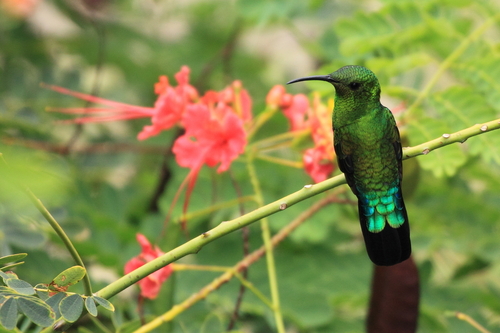 Green-throated Carib
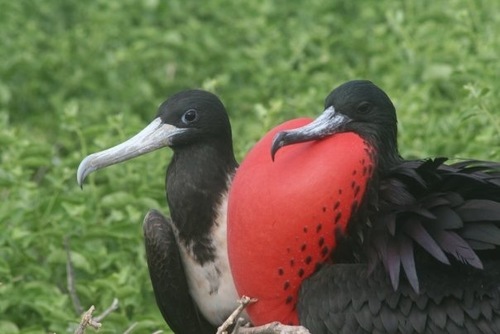 Magnificent Frigatebird
In short
The most reliable field mark to separate Green-throated Carib from Magnificent Frigatebird is sheer size and structure: the frigatebird is a massive, long-winged seabird with a deeply forked tail, while the carib is a small, compact hummingbird. If you see a bird soaring high with a wingspan over 2 meters, it's a frigatebird; if it's hovering at flowers or perched with a short bill, it's the carib. Juvenile frigatebirds have a white head and underparts, which could confuse at a glance, but their long wings and forked tail are unmistakable. In any context, the carib's bright green gorget and small, hovering flight are never matched by the frigatebird.
Identification tips
- Size is the fastest check: If the bird looks huge, with a wingspan over 2 meters, it's a Magnificent Frigatebird. If it's tiny and hummingbird-like, it's a Green-throated Carib.
- Wing and tail shape: Frigatebirds have extremely long, narrow wings and a deeply forked tail, visible in all ages and sexes. Caribs have short, rounded wings and a squared tail.
- Juvenile plumage: Young frigatebirds are white-headed and white-bellied with a diamond-shaped belly patch—no carib ever shows this. If you see a white-headed, white-bellied bird with long wings, it's a juvenile frigatebird.
- Adult male plumage: Male caribs have a bright green gorget and back, black belly, and dark blue tail. Male frigatebirds are all-black with a red throat pouch (inflated in breeding season), never green.
- Adult female plumage: Female caribs are similar to males but duller, with no white below. Female frigatebirds are black with a white breast and lower neck, a brown wing band, and a blue eye-ring—none of which are seen on caribs.
- Flight style: Frigatebirds soar and glide for hours, rarely flapping, and never hover. Caribs hover at flowers and make quick, darting flights.
- Bill shape: Caribs have a short to medium, slightly decurved bill (female's is longer and more curved). Frigatebirds have a long, hooked bill, visible even at a distance.
- Context and habitat: Frigatebirds are seen over open ocean or along coasts; caribs are found inland, in gardens or forest edges.
- Vocalizations: Only the carib gives sharp calls in the field; frigatebirds are silent except at the nest.
- Tail in flight: The frigatebird's tail is always long and deeply forked, often held closed to appear pointed; the carib's tail is short and squared, never forked.
- Sexual dimorphism: Both species show sex differences, but only frigatebird females have a white breast and blue eye-ring, and only male frigatebirds have a red gular sac.
- Feeding behavior: Caribs feed at flowers and sometimes catch insects; frigatebirds snatch fish from the ocean surface or harass other seabirds.
- Perched posture: Caribs perch upright on twigs or wires; frigatebirds rarely perch except at colonies or roosts, and look awkward on land.
- Upperwing pattern: No carib shows the brown wing band of female frigatebird or the juvenile's white underparts.
- Abundance and range: In the Caribbean, both can be locally common, but only the carib is found inland and in gardens; frigatebirds are always associated with the sea.
Size
Green-throated Carib is a tiny hummingbird, about 10.5–12 cm long and weighing only 6.2 grams [wikidata]. Magnificent Frigatebird is enormous by comparison: 89–114 cm long, with a wingspan of 2.17–2.44 meters, and weighs 1.1–1.59 kg [wikipedia]. Even at a great distance, the frigatebird's size and long, angular wings are obvious, while the carib is always tiny and compact.
Plumage
Juvenile Magnificent Frigatebirds are mostly white below with a white head and a distinctive diamond-shaped belly patch, while adults are all-black (males) or black with a white breast and lower neck (females). No age of Green-throated Carib ever shows extensive white on the head or underparts. Adult caribs of both sexes have a bright green back and gorget, black belly, and a dark blue (often appearing black) tail. Female caribs are slightly duller above and have a longer, more curved bill, but still never show white below. The male frigatebird's red gular sac is unique during breeding. In flight, the frigatebird's long, narrow wings and deeply forked tail contrast with the carib's short, rounded wings and squared tail. No age or sex of carib has the brown wing band or blue eye-ring seen in female frigatebirds.
Behaviour
Green-throated Carib is a hovering nectar feeder, often seen darting between flowers or perching quietly. Magnificent Frigatebird is almost always seen soaring or gliding high above the ocean, rarely flapping, and never hovers at flowers. Frigatebirds can spend days on the wing, using thermals to climb and then gliding for long distances. Caribs are agile and quick, but never soar or glide for long periods.
Habitat
Green-throated Carib is found in terrestrial habitats—gardens, second growth, and forest edges—on Puerto Rico and the Lesser Antilles [wikipedia]. Magnificent Frigatebird is a seabird, seen over tropical and subtropical oceans, rarely coming inland except near breeding colonies or coastal roosts. If the bird is over open water or far from land, it's a frigatebird; if it's in a garden or forest, it's a carib.
Voice
Green-throated Carib gives a sharp 'chup!' or 'chuwp!' call, and sometimes rattles or whirs its wings during disputes [wikipedia]. Magnificent Frigatebird is silent in flight, only making rattling sounds at the nest. If you hear a call, it's likely the carib.
Green-throated Carib · Magnificent Frigatebird · My Tricky Birds