

Green Heron vs Squacco Heron
Butorides virescens versus Ardeola ralloides
Play a quiz with Green Heron and Squacco Heron
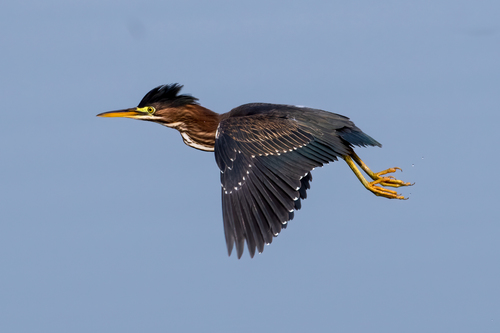 Green Heron
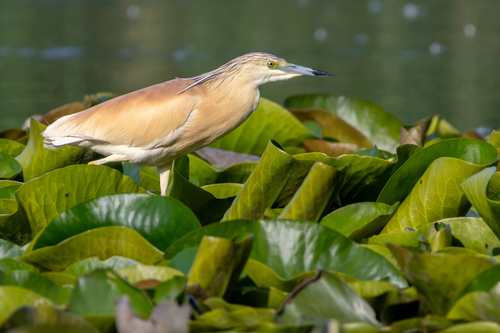 Squacco Heron
In short
The most reliable field mark between Green Heron and Squacco Heron is the dramatic difference in wing color in flight: Squacco Heron shows strikingly white wings contrasting with its buffy body, while Green Heron’s wings are dark and iridescent, never white. Juvenile Green Herons are heavily streaked and mottled brown above, while Squacco Heron juveniles are paler and less boldly marked. Structurally, Green Heron is more compact with a shorter neck and legs, and a darker, sharper bill, while Squacco Heron is stockier with a shorter, thicker bill and a buff-brown back. Perched, both can appear hunched, but the plumage and bill differences remain clear. Voice is not a strong separator in the field for these two, but context and geography are: Green Heron is strictly New World, Squacco Heron Old World.
Identification tips
- Wing color in flight (all ages): Squacco Heron always shows bright white wings in flight, contrasting with its buffy body. Green Heron's wings are dark greenish or bluish, never white. This is the single most reliable field mark.
- Juvenile plumage: Juvenile Green Herons are heavily streaked brown and white below, with tan-splotched upperparts and mottled wing coverts. Juvenile Squacco Herons are paler, with tawny upperparts and lighter, less bold streaking.
- Adult perched plumage: Green Heron adults have a glossy greenish-black cap, iridescent green or blue-black back and wings, and a chestnut neck with white throat stripes. Squacco Heron adults have a buff-brown back, white underparts, and (in breeding season) long neck plumes.
- Bill shape and color: Green Heron has a long, sharp, dark bill. Squacco Heron's bill is shorter, thicker, and paler, especially at the base.
- Neck and posture: Green Heron often appears more compact, with its neck pulled in tight against the body and shorter legs. Squacco Heron is stockier but can look longer-necked when alert.
- Leg color: Green Heron has short yellow (sometimes greenish-yellow) legs; Squacco Heron's leg color is not specified in the notes, but is typically yellowish in the field.
- Sex differences: Female Green Herons are slightly smaller and duller than males, especially in breeding season. No strong sexual dimorphism is noted for Squacco Heron.
- Behavior: Green Heron is solitary and intolerant of other birds when feeding; Squacco Heron nests in small colonies with other waders.
- Bait-fishing: Green Heron is known for using objects to lure fish, a behavior not described for Squacco Heron.
- Geographic range: Green Heron is New World (Americas); Squacco Heron is Old World (Europe, Middle East, Africa). If you are in the Americas, a pale, white-winged heron is almost certainly not a Squacco.
- Size and structure: Squacco Heron is slightly heavier and has a longer wingspan, but both are similar in length; size is not a reliable field mark in the field.
- Voice: Green Heron's calls are loud and abrupt; Squacco Heron's calls are not described here, so do not rely on voice for separation.
- Seasonal context: Green Heron migrates within the Americas; Squacco Heron migrates between Europe/Middle East and Africa. Out-of-range records are rare and should be carefully scrutinized.
- Habitat: Both use freshwater wetlands, but Green Heron is more likely to use human-made habitats (canals, ditches) in the Americas.
- Pitfalls: Beware of juvenile Green Herons, which can look paler and more streaked, but never show white wings in flight. Squacco Heron can look very pale when perched, but always flashes white wings when it flies.
Size
Both species are small herons, but Squacco Heron is slightly heavier (body mass ~288 g vs. Green Heron's ~240 g [wikidata, wikipedia]). Length is similar (Green Heron: 41–46 cm; Squacco Heron: 44–47 cm), but Squacco Heron has a noticeably longer wingspan (80–92 cm vs. Green Heron's 64–68 cm). In the hand or at close range, Squacco Heron is a bit bulkier, but in the field, size alone is not a reliable separator.
Plumage
- Juvenile/immature birds in flight: Squacco Heron always shows white wings, even in young birds, while Green Heron (all ages) has dark, greenish or bluish wings with no white. Juvenile Green Herons are heavily streaked brown and white below, with tan-splotched upperparts and wing coverts; their backs are duller and more mottled than adults. Juvenile Squacco Herons are paler overall, with tawny upperparts, lighter streaking, and less contrast between back and wings.
- Adults (perched): Green Heron adults have a glossy greenish-black cap, iridescent green or blue-black back and wings, and a rich chestnut neck with white throat stripes. Squacco Heron adults in breeding plumage have a buff-brown back, white underparts, and long neck plumes; their bill is shorter and thicker.
- Adults (in flight): Squacco Heron transforms in flight, with the entire upper- and underwing appearing bright white, in stark contrast to the body. Green Heron’s wings remain dark and never show white.
- Sex differences: Female Green Herons are slightly smaller and duller than males, especially in breeding season; no strong sexual dimorphism is noted for Squacco Heron.
Behaviour
Both species are typically solitary and secretive when foraging, often standing motionless at water’s edge. Green Heron is intolerant of other birds when feeding and rarely forages in groups, while Squacco Heron nests in small colonies with other waders. Green Heron is known for bait-fishing (using objects to lure prey), a behavior not specifically noted for Squacco Heron. In flight, Squacco Heron appears whiter and more buoyant due to its longer wings, while Green Heron looks compact and dark.
Habitat
Green Heron is found in North and Central America, favoring riparian zones, wetlands, ponds, lakes, and even human-made ditches and canals. Squacco Heron is strictly Old World, breeding in southern Europe and the Middle East, wintering in sub-Saharan Africa, and favoring marshy wetlands. A sighting outside these ranges is likely a vagrant. Both species use similar freshwater habitats, but their ranges do not overlap under normal circumstances.
Voice
Green Heron has a loud, abrupt 'kyow' call and a series of softer 'kuk' notes, with additional courtship calls ('raah-rahh', 'whoom-whoom-whoom', 'roo-roo', 'aaroo-aaroo'). Squacco Heron's calls are not described in the provided notes, and voice is not a primary field mark for separating these two species.