

Green-backed Trogon vs Yellow-rumped Cacique
Trogon viridis versus Cacicus cela
Play a quiz with Green-backed Trogon and Yellow-rumped Cacique
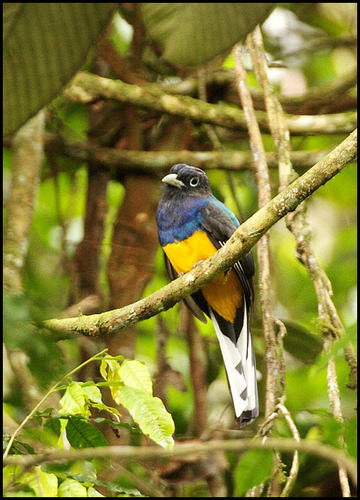 Green-backed Trogon
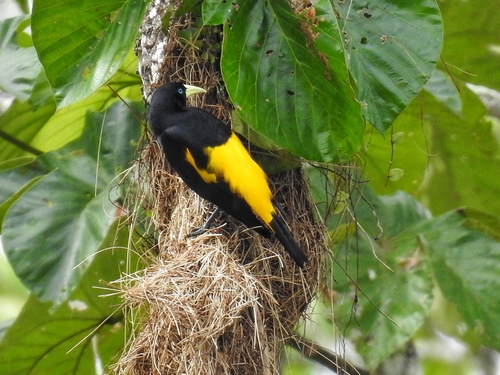 Yellow-rumped Cacique
In short
The most reliable way to separate Green-backed Trogon and Yellow-rumped Cacique is by their overall structure and key plumage contrasts: the trogon is a chunky, upright-perching bird with a short tail and a striking black-and-white undertail, while the cacique is a slim, long-tailed icterid with a bright yellow rump and base of tail, plus a pale yellow pointed bill. Even at a distance or in flight, the cacique's yellow rump and wing epaulets stand out, while the trogon shows no yellow on the upperparts and instead flashes white on the undertail. Both species can be similar in length, but their build, posture, and flight style are entirely different. Sex and age differences are subtle in the cacique but pronounced in the trogon, so be especially careful with female and immature trogons.
Identification tips
- Overall shape and posture: Trogon is chunky, short-tailed, and perches upright and motionless; cacique is slim, long-tailed, and active, often seen moving or flying.
- Bill shape and color: Trogon has a broad, dark bill; cacique has a long, pointed, pale yellow bill (very obvious in adults, less so in juveniles but still slender and pointed).
- Tail pattern (perched or in flight): Trogon (all ages) shows black-and-white undertail: broad black bases and broad white tips/edges on each feather. Cacique never shows white in the tail or undertail—tail is black with yellow at the base.
- Upperparts and rump: Cacique always shows a bright yellow rump and base of tail, visible both perched and in flight. Trogon never shows yellow on the back or rump—back is green (male) or gray (female/immature).
- Wing pattern: Trogon wings are black with fine white vermiculations; cacique wings are plain black with yellow 'epaulets' (shoulder patches) visible when wings are folded or in flight.
- Underparts: Trogon has orange-yellow belly and lower breast; cacique has black underparts with yellow only on the lower belly and vent.
- Eye color: Adult trogon has a pale bluish eye-ring; cacique has blue eyes (adults) or dark eyes (juveniles). Not always visible at a distance, but useful up close.
- Sexual dimorphism: Trogon is strongly dimorphic—males green-backed with dark blue head, females gray-backed and gray-headed. Cacique is only slightly dimorphic—females are duller black, but both sexes have yellow rump and epaulets.
- Juvenile confusion: Juvenile caciques resemble dull females but always show yellow rump and wing epaulets, and have a brown bill base and dark eyes. Juvenile trogons are gray above with barred tails, lacking any yellow on the rump.
- Flight style: Trogon rarely flies, but when it does, flight is fast and direct, with a short tail and broad wings. Cacique flies often, with strong, direct wingbeats and a long tail.
- Behavior: Trogon is solitary or in pairs, often motionless; cacique is social, noisy, and often in colonies.
- Habitat context: Both can occur in the same general region, but cacique is more likely in open or edge habitats and near colonies; trogon prefers dense forest interior or edge, often away from human disturbance.
- Vocalizations: Trogon's song is a slow, accelerating series of 'cow' notes; cacique's song is a complex mix of fluting, cackles, and mimicry, and colonies are very noisy.
- Size impression: Both can be similar in length, but trogon is bulkier and heavier, with a short tail; cacique is slender and long-tailed.
- Common pitfalls: At a distance, a perched cacique may look like a dark bird with a yellow vent, but the yellow is always on the rump and base of tail, not the undertail. Trogon never shows yellow above the tail, and the black-and-white undertail is unique in the region.
Size
Both species can reach about 28–30 cm in length ([wikipedia]), but the Green-backed Trogon is bulkier and more robust, with a short tail and broad bill, while the Yellow-rumped Cacique is much slimmer, with a noticeably longer tail and a more pointed, pale yellow bill. The cacique is also lighter in build: adult males average 104 g, females 60 g, compared to the trogon's heavier, more solid appearance. The cacique's longer tail and slender body give it a very different silhouette, especially in flight.
Plumage
Juvenile and female Green-backed Trogons are gray above with black-and-white barring on the tail, while adult males are green-backed with a dark blue (almost black) head and upper breast, orange-yellow lower underparts, and a black-and-white patterned undertail. The undertail pattern is diagnostic: broad black bases and broad white tips and edges on each feather. In contrast, Yellow-rumped Caciques of all ages are mainly black with a bright yellow rump, lower belly, tail base, and wing epaulets; the bill is pale yellow and pointed, and the eyes are blue in adults (dark in juveniles). Juvenile caciques resemble duller females, with a brown bill base and dark eyes, but always show the yellow rump and epaulets. The cacique never shows white in the tail or undertail, and the trogon never shows yellow on the upperparts or rump. In flight, the cacique's yellow rump and wing epaulets are obvious, while the trogon's white undertail flashes below.
Behaviour
Green-backed Trogons perch upright and motionless, often remaining still for long periods and reluctant to fly far. Their flight is fast but infrequent, and they are usually solitary or in pairs, rarely joining mixed flocks. Yellow-rumped Caciques are much more active and social, often seen in noisy colonies, moving through the canopy or open areas, and flying with strong, direct wingbeats. The cacique's behavior is conspicuously icterid: restless, vocal, and often in groups, while the trogon is quiet and still.
Habitat
Both species occur in humid tropical forests of northern South America, including the Amazon and Trinidad. However, Green-backed Trogon is typically the commonest trogon in its range, favoring dense forest interiors and edges, while Yellow-rumped Cacique is more likely to be seen in open woodland, forest edges, and especially near colonies, sometimes in more disturbed or open habitats. The cacique's presence is often revealed by its noisy colonies and conspicuous activity, while the trogon is more easily overlooked, sitting quietly in the mid- to upper canopy.
Voice
Green-backed Trogon's song is a series of about 20 'cow' notes, starting slow and accelerating, with a slower tempo and higher pitch than some other trogons. Yellow-rumped Cacique males produce a brilliant, varied mix of fluting notes, cackles, wheezes, and mimicry, and colonies are very noisy. The cacique's vocalizations are much more varied and complex, and a colony can be heard from a great distance, while the trogon's song is more measured and less conspicuous.
Green-backed Trogon · Yellow-rumped Cacique · My Tricky Birds