

Green-backed Trogon vs Screaming Piha
Trogon viridis versus Lipaugus vociferans
Play a quiz with Green-backed Trogon and Screaming Piha
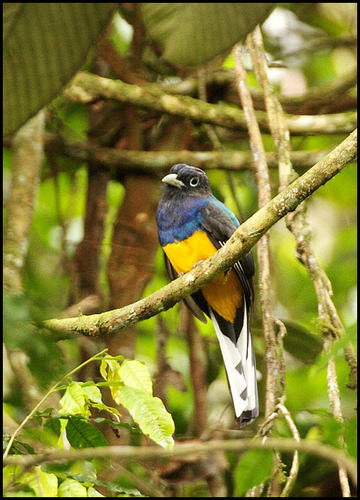 Green-backed Trogon
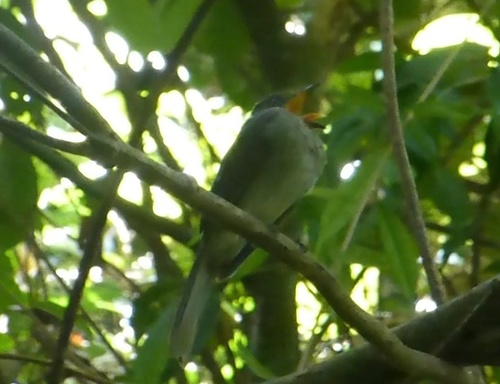 Screaming Piha
In short
The most reliable field mark to separate Green-backed Trogon from Screaming Piha is plumage: adult male trogons show a striking combination of a green back, dark blue-black head, orange-yellow belly, and a boldly patterned black-and-white undertail, while Screaming Piha is a uniform medium gray bird with no strong color contrasts or undertail pattern. Juvenile Pihas have cinnamon-rufous in the wings and tail tips, which is never seen in trogons. Structure and behavior also help: trogons perch upright, often motionless, with a thick bill, while Pihas are slimmer, more active, and famous for their ear-splitting song. Both species can occur in the Amazonian lowland forest, but the trogon is more likely to be seen sitting quietly, while the Piha is often detected by its voice.
Identification tips
- Juvenile Screaming Piha shows cinnamon-rufous wing coverts and tail tips—if you see this warm color in the wings or tail, it is Piha, not trogon. This mark is diagnostic for Piha juveniles.
- Adult male Green-backed Trogon has a green back, dark blue-black head, and orange-yellow belly—no Piha ever shows this combination of colors. If you see these, it is a trogon.
- Female Green-backed Trogon is gray above and below with a distinct black-and-white barred tail—while superficially plainer, the tail pattern is still diagnostic. Piha never shows barring or strong contrast in the tail.
- Screaming Piha (all ages and sexes) is uniform medium gray above, paler below, with duskier brownish wings and tail—never any bright colors, barring, or strong contrasts. If the bird is all gray, consider Piha.
- Undertail pattern is key for perched birds: trogon males have a black-and-white undertail with broad black base and white tip/edge to each feather; females have black-and-white barring mainly on outer webs. Piha undertail is plain and unmarked.
- Eye-ring color: Green-backed Trogon has a pale bluish eye-ring, while Piha's iris is brown to gray and lacks a colored eye-ring. This is subtle, but can help in close views.
- Bill shape and color: Trogons have a broad, thick bill adapted for fruit-eating; Piha has a slimmer, dark bill. Bill shape is best seen in profile.
- Perching posture: Trogons perch very upright and motionless, often for long periods; Pihas are more horizontal and shift perches frequently, especially when singing.
- Flight behavior: Trogons are reluctant to fly far and move with short, fast flights; Pihas are more active and may move more frequently through the midstory.
- Vocalization: If you hear an extremely loud, far-carrying 'qui, qui, yo' or mewing notes, it's Piha. Trogon song is a series of softer, accelerating 'cow' notes.
- Sexual dimorphism: Only the trogon is sexually dimorphic; Piha sexes are identical. If you see two birds together with different plumages, it's likely trogon.
- Habitat overlap: Both occur in Amazonian humid forests; do not use habitat alone for separation.
- Size: Trogon is slightly longer and bulkier, but size is not reliable in the field unless both are seen together.
- Leg and foot color: Piha's legs and feet are variably dark (green, brown, gray, black); trogon's are not described, but this is not a strong separator.
- Feeding behavior: Trogons are more frugivorous and less likely to join mixed flocks; Piha's foraging behavior is less distinctive, but more active overall.
Size
Green-backed Trogon is slightly larger in length (28–30 cm) than Screaming Piha (24–26 cm), but both are robust, medium-sized birds. Screaming Piha averages 81 g in mass, while trogon mass is not specified, though it is described as relatively large for a trogon. In the field, size alone is not a reliable separator, but the trogon appears bulkier and more compact, especially when perched upright.
Plumage
Juvenile Screaming Pihas are the only one of the two with cinnamon-rufous wing coverts and tail tips, which immediately separates them from any age or sex of Green-backed Trogon. Adult male Green-backed Trogons have a dark blue (almost black in poor light) head and upper breast, green back, orange-yellow underparts, and a black-and-white patterned undertail (broad black base, broad white tip and edge to each feather). Females are similar but with a gray back, head, and breast, and more extensive black-and-white barring on the outer webs of tail feathers. In contrast, Screaming Piha adults of both sexes are plain medium gray above, paler gray below, with duskier brownish wings and tail, and no strong color contrasts or barring anywhere. The Piha's bill is dark, and the legs/feet are variably dark. The trogon's eye-ring is pale bluish, while the Piha's iris is brown to gray. There is no seasonal or sex-based plumage variation in Piha; trogons are sexually dimorphic.
Behaviour
Green-backed Trogons typically perch upright and remain motionless for long periods, moving infrequently and flying only short distances. They are rarely seen in mixed-species flocks, foraging mainly on fruit and sometimes insects or lizards. Screaming Pihas are more active, frequently shifting perches, especially when singing. During vocal displays, the Piha tips forward and back vigorously. The Piha is much more likely to be detected by sound than by sight, while the trogon is often found by scanning for a still, upright bird in the midstory.
Habitat
Both species inhabit humid lowland forests in the Amazon and adjacent regions. Green-backed Trogon is typically the commonest trogon in its range and is a resident of tropical forests, including the Guiana Shield and Atlantic Forest in Brazil. Screaming Piha is widespread throughout mainland South America (except the southern cone), and occupies similar forest types, but may be more often heard than seen. Both can occur in the same general habitats, so context alone is not diagnostic.
Voice
Vocalization is a major separator: Screaming Piha is renowned for its extremely loud, far-carrying 'qui, qui, yo' call, often preceded by faint 'groo' notes, and can be heard up to 400 meters away. Its song is among the loudest of any bird. Pihas also produce loud mewing notes and various squeaks and whistles. In contrast, Green-backed Trogon's song is a series of about 20 'cow' notes, starting slow and accelerating, but it is much softer, slower than White-tailed Trogon, and higher pitched than Black-tailed Trogon. The trogon's voice is never as loud or piercing as the Piha's.