

Green-backed Trogon vs Blue-grey Tanager
Trogon viridis versus Thraupis episcopus
Play a quiz with Green-backed Trogon and Blue-grey Tanager
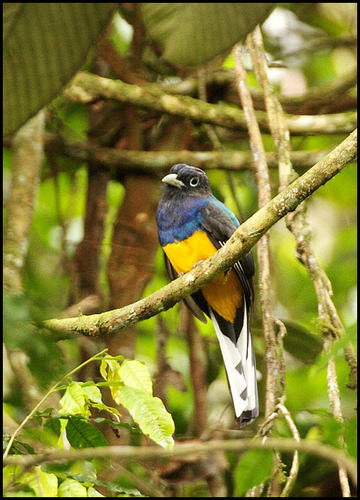 Green-backed Trogon
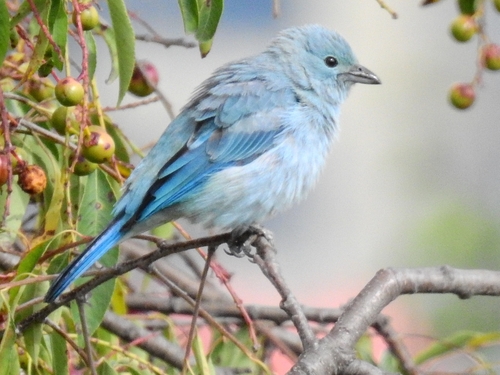 Blue-grey Tanager
In short
The most reliable field mark to separate Green-backed Trogon from Blue-grey Tanager is the undertail pattern: adult male Green-backed Trogons show bold black-and-white undertail feathers with broad black bases and broad white tips, while Blue-grey Tanagers have plain blue tails with no such pattern. Immature Blue-grey Tanagers are overall duller but never show the trogon's striking undertail. Structurally, trogons are larger, thickset birds with a broad bill and upright posture, while tanagers are slimmer, shorter-tailed, and more active. Even at a distance, the trogon's bright yellow belly and blue-black head contrast with the tanager's softer, uniform blue tones. These differences hold in both perched and flight views, but undertail and posture are the fastest checks.
Identification tips
- Undertail pattern: Adult Green-backed Trogons (especially males) show bold black-and-white undertail feathers, each with a broad black base and broad white tip/edge. Blue-grey Tanagers have plain blue tails with no black or white pattern. This is the single most reliable mark in all ages and sexes.
- Yellow belly: Only Green-backed Trogon has a vivid orange-yellow lower belly and vent. Blue-grey Tanagers are blue or bluish-grey below, never yellow.
- Head and back color: Male trogons have a dark blue (almost black) head and upper breast with a green back; females are grey-headed and grey-backed. Blue-grey Tanagers are light bluish on the head and underparts, with darker blue upperparts and a blue shoulder patch. No tanager shows a green back or blackish head.
- Bill shape: Trogons have a broad, hooked bill suited for fruit-eating; tanagers have a shorter, thick, conical bill. This is visible at close range or in good profile views.
- Size and structure: Trogons are much larger and bulkier (28–30 cm) than tanagers (16–18 cm). Trogons perch upright and appear thickset; tanagers are slimmer and more horizontal in posture.
- Wing pattern: Trogons have black wings vermiculated with white; tanagers' wings are plain blue, sometimes with a differently shaded shoulder patch depending on subspecies. No tanager shows vermiculation or barring.
- Eye-ring: Male Green-backed Trogons have a complete pale bluish eye-ring; tanagers lack a contrasting eye-ring. This is subtle but can help at close range.
- Female/immature confusion: Female trogons are grey above but still show the diagnostic undertail pattern and yellow belly. Immature tanagers are duller blue but never develop these trogon features.
- Behavior: Trogons sit still for long periods, often high in the canopy; tanagers are active, moving frequently and foraging openly.
- Habitat: If the bird is in a city, garden, or open secondary growth, it's almost certainly a tanager. Trogons are forest interior specialists.
- Voice: Trogons give a slow, accelerating series of 'cow' notes; tanagers produce squeaky, twittering calls. If you hear a slow, repetitive song, suspect trogon.
- Flight: Trogons are reluctant fliers, usually flying only short distances; tanagers are more agile and active in flight.
- Shoulder patch: Some Blue-grey Tanager subspecies have a contrasting shoulder patch (white, violet, or darker blue), but this is never as bold or patterned as the trogon's wing or undertail.
- Mixed flocks: Trogons rarely join mixed-species flocks; tanagers often do. If seen in a flock with other small birds, it's likely a tanager.
- Pitfall: In poor light, the trogon's head may look blackish rather than blue, but the undertail and yellow belly remain visible. Always check the undertail and belly color for confirmation.
Size
Green-backed Trogon is notably larger, at 28–30 cm in length [wikipedia], compared to the Blue-grey Tanager's 16–18 cm. The trogon is also bulkier, with a more robust body and broad bill, while the tanager is lighter and slimmer. In the field, this size gap is obvious if both are seen together, but can be underestimated if seen alone or at a distance.
Plumage
No matter the age, Blue-grey Tanagers never show the black-and-white undertail of Green-backed Trogons. Adult male trogons have a dark blue (almost black in shade) head and upper breast, green back, and vivid orange-yellow lower underparts, with black wings vermiculated with white. Their undertail is diagnostic: each feather has a broad black base and broad white tip/outer edge. Females are similar but with a grey head, back, and breast, and more black-and-white barring on the outer webs of the tail feathers. In contrast, Blue-grey Tanagers (both sexes) are light bluish on the head and underparts, with darker blue upperparts and a differently shaded blue shoulder patch. Immatures are duller but never develop the trogon's undertail or yellow belly. No tanager age or sex shows the trogon's bright yellow belly, green back, or bold undertail pattern. The tanager's tail is plain blue, and the bill is short and thick, unlike the trogon's broad, hooked bill.
Behaviour
Green-backed Trogons perch upright and motionless for long periods, often high in the canopy, and are reluctant to fly any distance. Their flight is fast but infrequent. Blue-grey Tanagers are much more active and restless, frequently moving between perches, foraging openly, and often seen in pairs or small groups. Trogons rarely join mixed-species flocks, while tanagers are more likely to be seen with other birds.
Habitat
Both species can occur in humid tropical forests of the Amazon, but Green-backed Trogon is more strictly a forest interior species, often in mature, undisturbed forest, and is typically the commonest trogon in its range. Blue-grey Tanagers are more adaptable, found in forest edges, secondary growth, gardens, and even urban areas. If seen in a city park or open area, the bird is almost certainly a tanager.
Voice
Green-backed Trogon's song is a series of about 20 'cow' notes, starting slow and accelerating, slower than White-tailed Trogon and higher pitched than Black-tailed Trogon. Blue-grey Tanager gives a squeaky twittering song with 'tseee' and 'tsuup' call notes. The trogon's song is more measured and repetitive, while the tanager's is higher, thinner, and less regular.