

Green-backed Camaroptera vs Common Waxbill
Camaroptera brachyura versus Estrilda astrild
Play a quiz with Green-backed Camaroptera and Common Waxbill
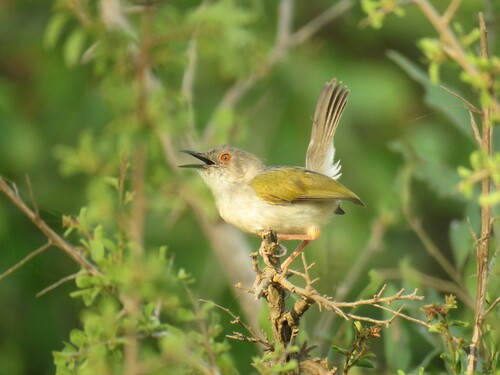 Green-backed Camaroptera
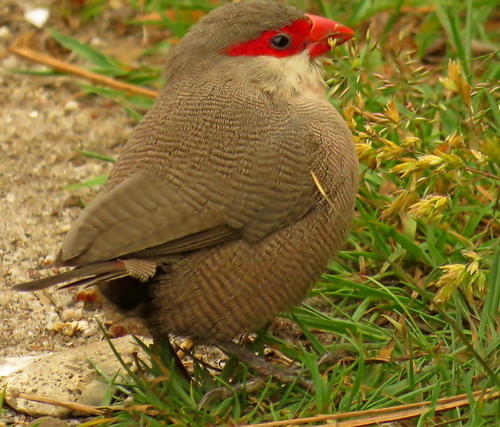 Common Waxbill
In short
The most reliable field mark to separate Green-backed Camaroptera from Common Waxbill is the bill and face pattern: Common Waxbill has a bright red bill and a red eye-stripe, while Green-backed Camaroptera has a plain, dark bill and no facial stripes. Juvenile Common Waxbills have a black bill and lack the red face stripe, but still show fine barring and a longer, graduated tail. Camaroptera is a plain greenish bird with olive wings and a short tail, typically skulking low in dense cover, while Common Waxbill is more open, slender, and often in flocks. Both are small, but Camaroptera is slightly heavier and more compact, with a noticeably shorter tail.
Identification tips
- Bill color and shape: Adult Common Waxbill has a bright red, conical bill; juveniles have a black bill. Green-backed Camaroptera always has a plain, dark, slender bill. This is the most immediate field mark at close range.
- Face pattern: Waxbill shows a bold red stripe through the eye and pale cheeks/throat; Camaroptera’s face is plain, lacking any stripes or bold facial markings.
- Tail length and shape: Waxbill has a long, graduated, dark tail that extends well past the undertail coverts. Camaroptera’s tail is short and stubby, giving it a compact look.
- Body shape and jizz: Camaroptera is round-bodied, compact, and short-tailed, often appearing hunched. Waxbill is slender, with a more elongated body and a longer tail, often perching upright on stems.
- Plumage color: Camaroptera is green above with olive wings and whitish-grey underparts; juveniles are paler below. Waxbill is grey-brown with fine dark barring, a red eye-stripe, and often a reddish or pinkish flush on the underparts (especially in adults and some subspecies).
- Juvenile confusion: Juvenile Waxbills lack the red face stripe and have a black bill, but still show fine barring and a longer tail than Camaroptera. Juvenile Camaroptera is paler yellowish on the breast but otherwise similar to adults.
- Rump and vent: Waxbill has a brown rump and dark tail/vent; Camaroptera’s rump blends into the green upperparts and short tail.
- Habitat: Camaroptera is always in dense, low vegetation; Waxbill is in open grassy areas, fields, and sometimes urban parks, often in flocks.
- Behavior: Camaroptera is solitary or in pairs, skulking and rarely seen in the open. Waxbill is social, often in groups, and feeds openly on grass seeds.
- Flight style: Waxbill’s flight is fast and undulating, often accompanied by high-pitched calls; Camaroptera is less likely to be seen in flight and usually moves low through cover.
- Vocalizations: Listen for Waxbill’s twittering and high-pitched flight calls in open areas. Camaroptera’s calls are less well described here, but are typically heard from within dense bushes.
- Size: Both are small, but Camaroptera is slightly heavier and more compact; Waxbill is lighter, longer, and more slender.
- Sex differences: Both species are similar between sexes, but female Waxbills are paler with less red on the belly; Camaroptera sexes are alike.
- Seasonal variation: No strong seasonal plumage change in either species, but juvenile Waxbills are duller and lack red on the face and belly.
- Common pitfalls: In poor light, a juvenile Waxbill with a black bill and faint barring could be mistaken for Camaroptera, but the longer tail and open-country behavior are clues. Camaroptera is never as finely barred or as long-tailed as Waxbill.
Size
Green-backed Camaroptera is slightly heavier (10.0g vs 8.2g) and appears more compact and round-bodied, with a short tail. Common Waxbill is a bit lighter and longer (9.5–13cm), with a noticeably long, graduated tail and a slender build. In the field, Camaroptera looks stubby and short-tailed, while Waxbill is slim and long-tailed. Both are small birds, but the difference in tail length and body shape is often apparent when perched or in flight.
Plumage
No distinctive age-specific wing or flight pattern is described for either species, but overall plumage is quite different. Green-backed Camaroptera of all ages shows green upperparts, olive wings, and whitish-grey underparts; juveniles are paler yellowish on the breast but otherwise similar. Common Waxbill adults are grey-brown with fine dark barring, a bright red bill, a red stripe through the eye, and often a pinkish or reddish flush on the underparts and belly (depending on subspecies); the rump is brown, and the tail and vent are dark. Juvenile Waxbills are duller, with little or no red on the belly, fainter barring, and a black bill. The Waxbill’s face pattern (red eye-stripe, pale cheeks and throat) is unique, while Camaroptera’s face is plain. Waxbill also shows a long, dark tail and a reddish belly stripe in some subspecies, never present in Camaroptera.
Behaviour
Green-backed Camaroptera is a skulker, usually found low in dense bushes, rarely venturing into the open. It moves quietly and is often hard to see, preferring to stay hidden. Common Waxbill is much more social and active, often seen in flocks feeding on grass seeds in open areas, and perching on exposed stems or wires. Waxbills are more likely to be seen out in the open, moving in groups, and are less secretive than Camaroptera.
Habitat
Green-backed Camaroptera prefers dense, low vegetation and thickets, rarely straying far from cover. It is typically found in bushy or woodland edges, and is not seen in open grassland. Common Waxbill, in contrast, favors open grassy areas, reedbeds, and cultivated fields, and is often found in urban parks and gardens, especially where grass seeds are abundant. Waxbill is much more likely to be seen in open country or disturbed habitats, while Camaroptera is tied to dense undergrowth.
Voice
Common Waxbill has a variety of twittering and buzzing calls, plus a distinctive high-pitched flight call and a simple, harsh, nasal song that descends at the end. Green-backed Camaroptera is also known as the 'bleating' camaroptera, but no detailed description of its calls or song is provided in the notes. In practice, Waxbill’s calls are more likely to be heard in open areas and in flight, while Camaroptera’s vocalizations are heard from within dense cover.