

Green-and-rufous Kingfisher vs Variegated Flycatcher
Chloroceryle inda versus Empidonomus varius
Play a quiz with Green-and-rufous Kingfisher and Variegated Flycatcher
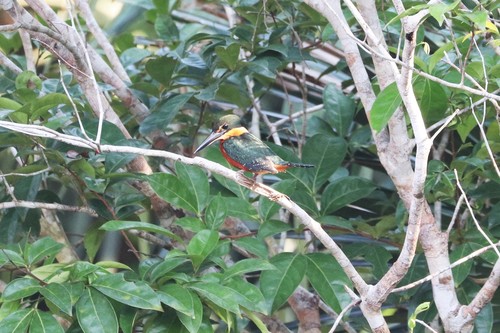 Green-and-rufous Kingfisher
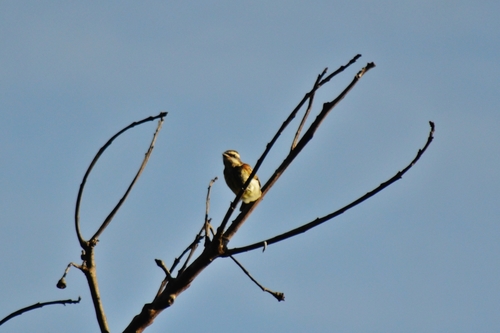 Variegated Flycatcher
In short
The most reliable field mark is overall structure: Green-and-rufous Kingfisher is a chunky, large-headed, heavy-billed bird with a shaggy crest, while Variegated Flycatcher is a slim, long-tailed, small-billed passerine with a strong white supercilium. In all plumages, the kingfisher shows rich rufous underparts and glossy green upperparts, while the flycatcher is streaked brown above and pale below with a yellowish wash and lacks any solid rufous areas. Juvenile kingfishers have a green breast band and heavy white spotting, which never appears on the flycatcher. In flight or perched, the kingfisher’s short tail and large bill are obvious, versus the flycatcher’s long tail and slender bill. Both can be found near water, but the kingfisher is always close to streams or rivers, while the flycatcher perches more openly and higher in trees.
Identification tips
- Bill shape and size: Kingfisher has a massive, dagger-like black bill with some pale yellow at the base; flycatcher’s bill is much shorter, slender, and only slightly hooked at the tip. This is often the quickest way to separate them, especially in profile.
- Head and crest: Kingfisher has a large, blocky head with a shaggy crest; flycatcher’s head is proportionally small and smooth, with a dark crown and a hidden yellow patch (rarely visible).
- Tail length and shape: Kingfisher’s tail is short and square; flycatcher’s tail is long, often fanned or wagged, with rufous edges visible in good light.
- Plumage color (adults): Kingfisher is glossy green above with a pale collar and rich rufous underparts (male solid, female with a green/white breast band); flycatcher is brownish above with pale streaks, a strong white supercilium, and pale yellowish underparts with faint streaks, never solid rufous.
- Juvenile plumage: Juvenile kingfishers have a green breast band and heavy white spotting on the upperparts; juvenile flycatchers lack streaks or breast bands and are overall duller.
- Wing and tail pattern in flight: Kingfisher shows white spots on the upperwing coverts, secondaries, tertials, and tail; flycatcher has broad white edges on the wing coverts and flight feathers but no spots.
- Supercilium: Flycatcher has a long, bold white supercilium extending around the nape, a unique mark never shown by kingfisher.
- Leg color: Kingfisher’s legs are pinkish to dark gray; flycatcher’s are black.
- Perching behavior: Kingfisher perches low over water, often on exposed branches close to the surface; flycatcher perches higher, often in the open, and sallies out for insects.
- Habitat context: If seen away from water or high in the canopy, suspect flycatcher; kingfisher is almost never far from water.
- Sex differences: Only the kingfisher shows sexual dimorphism (female with green/white breast band); flycatcher sexes are identical.
- Body shape: Kingfisher is stocky and compact with a huge head; flycatcher is slim and elongated.
- Underpart color: Kingfisher’s underparts are deep rufous (male) or rufous with a green/white band (female/juvenile); flycatcher’s are pale yellowish white with faint streaks, never rufous.
- Crown pattern: Flycatcher has a dark crown with a hidden yellow patch; kingfisher’s crown is green and shaggy, lacking any patch.
- Flight style: Kingfisher’s flight is direct and heavy; flycatcher’s is lighter, more fluttery, and often includes sallying from a perch.
Size
Green-and-rufous Kingfisher is distinctly larger and bulkier (about 24 cm, males 40–60 g, females 53–62 g) than Variegated Flycatcher (18–19 cm, ~25 g). The kingfisher’s body is stocky with a proportionally huge head and bill, while the flycatcher is slender, long-tailed, and lightweight. Even at a distance, the kingfisher’s size and proportions are noticeably more robust than the flycatcher’s.
Plumage
Juvenile Green-and-rufous Kingfishers (both sexes) show a green breast band and heavy white spotting on the upperparts, with a rich rufous belly—this combination is never matched by Variegated Flycatcher juveniles, which have unstreaked underparts and lack any rufous or green tones. Adult male kingfishers are glossy green above with a pale yellowish collar and solid dark rufous underparts; females add a broad green, white-speckled breast band and more upperpart spotting. Variegated Flycatchers of all ages are brownish above with pale streaks, a dark crown, and a strong white supercilium; their underparts are yellowish white with faint streaks, never solid rufous. The flycatcher’s tail and uppertail coverts are rufous-edged, but the effect is subtle and never as bold as the kingfisher’s underparts. In flight, kingfishers show white spots on the wings and tail, while flycatchers have broad white wing edges but no spotting.
Behaviour
Green-and-rufous Kingfisher is typically seen perched low over water, often on a branch or snag near a stream or river, from which it dives for prey. Its movements are direct and purposeful, with short flights and frequent returns to a favored perch. Variegated Flycatcher usually perches higher, often in the open at mid-levels or treetops, sallying out to catch insects in flight or briefly hovering to pick fruit or insects from foliage. The flycatcher’s flight is lighter and more fluttery, and it often joins mixed-species flocks, unlike the solitary kingfisher.
Habitat
Both species can be found near water, but Green-and-rufous Kingfisher is restricted to forested streams, rivers, and shaded watercourses, rarely venturing far from water’s edge. Variegated Flycatcher is more versatile, found in open woodland, forest edges, and clearings, often away from water, and perches conspicuously higher in trees. If the bird is seen well away from water or high in the canopy, kingfisher can be ruled out.
Green-and-rufous Kingfisher · Variegated Flycatcher · My Tricky Birds