

Greater White-fronted Goose vs Pink-footed Goose
Anser albifrons versus Anser brachyrhynchus
Play a quiz with Greater White-fronted Goose and Pink-footed Goose
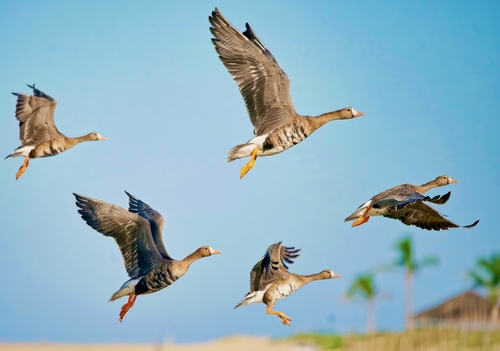 Greater White-fronted Goose
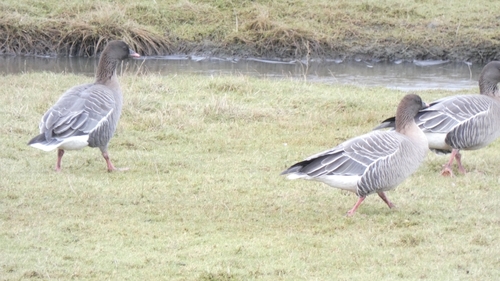 Pink-footed Goose
In short
The most reliable field mark to separate Greater White-fronted Goose from Pink-footed Goose is the bill: Greater White-fronted has a longer, mostly pink bill, while Pink-footed shows a shorter bill with a distinctive pink band and black base/tip. In flight or perched, Greater White-fronted often shows a bold white blaze at the base of the bill and variable dark belly bars, while Pink-footed lacks the white blaze and has a plain, darker brown head and neck. Upperwing coverts and wing bars differ subtly, but are best judged at close range. Both species are similar in size and shape, so careful attention to bill color and facial pattern is key.
Identification tips
- Bill color and shape: Greater White-fronted Goose has a longer, mostly pink bill (sometimes orange-yellow in Greenland birds), while Pink-footed Goose has a noticeably shorter bill with a pink band and black base/tip. This is the most reliable field mark at all ages and seasons.
- White facial blaze: Adult Greater White-fronted shows a bold white blaze at the base of the bill, absent in Pink-footed. Juvenile Greater White-fronted may lack or have a reduced blaze, so do not rely solely on this in first-winter birds.
- Belly barring: Adult Greater White-fronted often shows variable dark brown to black bars and blotches on the belly, while Pink-footed's belly is plain. However, belly barring is variable and can be absent in young or some adults, so use with caution.
- Upperwing covert pattern in flight: Greater White-fronted (especially European birds) has prominent white fringes on the lesser and median coverts, creating bold wing bars. Pink-footed's upperwing is more uniform pale bluish-grey, lacking strong wing bars. This is subtle and best seen at close range or in good light.
- Tail pattern: Both have a white-tipped tail, but Greater White-fronted's white tip and sides are broader and more obvious than Pink-footed's.
- Head and neck color: Pink-footed Goose has a richer, darker brown head and neck, contrasting with a paler body. Greater White-fronted is more uniformly grey-brown, with less contrast between head/neck and body.
- Leg color: Both have bright legs, but Pink-footed's are distinctly pink, while Greater White-fronted's are orange to orange-yellow. This can be hard to judge at distance or in poor light.
- Size and structure: Greater White-fronted can be slightly larger and bulkier with a longer bill, but overlap is considerable. Not a reliable mark unless birds are side by side.
- Voice: Listen for the high-pitched cackling 'he-he' of Greater White-fronted versus the medley of honks from Pink-footed. Calls are best used when birds are vocal and close.
- Juvenile/first-winter confusion: Young Greater White-fronted may lack the white blaze and belly bars, making them look plainer. In these cases, bill color and upperwing covert pattern become more important.
- Context and flock composition: Both species often mix in winter, so do not assume a single species based on flock size or habitat.
- Subspecies variation: Greenland Greater White-fronted (A. a. flavirostris) shows a longer, slimmer orange-yellow bill and less obvious wing bars than European birds, occasionally resembling Pink-footed in dull light. Bill structure and face pattern remain key.
- Lighting effects: Bill and leg color can appear different in bright sun versus dull light; check multiple features if possible.
- Perched vs. in flight: Bill and face pattern are easier to judge on the ground; wing covert pattern and tail tip are more useful in flight.
- Do not confuse with Lesser White-fronted Goose: Only Greater White-fronted is in this comparison; Lesser White-fronted is smaller, with a much larger white blaze and a yellow eye ring.
Size
Both species are medium-sized geese and can overlap in size, but Greater White-fronted Goose can be slightly larger (64–81 cm length, wingspan 130–165 cm, mass up to 3.3 kg) compared to Pink-footed Goose (60–75 cm, wingspan 135–170 cm, mass 1.8–3.4 kg) [wikipedia][wikidata]. In the field, size difference is subtle and not a reliable separator unless birds are side by side. Structure is similar, but Greater White-fronted may appear a bit bulkier and longer-billed.
Plumage
Juveniles and adults of both species can be confused, especially in flight. Greater White-fronted Goose (especially the European A. a. albifrons) shows prominent white fringes on the upperwing coverts, creating obvious wing bars, and a broad white tip to the tail. Pink-footed Goose has more uniform pale bluish-grey upperwing coverts, lacking strong wing bars, and a tail with a broad white tip but less contrast. Adult Greater White-fronted shows a white blaze at the bill base and variable black belly bars (though these can be absent or faint in young birds), while Pink-footed lacks the white blaze and has a plain, darker brown head and neck. Bill color is key: Greater White-fronted has a mostly pink bill (sometimes orange-yellow in Greenland birds), while Pink-footed has a short bill with a pink band and black base/tip. Both have orange or pinkish legs, but Pink-footed's are distinctly pink. In first-winter and juvenile birds, the white blaze and belly barring are reduced or absent in Greater White-fronted, making bill and wing covert patterns more important.
Behaviour
Both species are highly gregarious, often forming large flocks in winter. They feed in open fields and wetlands, grazing on grasses and crops. Flight style is similar, with steady, direct flapping and frequent calling. No major behavioral differences are noted in the sources that are useful for field separation.
Habitat
Both species are migratory and overlap in wintering areas in northwest Europe, especially the UK, Ireland, and the Netherlands [wikipedia]. Greater White-fronted Goose breeds farther east (northern Canada, Alaska, Russia, Greenland), while Pink-footed breeds mainly in eastern Greenland, Iceland, Svalbard, and recently Novaya Zemlya. In winter, both use farmland, marshes, and estuaries, often together. Habitat alone is not diagnostic where ranges overlap.
Voice
Greater White-fronted Goose gives a high-pitched, laughing cackle, often described as 'he-he', with a distinct break between notes. Pink-footed Goose is very vocal in flight, producing a medley of high-pitched honking calls that can be deafening in large flocks. Both are noisy, but the cackling quality of Greater White-fronted can be distinctive if heard well.
Greater White-fronted Goose · Pink-footed Goose · My Tricky Birds