

Greater Pewee vs Northern Tropical Pewee
Contopus pertinax versus Contopus bogotensis
Play a quiz with Greater Pewee and Northern Tropical Pewee
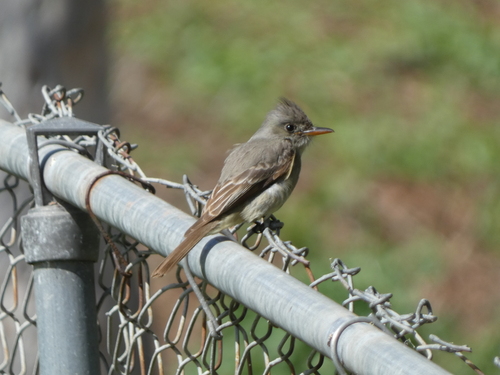 Greater Pewee
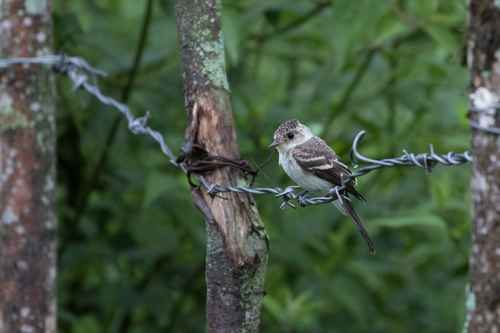 Northern Tropical Pewee
In short
The most reliable field mark between Greater Pewee and Northern Tropical Pewee is overall size: Greater Pewee is much larger and heavier, with a notably bulkier structure. In the field, Greater Pewee shows a plain olive-gray face and head with only faint wing bars, while Northern Tropical Pewee has a darker crown, a thin white eye-ring, and more distinct wing bars, especially in juveniles. Juvenile Northern Tropical Pewee also shows obvious cinnamon-buff tips to the wing coverts, a feature never present on Greater Pewee. Bill color is similar but the Greater Pewee’s bill appears slightly stouter. If seen together, the difference in size and the facial contrast of Northern Tropical Pewee are the quickest ways to separate them.
Identification tips
- Size is the fastest check: Greater Pewee is much larger and heavier than Northern Tropical Pewee. If you see a flycatcher that looks big and chunky, Greater Pewee is likely; a small, dainty bird points to Northern Tropical Pewee.
- Juvenile plumage is diagnostic: Juvenile Northern Tropical Pewee has broad cinnamon-buff tips to the wing coverts and a brown chin, never seen on Greater Pewee. If you see these marks, you have a Northern Tropical Pewee juvenile.
- Facial contrast: Northern Tropical Pewee shows a thin white eye-ring and a darker crown, giving a more contrasting face. Greater Pewee’s face is plain olive-gray with only pale lores and no eye-ring.
- Wing bars: Both species have two wing bars, but on Greater Pewee they are faint and grayish; on Northern Tropical Pewee (especially juveniles) they are more distinct and can be pale cinnamon-buff in young birds.
- Crest shape: Greater Pewee has a spiky crest, which can look more pronounced than the slight crest of Northern Tropical Pewee.
- Bill structure: Both have a dark upper mandible and yellowish to orange lower, but Greater Pewee’s bill is stouter and proportionally larger, matching its bigger head.
- Underparts color: Greater Pewee has a buffy belly and undertail coverts; Northern Tropical Pewee’s are white to yellowish white, with pale brown undertail coverts.
- Rump features: Northern Tropical Pewee has a hidden white feather tuft on each side of the rump (not visible unless fluffed or handled), absent in Greater Pewee.
- Iris color: Both have brown irises, not useful for separation.
- Leg color: Both species have dusky to blackish legs and feet; not a useful field mark.
- Perching behavior: Northern Tropical Pewee often returns to the same perch and may shiver its tail upon landing; this is less noted in Greater Pewee.
- Habitat and elevation: In overlapping regions, Greater Pewee is more likely in higher-elevation pine-oak woodlands, while Northern Tropical Pewee prefers lower, humid forest edges.
- Sexes alike: Both species show no sexual dimorphism in plumage—do not use sex as a clue.
- Seasonal wear: Greater Pewee’s plumage fades with wear, becoming less olive, but this is subtle and not a strong field mark.
- Voice: Not covered in the notes; do not rely on vocalizations for separation based on current information.
Size
Greater Pewee is substantially larger: 18–20 cm in length and about 27 g in mass, compared to Northern Tropical Pewee’s 12–14 cm and 8–14 g. This is a dramatic difference in hand and should be obvious in the field if you have any size reference. Greater Pewee appears longer and heavier-bodied, with a proportionally larger head and bill. Northern Tropical Pewee is much more petite, with a lighter build and smaller bill.
Plumage
Juvenile Northern Tropical Pewee is distinctive, showing browner upperparts and broad pale cinnamon-buff tips to the wing coverts, plus a brown chin—none of which are ever seen on Greater Pewee of any age. Adult Northern Tropical Pewee has a dark blackish gray crown, a thin white eye-ring, and a hidden white feather tuft on each side of the rump; its wing bars are thin but more distinct than the faint bars of Greater Pewee. Greater Pewee adults are plainer, with a spiky crest, plain olive-gray head and upperparts, and only faint grayish wing bars. Both species have pale lores, but only Northern Tropical Pewee shows a clear eye-ring. Underparts differ subtly: Greater Pewee has a buffy belly and undertail coverts, while Northern Tropical Pewee’s are white to yellowish white, with pale brown undertail coverts. Bill color is similar (dark upper, yellowish to orange lower), but Greater Pewee’s bill is a bit stouter. Both have dusky legs and brown irises.
Behaviour
Both species are classic Contopus flycatchers, sallying from exposed perches to catch insects. Northern Tropical Pewee often returns to the same perch and may shiver its tail on landing, a behavior not specifically noted for Greater Pewee. Greater Pewee’s larger size may make its movements appear slower and more deliberate. Both tend to perch upright and are not known for joining mixed-species flocks.
Habitat
Greater Pewee is found from Arizona and New Mexico south to Nicaragua, typically in pine-oak woodlands and montane forests. Northern Tropical Pewee ranges from southeastern Mexico to northern South America, favoring forest edges and mid-level perches. There is some overlap in Central America, but Greater Pewee is more likely at higher elevations and in drier pine-oak habitats, while Northern Tropical Pewee prefers humid forest edges and lower to mid-levels within the forest.