

Greater Pewee vs Eastern Wood-Pewee
Contopus pertinax versus Contopus virens
Play a quiz with Greater Pewee and Eastern Wood-Pewee
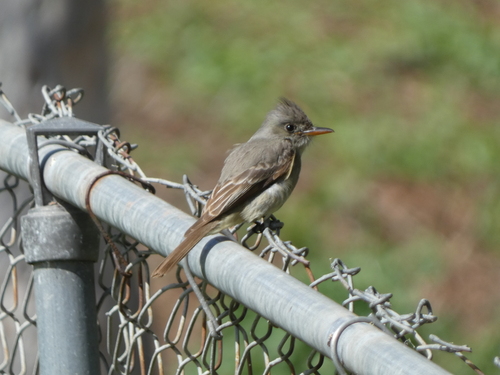 Greater Pewee
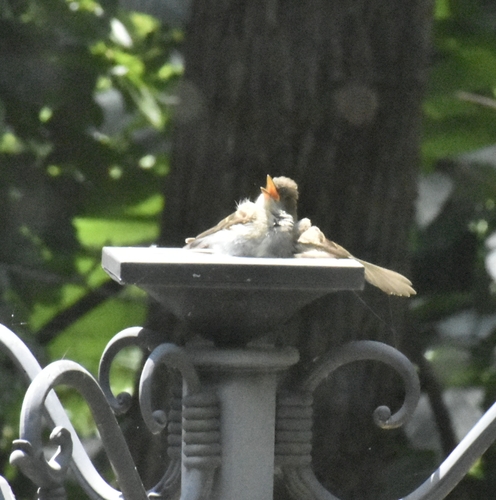 Eastern Wood-Pewee
In short
Greater Pewee and Eastern Wood-Pewee are both Contopus flycatchers, but the Greater Pewee is notably larger and bulkier, with a spiky crest and a more robust, longer bill. Both show two pale wingbars and similar olive-gray tones, but the Greater Pewee’s face is plainer and slightly paler, and its lower mandible is more distinctly orange. In the field, structure and size are the most reliable clues: Greater Pewee appears longer, heavier, and more upright, while Eastern Wood-Pewee is smaller, slimmer, and more delicate. Vocalizations are completely different and diagnostic when heard.
Identification tips
- Size and bulk: Greater Pewee is much larger and heavier than Eastern Wood-Pewee; use this when seen well or with reference to nearby birds. Works for all ages and seasons.
- Bill color and shape: Greater Pewee has a longer, stouter bill with a more orange or yellowish lower mandible, often obvious even at a distance. Eastern Wood-Pewee’s bill is shorter and the lower mandible is yellowish but less bright.
- Crest: Greater Pewee shows a spiky crest, especially when alert or agitated; Eastern Wood-Pewee’s crown is smooth and rounded. This is subtle but reliable in good views.
- Facial pattern: Greater Pewee’s face is slightly paler than the crown and back, with pale lores; Eastern Wood-Pewee’s face is not noticeably paler than the rest of the head. Works best in bright light.
- Wingbars: Both species have two pale wingbars, but they are faint and sometimes hard to see on Greater Pewee, while more distinct on Eastern Wood-Pewee. Not always reliable, especially in worn plumage.
- Underparts: Greater Pewee shows a dull whitish chin, olive-gray sides and throat, and a buffy belly and undertail. Eastern Wood-Pewee is lighter below, with olive wash on the breast but not as buffy on the belly.
- Primary projection: Eastern Wood-Pewee has long primary projection, giving the wingtip a slim, pointed look. Greater Pewee’s wings are proportionally shorter and less pointed. Subtle but useful in perched birds.
- Posture and jizz: Greater Pewee perches more upright and appears more robust; Eastern Wood-Pewee is slimmer and less upright. Useful when comparing multiple birds.
- Tail: Greater Pewee’s tail is longer and dusky grayish brown; Eastern Wood-Pewee’s tail is shorter and less prominent.
- Voice: If heard, the song is instantly diagnostic: Greater Pewee’s whistled phrase ("José María") vs. Eastern Wood-Pewee’s "pee-a'wee". Calls are also different.
- Range and habitat: Greater Pewee is found in pine-oak and highland forests of the Southwest and southward; Eastern Wood-Pewee is in deciduous/mixed woods of the East. Use with caution in migration or at range edges.
- Sex and age: Both species are sexually monomorphic; age differences are not strongly marked in plumage, so structural and vocal clues are more reliable.
- Comparison with similar species: If you see a bold eye ring, it is not either of these species (likely an Empidonax). If the bird bobs its tail, consider Eastern Phoebe instead.
- Seasonal timing: In the East, Eastern Wood-Pewee arrives later in spring (late April–May) than Eastern Phoebe, but this does not separate it from Greater Pewee.
- Worn plumage: Both species can look duller and less contrasting after breeding, but the structural and size differences remain reliable.
Size
Greater Pewee is substantially larger and heavier (body mass ~27.2 g [wikidata], length 18–20 cm) than Eastern Wood-Pewee (length 13.5–15 cm, mass ~14 g [wikipedia]). This size difference is often obvious in direct comparison or with experience. Greater Pewee appears bulkier and longer, with a proportionally longer tail and bill.
Plumage
- Juvenile/immature upperwing pattern: No distinctive juvenile or immature upperwing marks are described for either species; both show two pale wingbars at all ages, though these are faint in Greater Pewee and more distinct in Eastern Wood-Pewee.
- Adults: Greater Pewee is plain olive-gray above with a slightly paler face and pale lores, two faint wingbars, and pale edges to secondaries. Its chin is dull whitish, with olive-gray throat and sides, and buffy belly and undertail. Eastern Wood-Pewee is gray-olive above, with light underparts washed olive on the breast, and two pale wingbars. Both have a dark upper mandible and yellowish lower mandible, but Greater Pewee’s is more orange and obvious. Neither species shows a strong eye ring. Both sexes look alike in both species.
Behaviour
Greater Pewee often perches upright and high in the canopy, showing a more robust, alert posture and sometimes raising its spiky crest. Eastern Wood-Pewee also perches in the open but appears daintier and slimmer, with a less upright stance. Both sally out for insects, but Greater Pewee’s movements are slower and more deliberate, matching its larger size.
Habitat
Greater Pewee is found from Arizona and New Mexico south to Nicaragua, favoring pine-oak woodlands and higher elevation forests. Eastern Wood-Pewee breeds in deciduous and mixed woods or pine plantations across eastern North America. Their ranges overlap minimally in the U.S. Southwest; context can help, but is not always diagnostic.
Voice
Vocalizations are highly diagnostic. Greater Pewee gives a distinctive whistled "José María" or similar phrase, very different from the Eastern Wood-Pewee’s mournful, whistled "pee-a'wee" or "pe-wee". If heard, the song alone separates them instantly.